

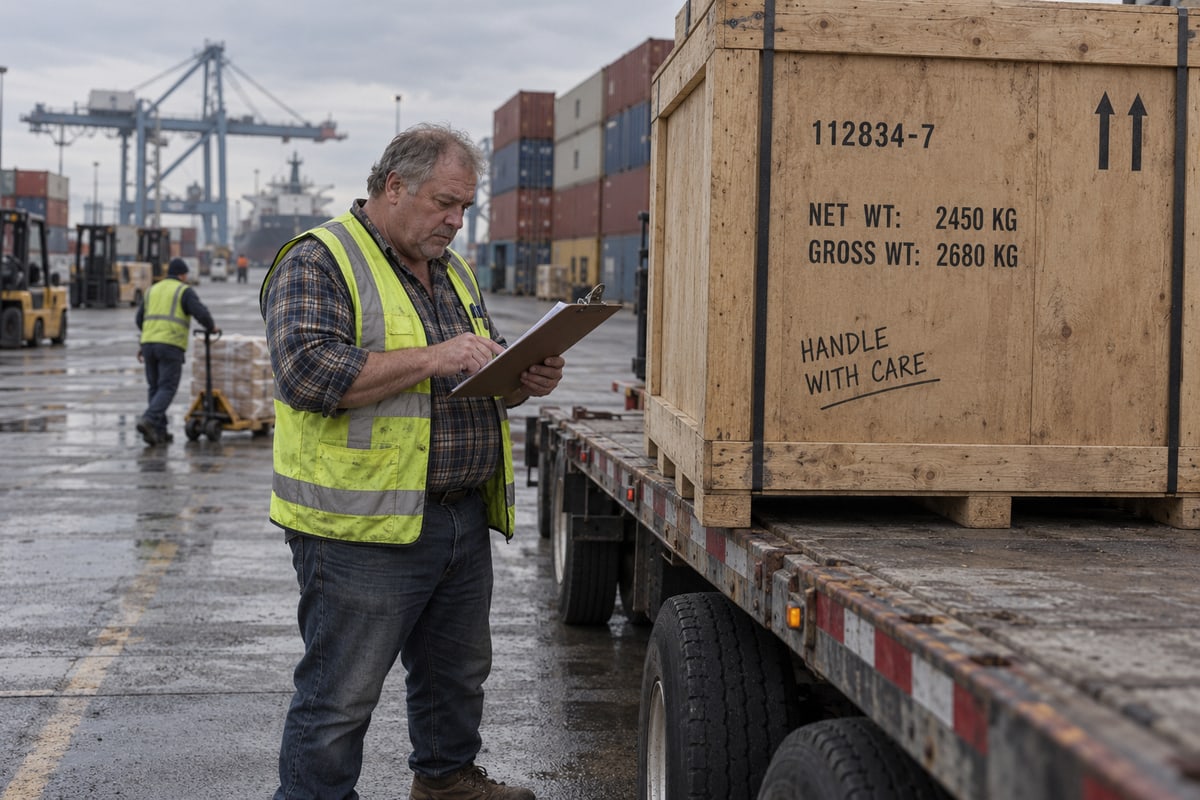
A pipe cutting machine 1 from our Wenzhou workshop once sat idle at a U.S. port. The documents needed for U.S. customs clearance were incomplete. Every day cost real money.
U.S. customs clearance for a pipe cutting machine requires a commercial invoice, packing list, bill of lading, CBP Forms 3461 and 7501, an importer number, a customs bond, and a broker power of attorney, plus a certificate of origin, ISPM 15 wood packaging proof, and a manufacturer safety declaration.
That list looks long. It is not hard to build. The trick is to prepare it before the crate leaves the factory. Below I walk through each group of documents, who prepares them, and where shipments usually go wrong.
Every crate that leaves our assembly floor in Wenzhou gets a document pack taped inside the lid. That habit started after a broker asked for papers we had never sent.
Before shipping a pipe cutting machine to the U.S., prepare a commercial invoice, packing list, bill of lading, Importer Security Filing data, CBP Form 5106 importer registration, a customs bond, a customs broker power of attorney, and technical specifications so CBP Forms 3461 and 7501 can be filed before arrival.

The easiest way to think about this is by owner. Some papers come from us as the supplier. Some come from the carrier. Some only the importer or the customs broker can create. If you know who owns each one, nothing falls through the cracks.
| Document | Prepared by | What it does |
|---|---|---|
| Commercial invoice | Supplier | Sets value, origin, and description for classification |
| Packing list | Supplier | Reconciles every crate, skid, and loose part |
| Bill of Lading or air waybill | Carrier or forwarder | Proves the importer’s right to make entry |
| Importer Security Filing (ISF) | Importer, via broker or forwarder | Pre-loading security data for ocean cargo |
| CBP Form 5106 | Importer | Registers the importer number, usually the EIN |
| Customs bond | Importer, via surety or broker | Guarantees duties, taxes, and fees |
| Power of Attorney | Importer, to the customs broker | Authorizes the broker to file entries |
| CBP Form 3461 | Customs broker | Entry/Immediate Delivery, releases cargo |
| CBP Form 7501 | Customs broker | Entry Summary, declares duties owed |
| Spec sheet, manual, photos | Supplier | Supports HTS code classification |
The Importer Security Filing is the one people forget. For ocean freight, the ISF must be transmitted at least 24 hours before the vessel is loaded at the origin port. Missing it can trigger a $5,000 penalty. We send the ISF data to the buyer’s forwarder the same day we book the container.
The second deadline is arrival. CBP Form 3461 should be ready before the vessel docks. That is only possible if the broker already has the invoice, packing list, and Bill of Lading in hand.
CBP uses formal entry procedures 2 for goods valued at $2,500 or more. A pipe cutting machine will always cross that line. So you will need a customs bond. A single-entry bond covers one shipment. A continuous bond 3 covers a year of entries. Buyers who order more than one machine from us usually choose the continuous option.
I hear this often. A broker can file documents. A broker cannot know how our machine cuts, which crate holds the electrical cabinet, or whether the price includes installation. The importer of record is legally responsible for the entry. The broker needs your inputs to get it right.
A procurement manager in the Midwest once returned our commercial invoice with three lines circled. The model number did not match the packing list. He was right.
Your commercial invoice and packing list must name the seller, buyer, and importer of record, describe the machine’s function and cutting method, state model, serial number, condition, value, currency, Incoterms, and country of origin, and match the bill of lading crate by crate with net and gross weights.

The commercial invoice is the heart of the file. CBP uses it to set the customs value and to check the classification. The packing list is the map to the physical cargo. If the two disagree, or if either one disagrees with the Bill of Lading, an inspector will stop and ask why.
“Pipe cutter” or “industrial equipment” is too vague. The description must explain what the machine does, what material it processes, how it cuts, and whether it is complete. Here is the pattern we use on our own invoices:
“CNC automatic pipe cutting machine, model [your model], for cutting metal tube and aluminum profile. Servo-driven linear feed on guide rail, hydraulic clamping, circular saw blade 4 cutting with coolant system. PLC control with HMI touchscreen. New. Shipped complete in two wooden crates with electrical cabinet, spare blades, and tooling.”
Every element there answers a question a broker would otherwise ask. The cutting method matters because it drives the HTS code classification. The control system matters because numerically controlled machines sit in their own tariff lines. The condition matters because used machines need extra support.
| Field | Commercial invoice | Packing list | Bill of Lading | Common failure |
|---|---|---|---|---|
| Model number | Yes | Yes | In description | Supplier uses a sales name on one and a factory code on another |
| Serial number | Yes | Yes | Optional | Left off the packing list |
| Package count | Total | Per crate | Total | Loose coolant hose or blade box not counted |
| Weights | Net and gross | Net, tare, and gross per crate | Gross total | Estimated weight on invoice, scale weight on B/L |
| Country of origin | Yes | Yes | No | Shipping country listed instead of manufacturing country |
| Value | Unit and total, currency | No | No | Accessories shown with no value |
| Incoterms | Yes | No | No | FOB on quote, CIF on invoice |
Our machines leave in more than one crate. The base cabinet with the hydraulic cylinder and linear rail goes in one. The control tower, electrical cabinet, and coolant pump go in another. The packing list must list the contents of each crate, its dimensions, its marks, and its net, tare, and gross weight. Spare blades, drag chain sections, and leveling feet need a line too. An unexplained crate is the fastest way to get a physical exam.
Buyers ask this when a production line is waiting. CBP can accept a pro forma invoice 5 when a commercial invoice cannot be produced. But a normal sale still needs the final commercial invoice and an accurate CBP Form 7501. An incomplete pro forma for a complex machine creates valuation and classification problems that cost more time than it saves. We release the final invoice before the container is sealed, every time.
Heat-treated pallets taught us a lesson we never forgot. One shipment used untreated wood dunnage, and the crate was flagged on arrival. The machine inside was perfect.
A certificate of origin is not mandatory for every entry, but you should carry one to support country of origin marking and any trade-agreement duty claim. Bring ISPM 15 wood packaging proof, a manufacturer’s declaration on machine safety standards, and a TSCA Title VI declaration if composite wood is present.

These are the documents that do not release cargo but prove compliance later. Most buyers skip them until CBP or an insurer asks. We now treat three of them as standard: the Certificate of Origin, the wood packaging compliance proof, and the manufacturer’s declaration.
| Document | When you need it | Who issues it | What it proves |
|---|---|---|---|
| Certificate of Origin | Any entry, and required for USMCA or other trade-agreement claims | Supplier, often stamped by a chamber of commerce | Where the machine was manufactured |
| ISPM 15 wood packaging proof | Any solid wood crate, pallet, or dunnage | Treatment provider and supplier, via the IPPC stamp | Wood was heat-treated or fumigated |
| Manufacturer’s declaration / safety standard declaration | Any industrial machine | Supplier | Which safety and electrical standards the machine was built to |
| TSCA Title VI declaration | Composite wood in console, housing, or packaging | Importer, based on supplier data | Formaldehyde compliance for composite wood |
| IPR authorization letter | Machines using proprietary CNC or PLC software such as Siemens or Fanuc | Supplier with software vendor | Licensed use, avoids trademark seizure |
| AD/CVD scope statement | Any metal-working machine from a country with pipe trade remedy orders | Importer or broker | Machinery is distinct from steel pipe under AD/CVD orders |
| Safety Data Sheets | Coolant, hydraulic oil, or lubricant shipped with the machine | Chemical supplier | Hazard information for transport and handling |
Every foreign-origin article generally must be marked in English with its country of origin unless an exception applies. For a large machine, that means a durable plate. Our nameplate sits on the base cabinet next to the model and serial number. The marking must say the country of manufacture, not the port the container sailed from. The plate, the invoice, the Certificate of Origin, and the entry must all agree.
Marking and preferential duty treatment are separate questions. A machine can be marked “Made in China” and still be classified under one tariff treatment or another. The Certificate of Origin supports the marking. It does not change the duty rate by itself.
A pipe cutting machine has guards, an emergency stop, a safety enclosure, and an electrical cabinet. U.S. buyers want to know what standards those parts were built to. Our declaration lists the standards our engineers followed for the guarding, the PLC control circuit, and the cabinet wiring, and we attach the electrical schematic. CBP does not always ask for it. Workplace regulators, insurers, and your own plant safety team usually do.
Solid wood crates, pallets, and dunnage 6 must carry the IPPC stamp showing ISPM 15 treatment. Noncompliant wood can mean a hold, re-export, or destruction of the packaging with the machine still inside. We photograph the stamp on every crate before loading and send the photos with the packing list.
There is a trade-off I weigh every time a buyer asks me to put an HS code on a quote. A fast answer helps planning. A wrong one costs money.
Check the HTS code classification under Chapter 84 based on the machine’s cutting method and CNC control, confirm the duty rate on the USITC schedule, review any Section 301 or other origin-based tariffs, verify AD/CVD scope, and add the merchandise processing fee and harbor maintenance fee to your landed cost.

The Harmonized Tariff Schedule of the United States sets the duty rate, the statistical reporting number, and whether any extra tariff or trade remedy applies. The fact that a machine cuts pipe does not decide its tariff number. How it cuts does.
| Cutting method | Chapter 84 area to check first | Key question for the broker |
|---|---|---|
| Circular saw blade or band saw | Sawing or cutting-off machine tools for metal | Numerically controlled or not? |
| Abrasive cut-off wheel | Cutting-off machine tools for metal | Is it a dedicated cut-off machine or a grinder? |
| Laser or plasma | Machine tools operating by laser or plasma arc | Rated power and whether it is CNC |
| Rotary or orbital cutter | Other metal-working machine tools | Does it also bevel, drill, or thread? |
| Hand-operated pipe cutter | Chapter 82 hand tools, not Chapter 84 | Is it powered at all? |
| Parts shipped separately | Parts and accessories of machine tools | Does the shipment have the essential character of a complete machine? |
Our CNC machines use a saw blade with a coolant system, servo feed, and PLC control. That combination lands in a different line from a plasma unit or a hand tool. If the machine also bevels or drills, the principal function controls the classification. Your broker needs the spec sheet, the operating manual, and photos of the cutting head to answer these questions.
This is the objection I push back on hardest. A supplier’s code is an export code. The first six digits are shared internationally, but the U.S. HTS adds its own statistical breaks, duty rates, and trade remedies. Copying our code without review can put the machine in the wrong line. We state the code we believe is correct and tell every buyer to confirm it with their broker.
The HTS rate is the start, not the total. For a machine of Chinese origin, check whether Section 301 tariffs apply to that tariff line. Add the merchandise processing fee. For ocean freight, add the harbor maintenance fee. Then ask your broker to prepare an AD/CVD scope statement. Steel pipe products from several countries sit under antidumping and countervailing duty orders. The statement makes clear that the machinery that cuts pipe is not the pipe itself.
Some contracts bundle installation, training, or software licensing with the machine. If the final value is not settled at entry, a reconciliation entry lets the importer adjust the declared value later. Separating merchandise value from post-import services depends on the contract, so write those items as separate lines from the start.
A missing paper can idle a production line for days. The fix is simple. Build the full document pack before shipping, and send it to your broker early.
Interested in sourcing the products mentioned in this article? See details and request a quote here:
