

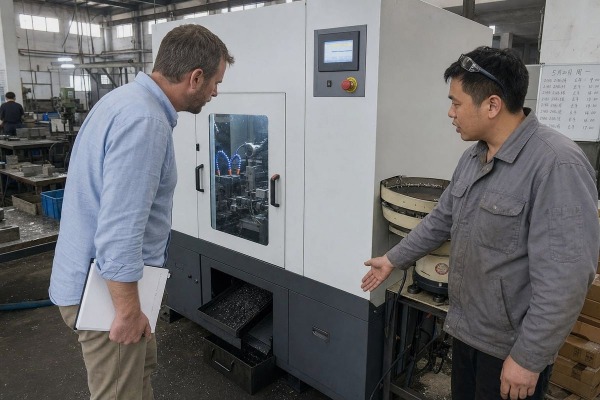
Buying a chamfering machine sight-unseen is a gamble I have watched buyers lose. Glossy brochures hide weak spindles, subcontracted parts, and slow support. On our production line in Wenzhou, we tell every serious buyer the same thing: come see the machine running, or verify it another credible way, before you wire a deposit.
Yes, you should visit the supplier’s workshop before buying a chamfering machine, especially for high-value or first-time purchases. A visit verifies real manufacturing capability, build quality, testing processes, and after-sales credibility. If travel is impossible, combine a live video factory tour with references and a Factory Acceptance Test.
Let me walk you through what a visit actually proves, how to verify quality remotely, what to ask on-site, and whether a video tour is good enough.
Last year, a procurement manager from the United States spent two days at our facility before ordering. He checked far more than the demo machine — and he was right to.
During a chamfering machine factory visit, inspect production floor activity, in-house machining capability, component brands, quality assurance protocols, spare parts inventory, live machine demonstrations with your own samples, safety features, and whether the team's scale and equipment match their claimed production capacity.

A manufacturing facility audit is not about being impressed by a clean lobby. It is about confirming that the supplier can build, test, and support the exact machine you plan to buy. In my experience hosting buyers from India, Mexico, and South Korea, the visitors who get the most value follow a structured checklist rather than a casual walk-through.
Watch whether machines are actively running. An idle workshop with dusty equipment tells you the supplier may be a trading company 1 or an assembler. Look at the assembly stations. Check whether the chamfering machine frames, tooling, and fixtures are machined in-house or arrive as finished modules from somewhere else. Ask to see the testing station where finished machines run continuous trials before shipment.
| Inspection Area | What to Check | Red Flag |
|---|---|---|
| Critical components | Brands of spindles, motors, guide rails, PLCs | Unbranded or unverifiable parts |
| Workshop discipline | 5S organization, labeled storage, clean stations | Chaotic floor, no traceability |
| Spare parts | Physical inventory of wear items | "We order parts when needed" |
| Testing | Live demo with your material samples | Only prerecorded videos offered |
| Safety | Guarding, e-stops, electrical compliance | Exposed moving parts, loose wiring |
| Documentation | QC records, service logs, drawings | No records available on request |
Bring your own workpieces. A live chamfering test on your material and geometry is the single strongest proof of precision engineering specifications. Measure the results yourself. Check chamfer angle consistency, surface finish 2, and cycle time across at least ten to twenty pieces, not just one perfect sample. Also confirm the operational safety features work as described — test the emergency stop, check the door interlocks, and look at the electrical cabinet wiring quality.
Finally, match the facility to the claims. If a supplier claims twenty machines per month but you see three technicians and two assembly bays, ask hard questions about outsourcing and lead time verification.
Not every buyer can fly to China. Roughly half of our export orders — to markets like Canada, Slovakia, and New Zealand — close without an in-person visit. Remote verification works, but only when it is layered.
Yes, you can verify chamfering machine quality remotely by combining a live video factory tour, third-party inspection audits, customer references, documented Factory Acceptance Test results, component brand verification, and a pre-shipment inspection. No single remote method is sufficient; use at least three together.

Remote supplier reliability evaluation is a layered process. Each layer catches problems the others miss. Here is how I recommend structuring it, based on how our own overseas buyers vet us.
Request the business license 3, factory address, equipment list, and relevant certifications before any technical discussion. Cross-check the registered address against the shipping origin. Ask for the exact machine model's technical drawings, component list with brand names, and quality assurance protocols 4 in writing. A serious supplier hands these over quickly. A reseller stalls.
| Remote Method | What It Proves | What It Misses |
|---|---|---|
| Live video tour | Real facility, active production | Component quality, long-term support |
| Third-party audit | Registration, capacity, QC systems | Machine-specific performance |
| Customer references | Real-world reliability, service speed | Fit for your specific application |
| Sample chamfering test | Precision on your parts | Machine durability over time |
| Pre-shipment inspection 5 | Build matches specification | Installation and commissioning quality |
Send your workpieces and ask for a recorded live test — a real-time video call, not an edited clip. Then insist on a documented Factory Acceptance Test 6 before shipment. During a FAT, the machine runs your parts to agreed tolerances while you watch remotely, and both sides sign off on the measured results. We run FATs this way for buyers in Vietnam and Malaysia, and it removes most of the guesswork.
Also verify after-sales technical support before ordering. Send a technical question at an odd hour and time the response. Ask how remote troubleshooting works, whether the PLC logic is open-access, and how spare parts ship. Slow answers before the sale predict slower answers after it.
A production manager from Serbia once asked me forty prepared questions during his visit. His discipline impressed me — and it changed how I advise other buyers to prepare.
Ask what percentage of the machine is built in-house versus subcontracted, what share of production chamfering machines represent, which component brands are used, how the FAT is conducted, what the real lead time is, how after-sales support works, and request contactable customer references.

The questions you ask on-site should force specific, verifiable answers. Vague replies are data too. Here is the question framework I would use if I were sitting on your side of the table.
The second question matters more than buyers realize. If chamfering machines are a tiny sideline, the supplier's tooling, spare parts, and engineering attention will follow their main business, not yours.
Ask for two or three reference customers running the same model in real production, ideally in your industry or region. One source of good advice I follow: seeing a machine in a customer's factory tells you more than seeing it in the vendor's showroom. Also ask to review recent QC records and service logs. A supplier who tracks nothing will fix nothing.
We run live WhatsApp video tours almost weekly for buyers who cannot travel. I have learned exactly where they work well — and exactly where they fall short.
A live video call factory tour is a reasonably reliable alternative for lower-value purchases or repeat orders, provided it is real-time, unscripted, and covers the workshop floor, testing area, and a running machine. For expensive or first-time purchases, it should supplement — not replace — in-person or third-party verification.

A video tour is only as good as the control you take over it. A prerecorded promotional video proves almost nothing. A live, interactive walkthrough where you direct the camera proves a great deal more. The difference is who decides what you see.
Insist on a real-time call, not a file. Direct the camera yourself: ask to see the assembly area, the testing station, the electrical cabinets, the spare parts shelves, and the warehouse. Ask them to power on the exact machine model you are buying and run parts on camera. Request close-ups of component nameplates 7 so you can verify spindle and motor brands. Ask spontaneous questions and watch how the technical team — not just the salesperson — responds. Team coordination on camera reflects team coordination on your project later.
| Factor | Live Video Tour | In-Person Visit |
|---|---|---|
| Cost and time | Low, one hour | High, days plus travel |
| Facility authenticity | Good if unscripted | Excellent |
| Build quality inspection | Limited by camera | Full hands-on access |
| Precision testing | Watch results remotely | Measure results yourself |
| Team assessment | Partial | Full — meet R&D and service staff |
| Spare parts verification | Moderate | Direct inventory check |
For a repeat order from a proven supplier, or a lower-cost standard machine, a live video tour plus a documented FAT and pre-shipment inspection is usually sufficient. For a six-figure custom automation project, or a first order from an unfamiliar overseas supplier, fly there or send a third-party auditor. And treat refusal as an answer: if a supplier will not allow a live video walkthrough at all, that alone tells you the manufacturing reality does not match the marketing.
A bad chamfering machine purchase costs far more than a plane ticket. Verify the workshop — in person for high-value orders, or through layered remote checks — before you commit.
1. Comprehensive Wikipedia definition of trading companies and their role in global commerce. ↩︎
2. Wikipedia explains the characteristics and measurement of surface finish in manufacturing. ↩︎
3. The U.S. Small Business Administration provides guidance on obtaining a business license and necessary permits. ↩︎
4. Authoritative Wikipedia entry explaining the international standard for quality management systems. ↩︎
5. Official World Trade Organization page explaining the practice of pre-shipment inspections. ↩︎
6. Wikipedia provides a comprehensive overview of the Factory Acceptance Testing process in engineering. ↩︎
7. Wikipedia describes the purpose and requirements for industrial nameplates on machinery components. ↩︎
