

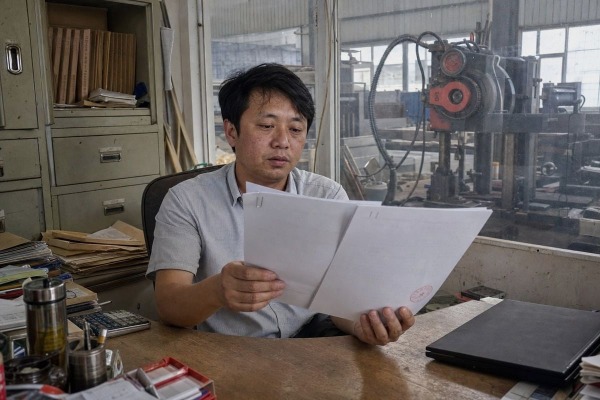
Verifying a supplier’s export qualifications for pipe cutting machines saved several of our overseas buyers from costly mistakes. On our Wenzhou production line, we see why this check matters.
To verify a supplier’s export qualifications for pipe cutting machines, check the business license and export license registration, authenticate CE and ISO 9001 certificates in official databases, review past export documents like the Certificate of Origin, and confirm real shipment records to your target market.
That is the short answer. But each step has traps. A supplier can look perfect online and still fail at customs. Below, I break down exactly what to check, in what order, and what warning signs mean walk away.
A German buyer once asked us for six documents before signing anything. His list was smart, and we now recommend the same package to every new customer who contacts our team.
Request the business license with the 18-digit Unified Social Credit Code, the Foreign Trade Operator Registration, the customs registration code, CE and ISO 9001 certificates, a sample Certificate of Origin from a past shipment, and a proforma VAT invoice confirming general taxpayer status.

Export qualification is not one document. It is a stack of documents that must all point to the same legal entity. When we prepare this package for buyers in the United States or Germany, we always check that the company name matches across every page. If the name on the bank account differs from the name on the contract, payment risk rises sharply.
| Document | What It Proves | What to Check |
|---|---|---|
| Business license | Legal existence | 18-digit Unified Social Credit Code; scope includes machinery manufacturing and export |
| Foreign Trade Operator Registration | Right to trade internationally | Registration is active, not expired |
| Customs registration code | Ability to clear goods legally | Code matches the contracting entity |
| CE / ISO 9001 certificates 1 | Product and system compliance | Certificate numbers verifiable in issuing-body databases |
| Certificate of Origin (sample) | Real past exports | Destination matches your region; dates are recent |
| Proforma VAT invoice | Financial legitimacy | General taxpayer status, which enables export tax rebates |
The business scope line on a Chinese license is easy to skip. Do not skip it. If the scope covers trading only, you may be dealing with a middleman, not a factory. That changes who is responsible for quality control inspection 2 and warranty support. Chinese suppliers can be checked through the National Enterprise Credit Information Publicity System 3, known as GSXT. It is free and official. Match the registered address there against the factory address the supplier gives you. A mismatch does not always mean fraud, but it demands an explanation before you pay a deposit.
Also ask which customs HS code the supplier uses for pipe cutting machines. A supplier who hesitates on this basic question has probably never shipped one abroad.
Here is a trade-off we weigh constantly: real certification costs money and audit time, while a fake PDF costs nothing. That gap is exactly why buyers must verify, not trust.
Verify CE and ISO 9001 certificates by requesting the full original document, then checking the certificate number directly in the issuing body's official online database. For CE, confirm the machine falls under the Machinery Directive and that the notified body actually exists and covers machinery.

Screenshots prove nothing. When our engineers prepare CE documentation 4 for shipments to Italy and France, the technical file behind the certificate is thicker than the certificate itself. A supplier who cannot show the supporting file probably bought the paper, not the compliance.
A certificate is a snapshot. Production discipline is a film. In our experience exporting to Japan and South Korea, buyers who combine certificate checks with a quality control inspection during production catch far more problems than buyers who rely on paperwork alone. Ask the supplier who signs off on final inspection before shipment release. If the answer is vague, the certificate is decoration. Also verify CNC control software licenses. Unlicensed software can face intellectual property challenges in your jurisdiction, and in the worst case, a machine can be remotely locked.
Painful lesson learned early in our factory's history: we once quoted against a competitor who promised a two-week delivery on a customized cutting machine. The buyer later told us the shipment never cleared customs. The signs were there all along.
Key red flags include a bank account name that differs from the contracting entity, cropped or unverifiable certificates, inability to name your country's import requirements, no sample export documents from past shipments, no customs HS code knowledge, and heavy undisclosed reliance on subcontractors.

Red flags rarely appear alone. One weak answer might be an honest gap. Three weak answers form a pattern. When we onboard distributors, they often test us with these exact questions, and we welcome it, because a genuine exporter answers them in minutes.
| Red Flag | Severity | Why It Matters |
|---|---|---|
| Bank account name mismatch | Critical | Signals impersonation or an unauthorized middleman; payment recovery becomes nearly impossible |
| Certificates cropped, expired, or unverifiable | Critical | Suggests forged or borrowed compliance documents |
| No export license verification possible | Critical | The supplier may be a domestic-only factory routing through unknown agents |
| Cannot produce past export documents | High | Indicates theoretical licensing without operational experience |
| Confusion between manufacturer vs trading company identity | High | Blurs responsibility for QC, warranty, and after-sales support |
| Cannot answer HS code or destination compliance questions | Medium | Reveals inexperience with your specific market |
| Refuses live video factory tour | Medium | May be hiding subcontracted production or a small assembly shop |
Ask directly: which manufacturing steps happen in your own facility? Some outsourcing is normal. We machine core components in-house but source Tier-1 motors and gearboxes from established brands, and we disclose that openly, including warranty coverage on those components. What is dangerous is a supplier who claims full in-house production but cannot show the machines, the staff, or the workshop on a live call. Also probe on newer requirements. A supplier serving Europe should at least recognize questions about CBAM-related environmental reporting. Blank stares on emerging compliance topics suggest the supplier stopped learning years ago.
A procurement manager from Ohio recently asked me a blunt question on WhatsApp: how do I know you have shipped machines to America before? I liked the question, because the proof is checkable, not just claimable.
Check a supplier's track record by searching global customs databases for shipment records to your region, requesting sample export documents from past deliveries, asking for buyer references in similar markets, reviewing dated factory and shipping videos, and using third-party factory audit reports.

Track record is the strongest single predictor of a smooth transaction. Licenses prove permission. Shipments prove execution. Our own export history covers the United States, Japan, Germany, India, South Korea, Italy, Mexico, and France, and we can produce document evidence for each lane. Any qualified supplier should be able to do the same.
| Evidence | Reliability | How to Obtain |
|---|---|---|
| Global customs database records | Very high | Third-party trade data platforms; search the supplier's legal name |
| Third-party factory audit report | Very high | Commission an inspection agency to verify capacity, machinery ownership, and workforce |
| Past export documents (bill of lading, packing list, Certificate of Origin) | High | Request redacted samples for shipments to your region |
| Live-stream Factory Acceptance Test | High | Require the supplier to cut your actual pipe samples on camera |
| Buyer references | Medium | Contact them directly; verify the reference company exists |
| Marketplace verified badges and trade assurance status | Medium | Useful starting point, but verify independently |
| Website testimonials | Low | Easy to fabricate; treat as marketing |
Export history answers whether the supplier can ship. It does not answer whether the machine suits your work. Before we finalize any custom order, we run cutting tests on the buyer's representative pipe sizes, wall thicknesses, and materials, then send videos and measured results. Insist on a live-stream Factory Acceptance Test where your specific samples are cut on camera. This one step exposes calibration problems, subcontracted assembly, and overstated throughput claims before your money leaves the bank. For higher-value machines or first orders, pair this with an on-site visit or a third-party factory audit report. The audit cost is trivial next to the cost of a failed shipment.
Export qualifications must be proven, not assumed. Verify legal identity, export licenses, authentic certificates, factory capability, and real shipment records before paying. Layered checks turn a risky purchase into a safe one.
1. Official ISO landing page for the 9001 standard, used to verify a supplier’s quality management system. ↩︎
2. Authoritative resource from the American Society for Quality explaining the role and importance of quality control inspections. ↩︎
3. Wikipedia’s explanation of the official Chinese system for verifying corporate registration, business scope, and legal status. ↩︎
4. European Commission’s resource on machinery regulations, essential for understanding CE compliance and documentation for mechanical exports. ↩︎
