

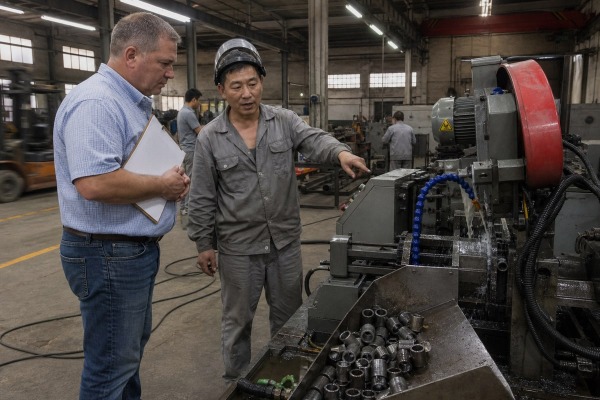
A buyer once wired a deposit to a pipe cutting machine supplier with a beautiful website — then heard nothing for weeks. On our Wenzhou production floor, we hear these stories constantly.
To verify a pipe cutting machine supplier’s industry reputation, cross-check business licenses and ISO 9001 certification against official registries, contact previous customers directly, request a live factory audit or video tour, and review verified transaction records on trade platforms like Made-in-China before paying any deposit.
That answer sounds simple. The hard part is knowing which signals are real and which are staged. Reputation in industrial equipment is not popularity. It is proof of industry recognition, real customer experience, a clean delivery record, and after-sales credibility. Below, I walk through each verification step in the order I recommend to our own buyers, so you can build your own vendor assessment checklist before requesting a single quote.
Last year, a procurement manager in Ohio asked our team for seven separate documents before his first order. He was right to ask, and we had every one ready.
Request the business license, ISO 9001 certification, CE declarations, export license verification, a recent factory audit report, and technical specification sheets. Cross-check each document against official registries, and confirm the legal name matches across the website, quotation, certificates, and bank account before you proceed.

Documents are the first layer of verification, but only if you actually check them. A PDF costs nothing to fake. What separates a credible pipe cutting machine supplier from a risky one is whether every document traces back to a real, matching legal entity.
Before any deposit, I tell buyers to collect this exact set of papers. Anything less is incomplete due diligence.
| Document | What It Proves | How to Verify It |
|---|---|---|
| Business license | Legal identity, registered address, business scope | Check China’s national enterprise credit database for violations or abnormal operations |
| ISO 9001 certification | A working quality management system | Look up the certificate number in the issuing body’s public registry |
| CE declaration | EU machinery safety compliance | Confirm the listed directive and the notified body actually exist |
| Export license verification | Real, legal export activity | Ask for past customs declarations or shipping records |
| Factory audit report | Verified production capability | Confirm an independent third party issued it, not the supplier |
| Technical specification sheets | Cutting capacity, tolerances, wall thickness range | Compare claims against witnessed test cuts on your material |
Cross-referencing takes minutes. Search the ISO certificate number on the certifier’s website. If the certifier is obscure or the number returns nothing, treat it as unverified. Then compare names. If the website says one company, the quotation says another, and the bank account belongs to a third, stop. Mismatched entities are one of the most reliable red flags in China sourcing. Also check dates. An ISO 9001 certificate 1 that expired two years ago tells you the quality system lapsed. Finally, remember the broader lesson: certificates support credibility, but they never replace performance testing on your own pipe samples.
Honest feedback beats any brochure. When we finish a cutting or chamfering line for a client, we ask permission to share their contact with future buyers.
Ask the supplier for at least three customer references in your industry, then contact them by email or WhatsApp with structured questions about machine quality, delivery timing, responsiveness, and problem resolution. You can also find real buyers through case studies, LinkedIn, and trade platform reviews.

Real customer experience is the second pillar of reputation, right after industry recognition. A supplier’s delivery record and after-sales reputation live in the memories of past buyers, not in marketing copy. Your job is to reach those buyers and ask sharp questions.
Start by asking the supplier directly. Credible suppliers usually tolerate reference calls; evasiveness is a warning sign. Then go beyond the supplied list. Read the supplier’s case studies and references, and note the company names mentioned. Search those names on LinkedIn and message the engineering or procurement contacts. Check YouTube comments under the supplier’s machine videos, since real users often ask technical follow-up questions there. Also search the supplier’s name plus words like “fraud,” “scam,” or “complaints” to surface risk patterns. Prefer references with pipe materials, diameter ranges, and wall thicknesses similar to yours. Success with adjacent machinery is less persuasive than documented success with pipe cutting machines specifically.
Structured questions get honest answers. Here is the short list I recommend.
| Question | What It Reveals |
|---|---|
| Did the machine arrive on the promised date? | Delivery record and supply chain reliability |
| How many hours per shift does it run today? | Real capacity versus sales claims |
| How fast did the supplier respond to a breakdown? | After-sales service support quality |
| Were spare parts shipped quickly or stocked locally? | Long-term operating cost |
| Would you order from them again? | Overall trust in one answer |
Weigh consistent answers across three references far more than one glowing quote. Customer testimonials curated on a supplier’s own site should be treated as advertising until independently confirmed.
There is a real trade-off here: flying to Wenzhou costs time and money, while a live video tour costs almost nothing. We host both for serious buyers.
Yes. Always request a factory audit or live video tour before signing. A real visit or video call confirms the supplier actually manufactures the machine, reveals production capability and QC processes, and lets you witness test cuts on your own pipe samples before paying a deposit.

Buyers now expect proof by video, not brochures. Online claims are easy to stage, but a live, unedited walkthrough is hard to fake. It is also the fastest way to separate a real manufacturer from a trading company reselling someone else’s machines. Here is the sequence I recommend.
For orders under a certain value, a video tour plus a third-party inspection is usually sufficient. For large or customized lines, an in-person factory audit — or hiring an independent inspector to produce a formal factory audit report — is worth the cost. Independent eyes catch what a camera angle hides.
Our own Made-in-China profile taught me something useful: buyers trust the data the platform verifies far more than anything we write about ourselves.
Made-in-China helps you check a supplier’s track record through verified company profiles, third-party audit reports, years of export history, transaction records, and buyer reviews. Use these signals to shortlist suppliers, then confirm findings independently with reference calls and a live factory tour.

Trade platforms are a filtering tool, not a final verdict. They compress years of a pipe cutting machine supplier’s history into a few scannable signals. The skill is knowing which signals carry weight and which are cosmetic decoration.
| Platform Signal | Weight | Why It Matters |
|---|---|---|
| Third-party audited supplier report | High | Compiled by an independent inspection company, covering premises, equipment, and staff |
| Years active plus named export markets | High | A decade of specialized pipe-cutting activity beats a new generalist listing |
| Transaction and review history | Medium-high | Reflects real completed orders, not promises |
| Trade show participation records | Medium | Signals ongoing industry presence and recognition |
| Membership tier alone | Low | Largely a paid feature, not an earned credential |
| Polished photos and slogans | Low | Easy to stage or borrow |
Platform profiles verify legal legitimacy and basic operational capability, which covers two of the three verification layers. The third layer — customer satisfaction — still requires your own reference calls. Also compare the platform data against outside sources. Does the registered name match the website and the quotation? Does a search engine check turn up complaints the platform reviews missed? Does the profile list machines matching your pipe sizes, or only similar products? A supplier whose platform record 3, audit report, and independent references all tell the same story has demonstrated supply chain reliability. A supplier whose story changes between channels has demonstrated the opposite.
Reputation is evidence, not marketing. Verify documents, call real customers, audit the factory, and check platform records before signing. We welcome that scrutiny — reach out and test us anytime.
