

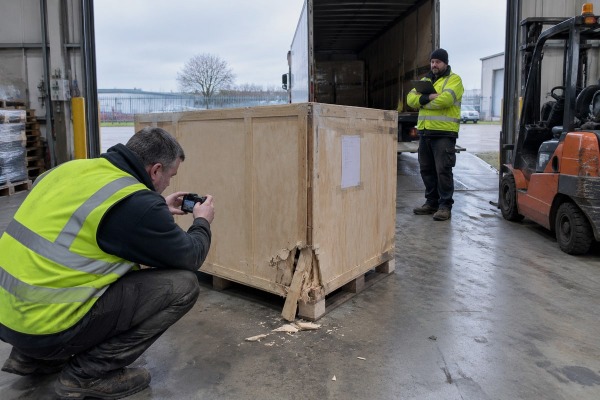
The crate for a cable lug making machine arrived in Mexico with a crushed corner last year, and our customer nearly signed a clean receipt marine cargo insurance 1. That moment decides most transit damage claims.
To handle transit damage on a cable lug making machine, document the damage before signing the Bill of Lading, keep all packaging, notify the carrier, insurer, and supplier in writing within hours, arrange a technical inspection, and submit a proof of loss with photos, invoices, test reports, and repair quotations.
I have helped buyers in India, the United States, Canada, and Serbia work through this exact situation. The process is not complicated, but the order matters. My rule is simple: evidence first, clarify who is responsible, and report without delay. The sections below walk through each step. I will also show you what we send from our side, so you are never building a claim alone.
Our after-sales team has learned one hard lesson across ten export markets: the receiving dock, not the insurer's office, is where a claim is won or lost.
At delivery, document the crate, pallet, straps, shock and tilt indicators, and every visible defect with photos and video, then write specific damage notes on the delivery receipt or Bill of Lading, get the driver's signature, and record carrier, vehicle, time, and location details.

I tell every customer the same thing: treat the first thirty minutes at the dock as an evidence exercise, not an unloading job. A cable lug making machine is heavy. It carries a press frame, hydraulic or pneumatic cylinders 2, a control cabinet, sensors, dies, and a stainless feeding chute. Visible dents are only part of the story. A tipped crate can throw die alignment out of tolerance while the paint looks perfect. So the goal at delivery is to lock in the condition of the shipment at the exact moment it changed hands.
Start with the truck still closed if you can. Then shoot the crate from all sides, the pallet, the bands, the wrapping, and any labels. If we have fitted ShockWatch or TiltWatch indicators on the crate, photograph them close up. A tripped indicator is objective proof that the shipment saw excessive force or was turned on its side. Our customers in the United States have found that one such photo carries more weight with an adjuster than a page of written description.
| What to record | Why it matters | Where it goes |
|---|---|---|
| Crate, pallet, straps, blocking | Shows whether packaging failed or was abused | Photo set, claim file |
| Shock and tilt indicators | Objective proof of impact or tipping | Photo set, damage inspection report |
| Specific defects (crushed corner, puncture, stains) | Links damage to transit, not installation | Delivery receipt or Bill of Lading 3 |
| Driver name, vehicle number, carrier, time, place | Establishes custody chain | Delivery receipt, notification email |
| Missing packages or broken seals | Supports shortage and loss claims | Delivery receipt, packing list comparison |
Your signature on the Bill of Lading has three possible meanings. A clean signature says you received the goods in good order. A damaged notation says you saw a problem and described it. A note that only says "subject to inspection" sits in the middle and is weaker than many people think. I always ask customers to write what they actually see: "forklift puncture on right side," "water staining on base," "machine frame visibly shifted." Specific words are harder for a carrier to argue with later. Ask the driver to sign next to your note. If the driver refuses to wait, write down that refusal and email the carrier, your forwarder, your insurer, and us the same day.
Refusing a damaged shipment feels natural. In practice it usually hurts you. The machine goes back into the carrier's custody, storage fees pile up, and you lose control of the evidence. Accept the delivery with detailed exceptions. Then keep the crate, the broken restraints, and the wrapping until commissioning is complete. Concealed damage often appears only when the machine is energized and run on sample lugs, and the packaging is what proves where that damage came from.
A procurement manager in Canada once asked us whether he should chase the trucking company or his insurer first. My answer was both, in writing, on the same day.
File the claim by sending a notice of intent to claim to the carrier and a notice of loss to your insurer, preserving the machine and packaging, allowing a surveyor inspection, then submitting a proof of loss with the Bill of Lading, invoice, photos, damage inspection report, and repair quotations.

Most buyers think of this as one claim. It is really two related claims running side by side. One is a freight claim against the carrier under the transport contract. The other is a claim under your own freight insurance coverage 4, whether that is a marine cargo policy, a machinery-in-transit policy, or an equipment floater. They draw on the same evidence, but they have different rules, different deadlines, and different payers. I keep both files consistent and I never claim the same dollar twice.
| Feature | Freight claim | Insurance claim |
|---|---|---|
| Who pays | Carrier, under carrier liability rules | Your insurer, under policy wording |
| Basis | Transport contract, tariff, Carmack Amendment in US domestic trucking, or international conventions | Policy terms, deductible, valuation clause |
| Limits | Often capped by declared value or per-kilogram limits | Insured value, often replacement cost value or invoice value plus freight and duty |
| Typical deadlines | Visible damage at delivery; concealed damage sometimes as short as five days in some arrangements | Notice often required within roughly thirty days, but policy wording controls |
| After payment | Carrier closes file | Insurer may pursue the carrier through subrogation |
The deadlines above are examples only. Your Bill of Lading, carrier terms, policy, and jurisdiction set the real dates, so read them before you rely on any number.
Does the policy cover loading, unloading, and temporary storage, not just the road or sea leg? Is the machine insured at invoice value or replacement cost value? Are tooling, dies, duties, and installation included? Is there a deductible? Are moisture, inadequate packaging, and pre-existing defects excluded? Are expediting expenses for rush-shipping replacement cylinders or control parts covered? Is business interruption separately insured? Each answer shapes how you write the proof of loss. If a claim moves toward total loss, the argument must rest on technical grounds: distorted frame, damaged precision surfaces, unavailable parts, or safety risk, not simply a high repair quote.
Before every crate leaves our Wenzhou workshop, our engineers test the machine on sample lugs, record results, and photograph it. That quality habit now anchors our customers' claims.
YQUNIQUE provides a factory test report, serial numbers, pre-packing and post-crating photos, loading photos, the packing list, commercial invoice, crate specifications, a technical damage assessment linking defects to transit, and itemized repair or replacement quotations to support your cable lug making machine insurance claim.

An insurer needs more than proof that your machine is damaged. It needs proof that the machine was sound when it left us, and that the damage is consistent with what happened in transit. That is where our documentation does its work. We are a small team of ten in Wenzhou, so we keep the process tight and personal. One engineer owns the file for each machine from factory test to commissioning.
| Document | What it proves | When we send it |
|---|---|---|
| Factory test report with sample lug results | Condition and performance before shipment | With shipping documents, before dispatch |
| Serial number record for frame, cylinders, PLC, and dies | Identifies the insured item and its components | With packing list |
| Pre-packing, post-crating, and loading photos | Packaging adequacy and condition at handover to carrier | Day of loading |
| Crate drawing and specification | Answers carrier arguments about inadequate packaging | On request, within the claim file |
| Packing list and commercial invoice | Declared value, contents, and shortage checks | With shipping documents |
| Technical damage assessment | Links observed defects to impact, tipping, or moisture | After remote or on-site inspection |
| Itemized repair and replacement quotations | Quantifies the loss for the proof of loss | After assessment, usually within days |
A repair quote alone will not satisfy an adjuster. It shows cost, not cause. So our engineers write a short assessment that walks through the machine the way we would at the factory. We check die alignment, press force, ram travel, hydraulic leakage, frame distortion, control cabinet condition, PLC and sensor operation, emergency stops, guarding, and pneumatic circuits. For the hydraulic power unit we specify a pressure and seal integrity test, because transit stress can cause micro-fractures that only show under load. For the die-sets we request a precision alignment audit, since a lug machine can power on and still produce out-of-tolerance crimps. Each finding is tied to physical evidence from your photos and from ours.
Carriers often argue that the packaging was inadequate or that the shipper loaded it wrong. Our crate specification and loading photos answer that directly. Insurers may say a visible dent does not justify replacing a control cabinet. Our assessment explains why a shifted cabinet with cracked terminal blocks is a transit consequence, not wear. Some buyers assume we file the claim for them. We do not, because the insurable interest usually sits with you once risk transfers under the agreed Incoterms 5. If we arranged marine cargo insurance under a CIF contract, we will tell you exactly who the insured party is and help you route the notice. Where a formal industrial equipment appraisal is required for a high-value total loss, our quotation and test records give the appraiser a factual baseline to work from.
Every quote we prepare includes a trade-off I weigh: a heavier, braced crate costs more freight, but a stripped-down box costs far more when a hydraulic unit shifts in transit.
Prevent transit damage by specifying purpose-built crating with blocking, bracing, and moisture barriers, fixing shock and tilt indicators, photographing the machine before packing and after loading, buying adequate marine cargo insurance before dispatch, clarifying Incoterms risk transfer, and training receivers to inspect and annotate deliveries.

Prevention is cheaper than any claim, and it also makes a claim easier if one still happens. I think of it in three layers: the physical shipment, the paperwork, and the people at the receiving end. Weakness in any layer shows up as a dispute later.
Our machines combine a rigid press frame with cylinders, coiled hoses, a touchscreen on an articulated arm, and a stainless feeding chute with leveling feet. Each of those parts fails differently in transit. The frame needs blocking so it cannot slide. The control arm and screen need removal or internal bracing. Hoses and regulators with gauges need protection from crush loads. Moisture is a quiet enemy for the control cabinet, so we use barrier wrap and desiccant 6 for sea freight. Lifting points are marked so forklift operators do not spear the base. Shock and tilt indicators go on the outside of the crate where they are visible before the lid comes off.
| Risk | Preventive measure | Who owns it |
|---|---|---|
| Sliding or tipping of frame | Bolted blocking and bracing to crate base, tilt indicators | Supplier |
| Impact on cylinders, screen, chute | Component removal or internal padding, shock indicators | Supplier |
| Moisture in cabinet and tooling | Barrier wrap, desiccant, sealed crate | Supplier |
| Forklift puncture | Marked lifting points, clear handling labels | Supplier and carrier |
| Underinsurance | Insure at replacement cost value including freight, duty, tooling | Buyer or seller per Incoterms |
| Weak delivery notation | Written inspection procedure, trained receivers | Buyer |
Clarify Incoterms before the order is confirmed. Under FOB or FCA, risk passes to you early and you should hold the policy. Under CIF or CIP, we arrange cover, but you should still read the certificate and confirm the limits match your real exposure. Ask whether the freight insurance coverage includes loading, unloading, storage, and installation, not just the voyage. Record factory test results and serial numbers with the shipping set. Specify carrier handling and securing requirements in writing. These details take an hour before dispatch and save weeks after delivery.
Train your receiving staff to use specific words on the delivery receipt. Give them a one-page checklist and a camera. Keep every piece of packaging until an authorized technician completes post-transit inspection and calibration and the machine runs your lugs within specification. Then, and only then, release the crate for disposal.
Transit damage threatens your schedule and your capital. Evidence first, clear responsibility, prompt notice. Follow that order, and your cable lug making machine claim stands on solid ground.
Interested in sourcing the products mentioned in this article? See details and request a quote here:
1. Comprehensive overview of marine insurance principles for protecting international cargo shipments. ↩︎
2. Technical explanation of core mechanical components found in industrial machinery. ↩︎
3. Authoritative government source explaining essential shipping documentation for international trade. ↩︎
4. Official US government guidance on carrier liability and cargo insurance requirements. ↩︎
5. Official source for international commercial terms defining risk transfer between buyers and sellers. ↩︎
6. Scientific explanation of moisture control methods used in industrial export packaging. ↩︎
