

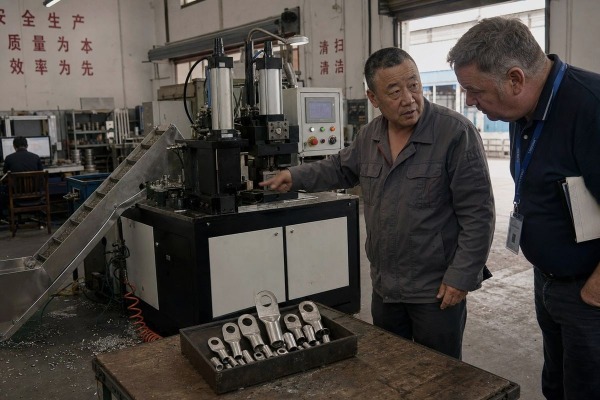
Finding reliable cable lug making machine suppliers from China is harder than it looks. I know, because buyers tell me their horror stories every week at our Wenzhou factory.
To find and screen reliable cable lug making machine suppliers from China, shortlist high-rated verified companies on B2B platforms, confirm real manufacturer status through business licenses, request valid ISO 9001 and CE certificates, demand live machine videos, ask peers for references, and compare quotes on identical specifications.
A wrong choice costs more than money. It costs months of downtime, failed installations, and unanswered support emails. Below, I break down the exact screening process I recommend to every buyer who contacts us.
A procurement manager from the United States once told me he shortlisted twelve suppliers online. After basic verification, only three turned out to be actual factories. That ratio matches what our team sees constantly.
Verify credibility by filtering for verified, high-rated suppliers on trusted platforms like Made-in-China, checking the business license shows manufacturing in its scope, reviewing the company website, asking industry peers which suppliers they buy from, and requesting current ISO 9001 and CE certificates.

The Chinese supplier market is huge and fragmented. Made-in-China alone lists over 517 manufacturers and suppliers for cable lug machinery, and more than 1,000 verified factories in the broader cable lug category. Alibaba search pages show 786 suppliers for this equipment type. That volume is a discovery advantage. But it is also a screening problem, because many listings mix real factories with traders and export intermediaries.
Here is the approach I recommend, and it is the same one I share with buyers who visit our workshop. Start with reliable Chinese supplier platforms 1 and filter strictly for high-rated, verified companies with Trade Assurance protection. Then leave the marketplace. Go to the company's own website and evaluate it. A real factory site usually shows process descriptions, custom mold design 2 capability, application guidance, and consistent branding that matches the marketplace listing.
Next, use your network. Ask industry peers which suppliers they actually purchased machines from. A peer reference is worth more than any review score, because reorder behavior proves the machine survived real production.
Finally, if certifications matter for your market, ask the supplier to provide their existing certificates. Do not accept a logo on a webpage. Ask for the document, check the dates, and cross-verify certificate numbers with the issuing bodies.
| Signal | Real Manufacturer | Trader / Intermediary |
|---|---|---|
| Product focus | Narrow, specialized (lug and terminal machines) | Broad, mixed catalogs |
| Business scope on license | Includes "manufacturing" or "production" | Only "trading" or "wholesale" |
| Factory evidence | Address, workshop photos, live videos | Generic stock images |
| Technical depth | Custom mold design, tooling, process details | Copied specification sheets |
| Branding | Consistent across platforms and website | Inconsistent names and logos |
One more check most buyers skip: the Chinese National Enterprise Credit Information Publicity System (NECIPS). It reveals administrative penalties and abnormal-operations records that English-language B2B profiles never show.
Before quoting any project, our engineers ask buyers seven questions: conductor material, lug size range, stud diameter, palm orientation, operating environment, target quantity, and destination market. Suppliers who skip these questions worry me.
Compare suppliers by requesting identical specification sheets covering lug size range, copper or aluminum compatibility, output capacity per hour, automation level, and tolerances. Then test customization depth by sharing your product drawings and asking how they would adapt tooling, molds, and feed systems.

Here is the trap: "cable lug making machine" is not one standardized machine. The term covers hydraulic crimping press units, punching machines, cold press terminal machine variants, fully automated terminal crimping line systems 3, and friction-welding equipment. Each production method affects speed, labor needs, and precision differently. If you compare a quote for a manual hydraulic unit against a quote for an automatic line, the price gap tells you nothing.
So the first step is defining your own requirement precisely. Are you producing copper lugs, aluminum lugs, or bimetallic terminals? What volume per shift? OEM high-volume production needs a different configuration than small customized runs. The best supplier is the one whose machine matches your actual end-use, not the one with the longest feature list.
| Machine Type | Best For | Automation | Typical Trade-Off |
|---|---|---|---|
| Hydraulic crimping press | Small batches, large-gauge lugs | Manual/semi | Low cost, high labor |
| Cold press terminal machine | Solid pin and cold-formed terminals | Semi/auto | Tooling investment |
| Automatic lug making line | High-volume OEM production | Full | Higher price, faster ROI |
| Punching/stamping machine | Flat ring terminals from strip | Semi/auto | Die maintenance |
In our export work across markets like the US, Mexico, South Korea, and Vietnam, buyers with limited customization support suffer most. Ask early whether the supplier does custom mold design in-house or outsources it. In-house tooling means faster iterations and better after-sale fixes. Also ask about servo motor options; energy-efficient drives and compatibility with recycled copper alloys matter more each year as ESG import requirements tighten.
Last year, a buyer sent us a photo of a machine he bought elsewhere. It arrived with no commissioning checklist, no spare parts, and a supplier who stopped replying after the balance payment. That failure was preventable with five questions.
Ask whether the supplier performs first-article inspection and documented QC, request an under-load video of your exact configuration, confirm pre-shipment acceptance testing, and negotiate a written after-sales package with at least a one-year warranty, a spare parts kit, and a 24-hour technical response commitment.

Quality control questions do two jobs. They protect your order, and they expose weak suppliers. A factory with real QC procedures answers these questions quickly and in detail. A trader forwarding your questions to an unknown workshop answers slowly and vaguely. Marketplace evaluations even score after-sales response speed, which confirms that responsiveness is a genuine differentiator among suppliers.
Start with production quality. Ask for the QC process in writing: incoming material checks, in-line inspection points, and first-article inspection before a full run. Ask for a material testing report on critical components. Then demand proof over promises. Request a live, under-load video demonstration of the machine running your intended material and size range. Watch speed, precision, and noise levels. Photos of a clean machine prove nothing; video of the machine producing your lug proves capability.
For higher-value orders, go further. Require a Virtual Factory Acceptance Test using multi-angle cameras to validate tolerances and safety interlocks 4 before you release the balance payment. CE marking compliance should also be verified against the actual machine configuration, not just claimed on a datasheet. Some suppliers now offer IoT-integrated machines with real-time production data and predictive maintenance alerts, which makes remote troubleshooting far easier after installation.
At our facility, we build tooling, run sample testing on the customer's own lug drawings, and film acceptance runs before shipment. I mention this not to sell, but because these steps should be your baseline expectation from any serious supplier.
The cheapest quote we ever lost to was forty percent below ours. Six months later, that same buyer came back asking us to fix the machine. Price comparison without specification comparison is guesswork.
Compare at least three to five quotes on identical specifications, expect roughly $12,000–$39,000 for automatic lug machines depending on capacity, plan for 25–50 day lead times, and negotiate standard terms of 30% deposit with 70% against the bill of lading copy.

Pricing for wire processing machinery 5 varies enormously by automation level and machine type. Marketplace data shows mechanical cable lug machines listed around US$22,000–25,000, automatic terminal-making configurations from roughly $3,000–$8,000 at the entry level, and broader aluminum and copper lug machine categories spanning approximately $12,000–$39,000. Our own equipment sits in the mid-to-high customized range, and I will be honest about why: buyers who chose the cheapest standardized unit often paid twice, first for the machine and then for the downtime.
So evaluate total cost of ownership, not the quote. A low sticker price can hide costs in tooling, mold setup, spare parts, shipping, installation, and weak support. Ask every supplier to itemize what the price includes.
| Item | Typical Range | What to Negotiate |
|---|---|---|
| Machine price (automatic) | $12,000–$39,000 | Itemized tooling and mold costs |
| Machine price (mechanical) | ~$22,000–$25,000 | Included dies and setup |
| Lead time | 25–50 days | Penalty or remedy for delays |
| MOQ | Often 1 set | Volume discounts for multi-unit orders |
| Payment terms | 30% deposit / 70% against B/L copy | Balance after inspection or vFAT |
| Warranty | 12 months minimum | Spare kit and response time in contract |
On lead times, be realistic. Customized machines with dedicated tooling need engineering time. A supplier promising two weeks for a custom automated line is either lying or shipping an untested unit. Larger factories may deliver standard models faster, while smaller specialists like our ten-person team in Zhejiang trade some speed for deeper customization. Know which trade-off fits your project.
On payment, protect yourself structurally. Use Trade Assurance protection where available, tie the balance payment to a passed acceptance test or third-party inspection, and get warranty, spare parts, installation support, and acceptance criteria written into the contract. A supplier who resists inspection before balance payment is telling you something. Listen.
Reliable sourcing is process discipline: discover broadly on verified platforms, verify licenses and certificates aggressively, compare identical specifications, confirm support in writing, and only then pay. I hope this checklist saves you the costly lessons others learned the hard way.
1. Wikipedia overview of B2B e-commerce platforms and their role in global industrial sourcing. ↩︎
2. Trade.gov offers guidance on international trade regulations and technical support for exporters. ↩︎
3. IEEE provides technical standards for automated industrial systems and electrical machinery. ↩︎
4. Official EU resource on safety requirements and CE marking standards for industrial machinery. ↩︎
5. ISO develops international standards for the safety and quality of industrial machinery. ↩︎
