

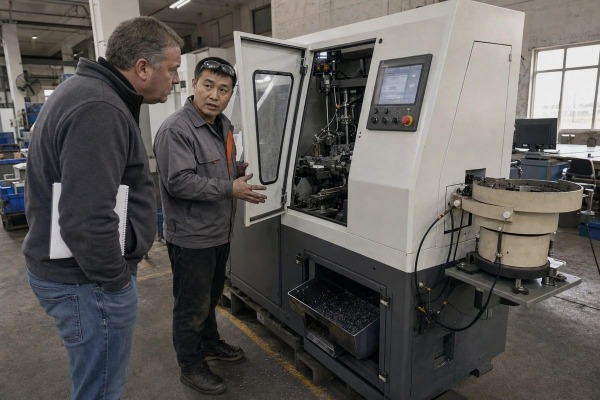
Choosing a supplier’s production equipment for automatic chamfering machines 1 is a production-risk decision, not a catalog exercise. On our Wenzhou production line, I have seen buyers burned by glossy brochures. A machine that drifts out of tolerance stalls your whole line, wastes material, and delays shipments. The fix is a structured evaluation before you pay a deposit.
To evaluate a supplier’s production equipment for automatic chamfering machines, check technical specifications against your real parts, audit component brands and quality control processes, verify worker and engineer experience, test customization and commissioning ability, and confirm delivery reliability plus after-sales technical support.
Below, I break this evaluation into four practical questions. Each one comes from real projects we have delivered to buyers in the US, Mexico, Vietnam, and beyond.
A buyer from Canada once sent me only a photo of his part and asked for a quote. Our engineers pushed back and requested drawings first, because specs without part data mean nothing.
Before ordering, verify workpiece diameter range, wall thickness capacity, material hardness compatibility, chamfer angle adjustability, tolerance and repeatability, cycle time, tooling life, CNC control system quality, and automated feeding method. Every specification must be matched against your actual part drawings, not generic samples.

The most common mistake I see is buyers comparing machines by model name and price alone. A chamfering machine is only "good" if it can process your real workpiece, at your required precision, at your required speed, shift after shift. So start with your application: material type 2, tube or bar diameter, wall thickness, chamfer angle, batch size, and target cycle time. Then check the machine against that list.
| Specification | What to Ask | Why It Matters |
|---|---|---|
| Diameter and wall thickness range | Min/max capacity with your material | Undersized machines vibrate and lose accuracy |
| Chamfer angle and length | Adjustment range and locking method | Fixed-angle tooling limits future products |
| Tolerance and repeatability | Proven accuracy across 100+ parts | One good sample proves nothing |
| Cycle time | Parts per hour on your part, not a demo part | Drives your cost per piece |
| Clamping system | Pneumatic or hydraulic, clamping force stability | Weak clamping causes angle drift |
| Control system | PLC/CNC brand, HMI usability, preset programs | Affects changeover speed and operator training |
Also look at machine tool precision fundamentals: spindle runout, linear guide grade 3, and frame rigidity. In our workshop, we test deburring and beveling quality on the customer’s own material before shipment, because metal pipe processing behaves differently across stainless steel 4, copper, and aluminum. Ask about tooling life and durability too. Tool wear directly affects chamfer geometry over long runs, so request expected tool life, replacement intervals, and tool-change time. Finally, check the automated material handling side. A vibratory bowl feeder or auto-loader determines whether the machine truly runs unattended or just runs "automatically" while an operator babysits it.
Early in our export business, I learned a hard lesson: an impressive equipment list on a website tells you almost nothing. What matters is what happens on the shop floor every day.
Verify manufacturing capability through a factory audit: inspect component brands, count and check production equipment, interview engineers and operators about experience, review in-process quality control records, calibration practices, and inspection tools, and request a witnessed trial run using your own parts and material.

From my experience running a small but complete team covering R&D, engineering design 5, and manufacturing, five things reveal a supplier's true capability. First, component brands. Ask which brands of linear guides, servo motors 6, PLCs, and pneumatic parts go into the machine. Tiered components predict lifecycle and spare-part availability. Second, worker production experience. A machine assembled by technicians with years of hands-on chamfering builds runs quieter and lasts longer. Third, engineer competence. Can their engineers read your drawings, discuss tolerances, and explain their design choices? Fourth, commissioning and debugging ability. Assembly is easy; tuning a machine to hold tolerance under load is the real skill. Fifth, the quantity and brand of their own production equipment. A supplier's machining and testing gear is a proxy for the quality they can build.
A proper production capacity audit, whether on-site or by video call, should cover:
| Evidence Type | Weak Signal | Strong Signal |
|---|---|---|
| Quality control | Final inspection only | Checks at each assembly stage with records |
| Components | Unbranded or vague answers | Named brands with sourcing rationale |
| Testing | Sales video of a demo part | Witnessed trial run on your material |
| People | Only sales staff answers questions | Engineers join technical calls directly |
A machine with impressive specs but weak inspection discipline will still produce inconsistent chamfers. Trust records and demonstrations, never claims.
One of our Mexican customers needed a non-standard chamfer angle plus an integrated feeding system for an odd-shaped terminal. That project taught me how much customization ability separates suppliers.
Look for a supplier who engineers from your product drawings and production process, offers tooling design and sample testing before shipment, provides clear commissioning support, trains your operators, and keeps engineers available for technical questions after installation, not just a sales contact.

Customization is where mid-to-high-end suppliers earn their price. In our OEM/ODM projects, the process starts with the customer's drawings. Our engineers review the part geometry, propose a machine layout, and design tooling around the actual production process. If a supplier cannot walk you through this workflow, they are likely reselling standard machines with a new label.
A capable supplier should follow a clear sequence:
Ask hard questions about the CNC control system too. Can programs be preset for multiple part recipes? Is the HMI available in your language? Can parameters be locked to prevent operator error? For digitally managed plants, ask whether the machine can output status or production data to your systems.
Technical support quality shows up in small details. When we ship a machine, we include an equipment maintenance schedule, lubrication points 7, and wear-part replacement intervals. We also stay reachable by email and WhatsApp for debugging questions, because a buyer's line cannot wait a week for an answer. A supplier who treats commissioning as your problem after payment is a supplier who will disappear when tooling wears out.
The trade-off I weigh most often with buyers is price versus lifecycle risk. A cheaper machine that arrives late and breaks down early costs far more than its discount.
Assess delivery reliability by checking stated lead times against reference customers, reviewing production planning transparency, and confirming penalty or update terms. Assess after-sales support through warranty scope, spare parts lead time, response-time commitments, remote debugging ability, and documented training and maintenance materials.

Delivery reliability is predictable if you know what to check. Ask how the supplier plans production: do they build against confirmed orders with a schedule, or do they promise dates first and figure it out later? Request weekly photo or video updates during your build. In our projects, we share assembly progress so buyers in different time zones never have to guess. Then verify with references. A supplier serving markets like the US, South Korea, and Slovakia should be able to connect you with buyers who confirm real lead times.
After-sales technical support is the other half of total cost of ownership. Purchase price is one line item; downtime, scrap, spare parts, and slow support are recurring costs.
| Factor | Low-Cost Supplier Risk | What a Reliable Supplier Offers |
|---|---|---|
| Warranty | Vague terms, parts only | Defined coverage on machine and controls |
| Spare parts | Weeks of waiting, unclear sourcing | Standard branded parts, stock or fast lead time |
| Technical response | Days for a reply | Same-day answers by email or WhatsApp |
| Remote support | None | Video debugging and parameter guidance |
| Documentation | A thin manual | Maintenance schedule, wiring diagrams, training materials |
Red flags I always tell buyers to watch for: no live demo with your part, vague answers on spare parts lead time, no access to the production floor, and no named engineer contact for support. Any one of these should slow you down. Two or more should stop you.
Brochure specs cannot protect your production line. Audit components, people, quality control, customization ability, and after-sales support. Verify with trial runs, then choose the supplier who proves capability, not just price.
1. Provides technical background on the chamfering process and its industrial applications. ↩︎
2. Explains how material properties affect cutting and machining processes in manufacturing. ↩︎
3. Authoritative source for linear guideway specifications and precision grades. ↩︎
4. Detailed overview of the properties and industrial uses of stainless steel alloys. ↩︎
5. Professional organization providing resources and standards for mechanical engineering design. ↩︎
6. Leading manufacturer of industrial servo systems used in automated machinery. ↩︎
7. Authoritative source for industrial lubrication systems and maintenance practices. ↩︎
