

Evaluating a chamfering machine supplier’s complaint handling saved one of our clients weeks of downtime ISO 9001 quality management certificates 1. I have seen European buyers sign contracts, then discover the supplier goes silent the moment a fault appears.
To evaluate a chamfering machine supplier’s complaint handling for European customers, check their documented complaint policy, guaranteed response times, multiple contact channels, verifiable European client references, after-sales documentation like SLAs and RMA procedures, and proven technical support coverage across European time zones.
That sounds like a lot to verify. It is not, once you break it into four questions. I will walk you through each one, using what we have learned shipping machines to Europe and North America.
's Response Time to Customer Complaints?A Slovakian distributor once told me he chose us over a cheaper quote for one reason: we answered his fault report in four hours. His previous supplier took nine days.
Look for a written acknowledgement within 24–48 hours, a defined investigation window, and a target resolution date. Also verify the supplier offers multiple contact channels — WhatsApp, WeChat, email, phone, and messaging — so complaints never depend on a single inbox.

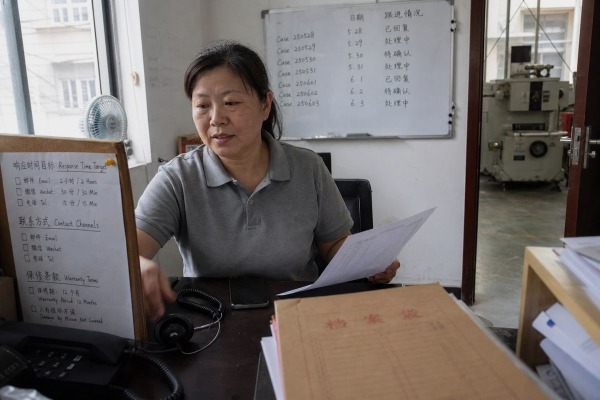
Response time is the first honest signal of a supplier's operational maturity. In my own practice, I treat every incoming complaint message as urgent, because I know a stopped chamfering machine can idle an entire production line in Europe. The timeliness and effectiveness of message replies matter more than polite words. So does the diversity of contact methods. We give every customer WhatsApp, WeChat, email, phone, and platform messaging access, because a complaint that cannot be filed easily is a complaint that festers.
You should assess complaint handling at three levels. Policy means the supplier states how to complain, what evidence is required, and what remedies exist. Process means you can actually file and track the complaint. Performance means they reply fast and close cases on time. A supplier can have a beautiful policy page and terrible performance. Test all three before you buy. Send a technical question at your local business hours and time the reply.
| Stage | Acceptable Standard | Red Flag |
|---|---|---|
| First acknowledgement | Within 24–48 hours | No reply for 3+ business days |
| Technical diagnosis | 2–5 business days | "We will look into it" with no date |
| Remedy proposal | Within 7 business days | Vague promises, no written offer |
| Complaint reporting window | 21–30 days after discovery | Rigid 14-day cutoff with no flexibility |
Some suppliers impose 14-day complaint windows; others allow 21 or 30 days. Short windows help suppliers preserve evidence, and that argument has merit for industrial damage claims. But you should push back. Latent defects in a chamfering machine integrated into a production line may not surface immediately. Negotiate reporting windows that reflect real fault discovery, and remember that supplier-imposed deadlines cannot override mandatory legal rights where those rights apply. A contractually-bound Service Level Agreement 2 turns these numbers from marketing into obligation.
's Track Record with European Clients?When our team shipped its first machine to Slovakia, the buyer asked for reference contacts before wiring the deposit. I respected that. Smart procurement managers verify; they do not assume.
Verify a supplier's European track record by requesting client references in EU/EEA countries, checking export history and CE marking compliance, reviewing case studies with named machine models, and confirming how past warranty claims and cross-border disputes were actually resolved in writing.

Track record is where marketing claims meet reality. A supplier can say "we serve Europe" while having shipped one machine to one country five years ago. You need evidence, not slogans. From our side of the table, we keep records of every export shipment — including machines sent to Slovakia and Serbia — precisely because serious buyers ask for them.
Start with references. Ask for two or three European clients you can contact directly. A confident supplier provides them. Then ask about complaint history specifically. The question "Tell me about a complaint from a European client and how you resolved it" is more revealing than any brochure. A supplier who has genuinely handled cross-border complaints will describe evidence collection, remote diagnosis, spare parts shipment, and documented closure. A supplier who has not will give you generalities.
's warranty claim resolution time from past cases, not promised averages.One objection I hear: "References can be cherry-picked." True. That is why you cross-check references against documentation and platform reviews. Also ask whether the supplier maintains a structured, auditable internal complaint register from intake to closure. If they cannot show how complaints are logged, they cannot prove how complaints are resolved. Customer satisfaction metrics gathered after closure — even a simple follow-up survey — signal a supplier that treats complaints as quality data, not annoyances.
's After-Sales Support Quality?Paperwork bores most buyers until a machine stops. Then the buyer with a signed SLA and a clear RMA procedure recovers in days, while the buyer with a handshake waits in silence.
Request the written complaint policy, the Service Level Agreement with response and resolution deadlines, the RMA procedure, the warranty terms with defined remedies, spare parts availability lists, ISO 9001 quality management certificates, and technical documentation in your working language.

Documentation is where you separate real complaint handling from cosmetic complaint handling. Some suppliers publish detailed rules: contact support first, submit a complaint form, attach purchase documents, report within a set period, receive a decision by a stated date. Others just say "contact us." Specificity is a positive signal. It reduces ambiguity when downtime is costly, and ambiguity always favors the seller. At our Wenzhou facility, we prepare tooling records, sample test reports, and machine acceptance documents for every custom project, because these papers become the evidence base if anything goes wrong later.
| Document | What It Proves | What to Check |
|---|---|---|
| Complaint policy | A defined intake process exists | Evidence requirements, deadlines, named channel |
| Service Level Agreement | Response times are contractual | Acknowledgement and resolution deadlines with penalties |
| RMA procedure | Returns are structured | Who pays freight, RMA process efficiency, turnaround time |
| Warranty terms | Remedies are defined | Repair, replacement, refund, or price reduction — tiered by severity |
| Spare parts list | Long-term supportability | Lead times to Europe, consumables stock, pricing |
| ISO 9001 / ISO 10002 certificates | Complaints feed a quality system | Certificate validity and scope |
| Technical documentation | You can operate and maintain | Manuals meeting technical documentation standards, wiring diagrams, HMI guides |
For European customers, insist that manuals and key support communications are available in a language your operators actually read. EU guidance sets a useful baseline: faulty goods must be repaired or replaced at no cost, and if that fails or drags on unreasonably, a full or partial refund is due. Many chamfering machine purchases are B2B, so contract terms govern more than consumer law. But here is the useful inference: a supplier with consumer-grade complaint discipline — prompt acknowledgement, transparent explanation, root-cause analysis 4 using methods like 8D problem-solving, and follow-up — almost always delivers better B2B after-sales technical support too. Ask whether complaints trigger 8D reports. A supplier who fixes root causes will not send you the same defect twice.
The hardest support call I ever handled came in at 2 a.m. China time from a client whose feeder system jammed mid-shift. We solved it by video call within the hour — because we had built our support around his clock, not ours.
Test the supplier before purchase: send technical questions during your business hours and measure reply speed. Reliable suppliers offer overlapping support windows, remote diagnostics via video call, multiple channels like WhatsApp and email, named support engineers, and defined escalation paths for urgent faults.

Time zones are the silent killer of cross-border support. China is six to seven hours ahead of Central Europe. If your supplier only answers during their office hours, your morning fault report sits unread until your afternoon — and their reply arrives after you have gone home. That cycle turns a two-hour fix into a three-day outage. Our team schedules support coverage so European morning hours overlap with our afternoon, and we keep WhatsApp and WeChat monitored beyond office hours for machine-down emergencies. Message reply timeliness is not a courtesy; it is an operational necessity.
| Support Layer | Typical Response | Best For |
|---|---|---|
| Instant messaging (WhatsApp/WeChat) | Minutes to hours | Urgent faults, quick parameter questions |
| Video-call diagnosis | Same or next day | Mechanical jams, HMI errors, commissioning |
| Spare parts dispatch | 3–10 days to Europe | Worn tooling, sensors, drive components |
| On-site or local service visit | 1–4 weeks | Major failures, installation, retrofits |
Some buyers object that a 10-person supplier cannot possibly cover European time zones. Fair concern. But small teams with disciplined channel coverage often outperform large firms with ticket queues, because your message reaches an engineer directly instead of a call center. Emerging tools strengthen this further: IoT-based monitoring can flag performance drift before a failure becomes a complaint, and digital records tied to each machine speed up fault reporting. Also expect cultural awareness — clear, direct, written communication suits most European buyers, and a good supplier adapts to that style. If a dispute ever escalates, structured industrial machinery dispute resolution paths, from mediation to the European Consumer Centres Network 5 for eligible cross-border cases, work best when every exchange is already documented in writing.
Complaint handling reveals a chamfering machine supplier's true maturity. Check response times, verify European references, demand written documentation, and stress-test time-zone support before you sign anything.
1. Official ISO page for the 9001 standard, which ensures organizations meet customer and regulatory requirements. ↩︎
2. Wikipedia provides a comprehensive overview of Service Level Agreements and their role in defining service standards. ↩︎
3. Official European Commission page explaining the requirements and importance of CE marking for products in the EEA. ↩︎
4. Wikipedia entry explaining root-cause analysis, a critical process for resolving the underlying issues of customer complaints. ↩︎
5. Official site of the ECC-Net, providing support and advice for cross-border consumer disputes within the EU. ↩︎
