

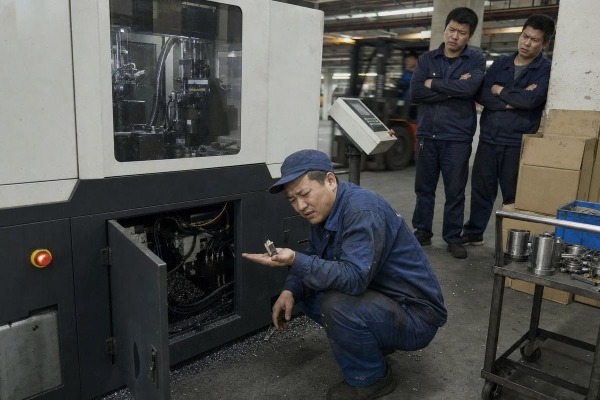
Your chamfering machine stops mid-shift. A worn insert, a broken sensor — and suddenly the whole line waits. On our production floor in Wenzhou, we know exactly how costly that silence is.
Not every chamfering machine supplier offers an online spare parts store. Many handle parts through after-sales service, inquiry forms, or direct sales contact instead. Some mature industrial suppliers do run searchable B2B e-commerce portals, so buyers should confirm the parts channel before purchasing the machine.
So the real question is not just “does a store exist” but “how do I actually get parts fast.” Let me walk you through what to look for, step by step.
A buyer from Mexico once emailed me a blurry photo of a cracked clamp block and asked, "Can I just buy this on your website?" That question comes up more than you would think in our export business.
To find genuine spare parts online, first ask the supplier's sales contact for the official company website and all their online platform channels. Check for a searchable parts catalog, verified marketplace listings, or an e-shop. If no store exists, order OEM replacement parts directly through the sales contact.

Here is the honest picture from inside the industry. Research on machinery suppliers shows a split market: some companies, like dedicated parts platforms, let you search by machine product code or spare part number and check out online. Others — including many chamfering machine makers — sell the machine on their site but route every parts request through a contact form or after-sales channel. Neither approach is wrong. But you need to know which one your supplier uses before your machine goes down.
My personal rule, and the advice I give every buyer: ask the salesperson for the company's official website URL, then ask them to list every online channel the company operates. For us at YQUNIQUE, that means our website, our Made-in-China storefront, Facebook, and YouTube. Once you know all the channels, you can verify the supplier is real, cross-check part listings, and — most importantly — buy directly through the sales contact when no self-service store exists. Direct purchase through a known sales contact is often faster and safer than hunting third-party sellers.
| Channel | What you can usually do | Genuine part risk |
|---|---|---|
| Official supplier website | Browse machines, submit parts inquiry | Low — direct from source |
| Supplier's marketplace store (e.g., Made-in-China) | Verify supplier, request quotes, sometimes order | Low if store is verified |
| Dedicated parts e-shop / B2B e-commerce portal 1 | Search by part number, order online | Low — original parts stated |
| Third-party resellers | Buy generic look-alikes | High — fit and quality unverified |
For consumable items like cutting inserts and blades, always confirm the exact part number against your machine's serial plate. A "compatible" insert from an unknown reseller can chip early and damage the spindle. Genuine OEM replacement parts cost a bit more, but they match the original tolerances your machine was built around.
Every export order we ship from Zhejiang teaches us the same lesson: the paperwork and verification done before the order matter more than anything done after it.
Before ordering overseas, verify the supplier's identity across all their official channels, confirm the exact part number against your machine serial number, check warranty and original-parts language, clarify payment and shipping terms, and request technical documentation and manuals to validate compatibility.

Overseas parts orders fail for boring reasons. Wrong part number. Mismatched machine revision. A payment sent to an unverified account. All of these are preventable if you follow a simple process. In our ten-person team, the after-sales engineer and the sales contact review every parts order together before it ships — precisely because a chamfering machine built to a customer's drawings may carry configuration-specific tooling that a generic catalog cannot capture.
This is also where a common buyer objection deserves a straight answer. Some buyers argue every supplier should offer open online checkout for parts. I understand the appeal: speed, transparency, no waiting for a quote. But for customized machines, human verification prevents expensive mistakes. A part that fits model S10-15 may not fit the same model built six months later with a modified feeder. Assisted parts sales exist to protect you, not to slow you down. The best suppliers combine both: a browsable catalog plus a real engineer who confirms fit.
| Document | Why it matters |
|---|---|
| Exploded parts diagram (BOM) | Lets you identify the exact part by position number |
| Technical documentation and manuals | Confirms specifications, torque values, wiring |
| Warranty terms in writing | Defines which replacement parts are free and when |
| Commercial invoice with part numbers | Smooths customs clearance and future reorders |
The trade-off we weigh on every project is this: stock more parts locally with the customer, or promise faster shipping from our side. There is no single right answer — but there is a right plan.
Standard wear parts typically ship within one to three business days from suppliers with real-time inventory, with international express delivery taking three to seven days. Custom-machined components may need one to four weeks. Keeping a critical spares kit on-site remains the fastest solution.

Speed depends on three things: whether the part is in stock, how it ships, and how quickly it is identified. Leading industrial suppliers now offer same-day shipping for wear parts specifically because high-volume production lines cannot absorb long downtime. Online stores with real-time inventory tracking 2 help here — you can see availability before you commit. But even without a storefront, a responsive supplier can move fast. When a customer in the United States sends us a photo on WhatsApp in their morning, our engineers can confirm the part the same day China time, and a stocked item leaves our Wenzhou facility on the next courier pickup.
The bigger lever, though, is preparation. This is why we recommend preventative maintenance kits at the time of machine purchase. A kit with cutting inserts and blades, seals, sensors, and common pneumatic fittings costs a fraction of one day of lost production. Industrial machinery maintenance planning should treat spare parts as insurance, not as an afterthought.
| Part category | Stock status | Typical delivery to overseas buyer |
|---|---|---|
| Cutting inserts, blades, wear plates | Usually stocked | 3–7 days by express courier |
| Sensors, relays, standard electrical parts | Usually stocked | 3–7 days by express courier |
| Pneumatic and hydraulic components | Often stocked | 5–10 days |
| Custom-machined tooling and fixtures | Made to order | 1–4 weeks plus shipping |
| Full spindle or drive assemblies | Made or configured to order | 2–6 weeks plus shipping |
One more forward-looking point worth knowing: the industry is moving toward as-a-service models where consumables ship automatically based on real-time machine usage data, and some platforms are even exploring digital part licenses that let you 3D-print non-critical components on-site. These are not yet standard for chamfering machines, but they show where downtime recovery is heading. Until then, the on-site spares kit plus a fast sales contact remains the winning combination.
A lesson I learned early in exporting: customers rarely know the part name. They know the symptom. "It squeaks near the feeder" or "the arm hesitates on the return stroke." Good technical support translates symptoms into part numbers.
Reputable suppliers provide after-sales technical support to identify spare parts through photos, videos, serial numbers, and exploded diagrams. Engineers confirm the exact component, check compatibility with your machine configuration, and guide installation — a service that matters more than any online catalog.

This is where the gap between "parts available" and "parts available online" really closes. Even the best B2B e-commerce portal cannot tell you which of three similar bushings sits at position 14 of your specific machine. A human engineer can. In our workflow, the customer sends a photo or short video via email or WhatsApp, we pull the machine's build file — every machine we ship has one, tied to its serial number — and our after-sales technical support team marks the exact part on the exploded diagram. The customer confirms visually. Only then do we quote and ship. This process typically takes hours, not days, and it eliminates the single most expensive mistake in parts procurement: ordering the wrong part twice across an ocean.
Good support also extends past identification. For CNC deburring tools and chamfering inserts 3, correct installation angle and torque affect edge quality directly. So we back parts shipments with installation guidance: annotated photos, short videos, and remote video calls during commissioning if needed. Technical documentation and manuals ship with the original machine, but a live engineer fills the gaps that paper cannot.
Looking ahead, augmented reality visual search 4 is expected to let technicians scan a physical component with a phone and pull up its store listing instantly. Some online stores are also beginning to integrate carbon footprint tracking per part for ESG reporting. Both trends will help — but neither replaces an engineer who knows your exact machine. When you evaluate a chamfering machine supplier, weigh the quality of their support people as heavily as the polish of their website.
Downtime punishes the unprepared. Confirm your supplier's parts channels early: ask sales for the website and every online platform, verify part numbers, stock wear parts, and lean on real technical support.
1. Alibaba.com exemplifies a verified B2B e-commerce portal used to check supplier authenticity and parts listings. ↩︎
2. UNCTAD provides analysis on global e-commerce and digital trade logistics. ↩︎
3. ISO is the global authority for industrial standards and technical specifications. ↩︎
4. Wikipedia explains the technology behind visual search and its industrial applications. ↩︎
