

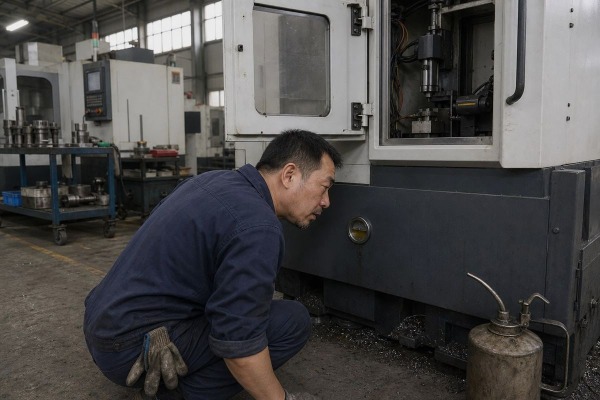
Daily maintenance for a chamfering machine’s lubrication system worries many buyers I talk to. They fear hidden labor costs. On our assembly floor in Wenzhou, we hear this question weekly, and neglect here is what really destroys spindles.
Daily maintenance for a chamfering machine’s lubrication system is easy and takes only five to ten minutes. Operators check oil levels through sight glasses, inspect for leaks, verify pump or air-line lubricator operation, and clean chips from lubrication points. Full greasing happens monthly, not daily.
So the short answer is yes, it is easy. But easy tasks are also easy to skip. Let me break down what the routine actually looks like, how often you refill, what you can fix yourself, and what tools you need.
During factory acceptance tests at our plant, I always tell customers the same thing: verify the lubrication system is qualified before the machine ships. That habit starts on day one.
Daily checks include verifying reservoir oil levels through the sight glass, walking around the machine to spot leaks at hose connections and manifolds, confirming the pump cycle or air-line lubricator drip rate, and wiping metal chips away from grease fittings and linear rails.

Daily maintenance is mostly inspection, not hands-on lubrication. That distinction matters. Many buyers imagine an operator greasing a dozen points every morning. In reality, on a well-designed machine, the daily routine is a short preventive maintenance checklist that you can finish before the first cycle runs.
Here is the sequence we train operators to follow before start-up:
| Task | Frequency | Time Needed |
|---|---|---|
| Oil level monitoring via sight glass | Daily | Under 1 minute |
| Leak walk-around at hoses and manifolds | Daily | 1–2 minutes |
| Pump cycle or drip-rate verification | Daily | 1–2 minutes |
| Chip and dust cleaning around lube points | Daily | 2–3 minutes |
| Greasing Zerk fittings on rails and spindle | Monthly | 10–15 minutes |
| Spindle housing oil drain and refill | Yearly | 30–60 minutes |
One more check people overlook: lubricant condition 1, not just quantity. If the oil in the reservoir looks discolored or carries visible particles, flag it. Topping off contaminated oil just circulates the problem. We cover this specifically during the systematic maintenance training we give buyers at machine acceptance, because condition checks are the ones operators forget first.
A procurement manager in the US once asked me for an exact refill schedule before signing. I told him honestly: the interval depends on duty cycle, and I gave him a range, not one number.
Refill reservoir oil whenever the sight glass shows a low level, often weekly under normal use. Grease Zerk fittings monthly for standard duty. Light-duty machines may need greasing every two to three weeks, while heavy-duty industrial machines may need it every two to three days.

Refill frequency is where "it depends" becomes a real engineering answer. The single biggest variable is duty cycle. A machine chamfering brass terminals eight hours a day consumes lubricant far faster than one running two short shifts a week. That is why we ask buyers about their production volume before we recommend an interval schedule.
| Duty Cycle | Greasing Interval | Reservoir Top-Off | Full Oil Change |
|---|---|---|---|
| Light duty (occasional runs) | Every 2–3 weeks | Check daily, refill as needed | Yearly |
| Standard duty (single shift) | Monthly | Weekly on average | Yearly |
| Heavy duty (multi-shift industrial) | Every 2–3 days | Every 1–2 days | Every 6–12 months |
Frequency means nothing if the lubricant is wrong. Manufacturers specify lubricant viscosity grades 2 for a reason. A grade like ISO VG 68 maintains the correct film strength 3 during high-speed spindle operation. Substituting a random shop oil changes film behavior and accelerates wear.
There is also a warning we repeat during every machine handover: do not use greases containing solid lubricants such as graphite or MoS2 on linear bearings. Those additives can interfere with recirculating ball elements. Spindle bearing lubrication and linear rail lubrication may even call for different products on the same machine, so keep the lubrication chart from your manual posted next to the machine.
Finally, replace rather than top off when oil condition fails. Discolored, contaminated, or particle-laden oil should be drained or filtered. Good metalworking fluid management treats lubricant as a machine component, not a consumable afterthought. Newer designs help here too. Modular sealed lubrication cartridges are replacing open reservoirs on some systems, cutting contamination risk and turning a refill into a thirty-second cartridge swap.
Years ago, a customer in Vietnam emailed us in a panic about a "broken pump." Ten photos later, we found a kinked hose behind a panel. The fix took two minutes, and it taught me most lube faults are operator-solvable.
Yes, operators can troubleshoot most common lubrication issues themselves, including low oil levels, blocked or kinked lines, minor leaks at fittings, incorrect drip-rate settings, and contaminated lubricant. Only pump replacement, internal spindle work, or electrical faults typically require a technician or manufacturer support.

Most lubrication faults announce themselves early if the daily check is done consistently. That is the whole payoff of the routine: machine downtime reduction comes from catching a small symptom before it becomes a seized bearing. Here is how I coach operators to think through the common failures.
| Symptom | Likely Cause | Can You Fix It? |
|---|---|---|
| Oil level drops fast | Leak at hose or manifold | Yes — tighten or replace the fitting |
| One rail runs dry, reservoir full | Blocked or kinked distribution line | Yes — trace, clear, or replace the line |
| Oil looks gray or gritty | Chip or dust contamination | Yes — drain, clean reservoir, refill |
| No drip at air-line lubricator | Drip rate set too low or empty bowl | Yes — refill and adjust the needle valve |
| Pump runs but no pressure builds | Worn pump or internal leak | Partly — diagnose yes, replace with support |
| Alarm on centralized lubrication system 4 | Pressure switch or sensor fault | Partly — check wiring, then call support |
The pattern is clear. Anything visible and mechanical — lines, fittings, reservoirs, automatic oiler settings — sits within operator skill. Anything inside the pump, inside the spindle housing, or inside the control cabinet is where we tell customers to stop and contact us. Our after-sales team handles these cases by video call first, because a live camera view resolves most of them without a site visit.
One diagnostic trick worth knowing: some modern lubricants carry UV-reactive additives. A specialized UV flashlight makes microscopic leaks and misting patterns glow, so you can spot seepage that is invisible in normal light. It is a cheap tool that turns leak hunting from guesswork into a one-minute scan.
Every machine we ship from Wenzhou leaves with a lubrication chart, and every acceptance test includes systematic maintenance training. I insist on this because equipment maintenance must become a daily project, not an occasional rescue mission.
You need only basic tools: a standard grease gun for Zerk fittings, the manufacturer-specified oil, clean lint-free rags, a funnel, and optionally a UV flashlight. Training requires one short session covering the lubrication chart, intervals, correct lubricant types, and the daily inspection routine.

The tooling barrier here is genuinely low. Manual lubrication of a chamfering machine involves periodic greasing of Zerk fittings on linear rails and spindle bearings, and that requires nothing more than a standard grease gun and a few minutes. This is not specialist industrial machinery maintenance in the way electrical or CNC control work is.
Tools are the easy half. The harder half is discipline, and that is where training design matters. From what we have seen across export markets from India to the United States, the operators who maintain machines well are the ones trained systematically at machine acceptance, not the ones handed a manual later. Our handover training covers four things: reading the lubrication chart, matching each point to its interval, identifying the correct lubricant for spindle bearing lubrication versus linear rails, and running the daily preventive maintenance checklist as a fixed shift-start habit.
Machine design can shrink the training load further. A centralized lubrication system feeds many points from one pump, so daily work shifts from greasing to verification. Self-lubricating solid-film coatings on internal sliding surfaces now create maintenance-free zones that reduce the total number of grease points. Some higher-end systems even add IoT-enabled sensors that monitor real-time lubricant viscosity and adjust delivery volumes as workshop temperature shifts. The trend is clear: less manual labor, more informed monitoring — but the trained daily glance never goes away.
Daily maintenance for a chamfering machine's lubrication system is quick and simple, but neglect is expensive. Verify the system at acceptance, train operators systematically, and make the five-minute check a daily habit.
1. NIST develops standards and measurement tools for condition monitoring and industrial fluid properties in manufacturing systems. ↩︎
2. ISO is the international body defining viscosity grades like VG 68 for industrial lubricants. ↩︎
3. Explains the fundamental principles of reducing friction and wear between surfaces in mechanical systems. ↩︎
4. Details the components and operation of automated systems used to deliver precise amounts of lubricant. ↩︎
