

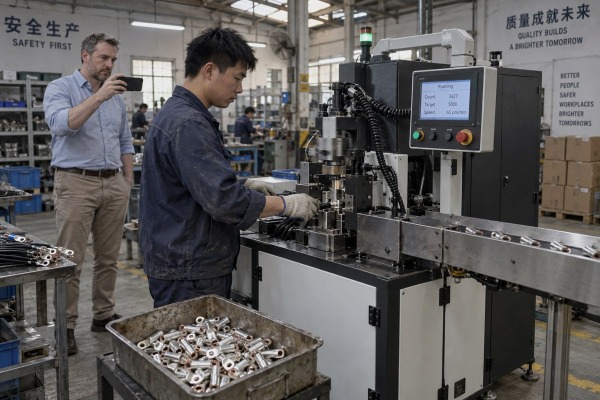
Follow-up orders based on cable lug machine trial performance should never rest on one good hour. Our Wenzhou workshop has learned that lesson shipping lug machines to ten countries.
Decide on follow-up orders by treating the cable lug machine trial as a production qualification. Confirm repeatable crimp quality, pull-off and electrical test results, realistic cycle time, operator consistency, and documented supplier support. Order fully, order conditionally, or decline based on a written scorecard.
Here is the problem. A machine can produce twenty perfect lugs in a sales demo and then drift on the night shift. If you place a [bulk order](https://yqunique.com/?p=6529) on that demo, you own the drift. The fix is simple. You run the trial like a qualification, you measure four things — machine stability, supplier professionalism, R&D reliability, and after-sales service — and you let the data decide. The sections below show how I do that with our own customers.
During one trial run at our factory, a customer from Mexico filmed every tenth lug. Then he measured barrel thickness. That habit told us more than the demo did.
Track first-pass yield, dimensional consistency across at least ten consecutive samples, pull-off force spread, contact resistance, actual production cycle time, changeover time, unplanned stops, and energy per crimp. Segment every metric by cable size, lug type, and operator so a strong average cannot hide a weak combination.

The metrics fall into two groups. The first group tells you whether the lugs are good. The second group tells you whether the machine will still make good lugs on day ninety. Both groups matter for a follow-up order. I will take them in turn.
Start with first-pass yield. The formula is plain: conforming samples 1 ÷ total samples × 100. Count a sample as conforming only if it passes visual, dimensional, mechanical, and electrical checks on the first attempt. Then break the number down by cable size 2, lug type, operator, shift, and material batch. A 98% average can hide a 70% result on your largest aluminum lug. That single combination is the one that will fail in the field.
Next comes dimensional consistency. Measure barrel thickness, barrel length 3, and hole position on at least ten consecutive samples. The spread matters more than the mean. If you have enough data from a short, uninterrupted run, calculate a Machine Capability Index 4 (Cmk). It quantifies machine repeatability of the forming or crimping stroke without operator or material noise mixed in.
Pull-off force testing follows. Record the maximum force, the failure mode, and the variation between samples. A wire break outside the crimp zone is a good sign. A clean pull-out points to weak compression, wrong tooling, or shallow conductor insertion. Crimping force consistency, read from the machine's own pressure or force log, should track closely with the pull results. If the force log is flat but pull values swing, the problem is upstream of the press.
Finally, measure contact resistance 5 or voltage drop. Low and stable resistance proves metal-to-metal contact. Rising resistance after heat cycling 6 is the early warning of a connection that will fail under load.
| Metric | How to measure during the trial | Why it decides the follow-up order |
|---|---|---|
| Production cycle time | Stopwatch the full loop: load, position, form or crimp, unload, inspect | Supplier-quoted speed ignores handling and minor stops |
| Changeover time | Time every switch between cable size, die set, and recipe | Mixed production lives or dies on changeover |
| Unplanned stops | Log every alarm, misfeed, jam, and restart | Short trials hide reliability problems unless you log them |
| Availability | Operating time ÷ planned production time × 100 | Converts stop counts into a number you can compare |
| Scrap rate analysis | Weigh or count rejects per thousand during a sustained high-speed run | Scrap is the hidden cost that erodes payback |
| Energy per crimp | Meter the machine over a known count of cycles | Feeds total cost of ownership for high-volume orders |
| Operator sensitivity | Have two or three operators of different skill run the same recipe | Large gaps signal a need for more automation or better guards |
| Vibration and acoustic signature | Record baseline sound and vibration at the die head | Changes hint at micro-stress that shortens tooling wear life |
| Digital readiness | Confirm cycle data can export to ERP or MES through an API or file | A machine you cannot audit is a machine you cannot trust at scale |
One more point. Check that the machine stops itself for burrs, misfeeds, and drifting tolerance. When we build in-process inspection into our own lug lines, we ask the buyer to trigger a deliberate misfeed during the trial. If the machine runs through it, the inspection is decoration, not control.
Our engineers weigh one trade-off before every acceptance test: test every cable-lug combination and lose weeks, or test a smart sample and accept some risk.
The cable lug machine meets your production standards when samples from your own copper or aluminum stock pass the standard you named before the trial, such as IEC 61238-1, DIN 46235, or UL 486A-486B, across your smallest, largest, and hardest combinations, with repeatable results from different operators.

The word "standards" means two things here. It means the published terminal crimping standards your market demands. It also means your own production targets for output and cost. A machine has to clear both. Let me deal with the published standards first, because the buyer, not the supplier, must choose them before the trial starts.
| Standard | Region or use | What it covers in a lug machine trial |
|---|---|---|
| IEC 61238-1 | International, power cable connections | Mechanical testing and electrical durability; durability work can involve around 1,000 heating cycles with contact-resistance monitoring |
| DIN 46235 | Europe, compression cable lugs | Dimensions and performance of tubular compression lugs |
| UL 486A-486B | North America | Connector safety plus mechanical and electrical performance |
| DIN 48083-4 | Europe, tooling | Coded dies recommended for DIN compression lugs so die and lug match |
| EN 16602-70-26 | High-reliability crimping | Ten samples per tool setting, tensile plotting to find the operating point, then metallographic examination |
Some IEC-type evaluations heat the conductor to roughly 250°C in a short-circuit condition. That level of testing is heavy for a routine industrial qualification. I mention it for one reason. It shows why a lug that looks fine after one crimp may not survive years of load cycling. If your lugs go into rail, energy, or transport wire harness assembly, borrow the discipline even if you scale the test down.
Buyers often tell me they cannot afford to validate every combination. They are right, and they do not have to. A risk-based sample works. Include the smallest size, the largest size, the most frequent size, and the combination with the worst failure consequence. Add boundary conditions such as your thinnest wall tubing. That set catches most problems at a fraction of the time.
| Category | Suggested weight | Must-pass gate? |
|---|---|---|
| Crimp quality and compliance | 30% | Yes |
| Mechanical and electrical test results | 20% | Yes |
| Repeatability and process stability | 15% | Yes |
| Throughput and changeover | 15% | No |
| Reliability and uptime | 10% | No |
| Operator usability and safety | 5% | Safety yes |
| Service, documentation, supplier responsiveness | 5% | No |
Shift the weights for your product. A high-voltage lug pushes quality toward half the score. A commodity ring terminal pushes throughput and cost upward. Whatever the weights, never let a strong speed score offset a failed electrical gate. Capability under ideal conditions is not the test. Repeatability across operators, shifts, and batches is the test.
A procurement manager in Canada once asked me a blunt question over WhatsApp: why did another supplier's trial data skip the largest lug size entirely?
Avoid a follow-up order when the supplier changes acceptance criteria mid-trial, hides failed samples, demonstrates only easy sizes, relies on one star operator, cannot explain failure modes, shows rising contact resistance under heat, loses settings after restart, or gives vague answers about spare parts, tooling, and service response.

I group warning signs under the four pillars I evaluate in any supplier: machine stability, supplier professionalism, R&D reliability, and after-sales service. The grouping helps because a red flag in one pillar often predicts trouble in another. A supplier who cannot explain a failure mode usually cannot fix it after installation either.
Watch for frequent manual adjustment during a sustained run. Watch for settings that do not survive a power cycle. Watch for crimping force consistency that drifts after the machine warms up. Listen to the die head. A change in the vibration or acoustic signature over a two-hour run points to micro-stress in the die set, and that shortens tooling wear life long before a visual defect appears. Pull-force results with wide scatter are the clearest single sign that machine repeatability is not there.
The acceptance criteria should be fixed in writing before the first sample. If the supplier moves the goalposts after testing begins, stop. The same applies to data presented selectively or failed samples that disappear without a root cause. A refusal to allow independent laboratory testing is a hard stop for me, no matter how good the demo looked.
Ask the supplier to explain each failure mode you observed. Ask how the recipe system prevents an operator from choosing the wrong recipe. Ask what happens when your drawing changes next year. We build customized lug and terminal equipment from customer drawings in Wenzhou, so I know what a confident engineering answer sounds like. Hesitation here means the machine was assembled, not engineered.
| Question to ask | Acceptable answer | Warning sign |
|---|---|---|
| Spare-parts lead time? | Specific days by part class, with a consumables list | "It depends" |
| Who fixes what? | Clear split between plant technicians and supplier service | Everything requires a supplier visit |
| Can I export recipes and logs? | Yes, in an open format, and the buyer owns them | Locked formats or no export |
| Training commitment? | Defined hours, on-site and remote | "The machine is easy" |
| Response time for a line-down fault? | Written hours, by channel | No written commitment |
Buyers hope an automated lug machine ends their dependence on skilled staff. It does not end it. It moves the skill from the press to setup, troubleshooting, and inspection. The question for your follow-up order is total labor content, not whether the machine is automated. Run the operator sensitivity test. If results depend on one unusually skilled operator, the machine is not ready for your shifts. A dedicated machine with fewer settings may serve a stable product better than a flexible one with more ways to go wrong. Equipment scalability means nothing if every added recipe adds risk.
Lesson learned the hard way: splitting factory acceptance from site acceptance saved one of our Vietnam installations, because plant air pressure differed from our Wenzhou test bench.
Negotiate bulk terms by writing trial results into the purchase order: approved cable-lug combinations, guaranteed first-pass yield and throughput, separate factory and site acceptance tests, payment retention until final acceptance, defined service response times, spare-parts lead times, tooling pricing, training hours, and software or recipe ownership.

A successful trial gives you leverage. Most buyers spend that leverage on unit price. I would spend it on risk transfer instead. Price is one number paid once. Yield guarantees, service response, and tooling supply pay back every month for the life of the line. Here is how I structure that conversation with our own customers.
| Trial outcome | Decision path | What to negotiate |
|---|---|---|
| All critical gates pass, results repeatable, support documented, business case holds | Proceed with full follow-up order | Volume pricing, delivery slots, extended warranty, priority service |
| Technical performance acceptable but extended reliability data limited, or a few noncritical issues open | Conditional or staged order | Corrective-action list, acceptance milestones, performance guarantees, partial release |
| Any critical safety, electrical, or mechanical failure; unexplained inconsistency; no traceable evidence | Delay or reject | Nothing yet; request re-trial with fixed criteria |
Production managers push to order fast. Demand is urgent, and early commitment locks in pricing and capacity. Quality leads push to extend the trial, because tool wear, thermal drift, and operator differences only appear over time. Both are right. The staged order settles it. Release the first machine against factory acceptance. Release the balance against site acceptance after a defined production period. You secure the slot and keep the exit.
Use a payback estimate: total investment ÷ annual net savings. Total investment includes the machine, dies and tooling, installation, training, shipping, commissioning, and calibration. Annual net savings include added output and reduced labor and scrap, minus maintenance, energy, consumables, financing, and downtime. A cheaper machine with higher scrap and longer changeover loses this calculation. An expensive machine loses it too if your volume cannot use its capacity. Our pricing sits above standardized low-cost equipment, so I expect buyers to run this math on us. I would rather win on the payback line than on the invoice line.
If the follow-up order is the first of several, negotiate equipment scalability now. Ask whether later machines will share tooling, recipes, and spare parts with the first one. Ask whether the controls can feed your MES from day one. A supplier with real R&D depth will answer with a roadmap. A trading company will answer with a price list.
A demo proves capability. A trial proves repeatability. Order from the supplier whose machine, team, R&D, and service hold up under your data, then write that data into the contract.
Interested in sourcing the products mentioned in this article? See details and request a quote here:
1. Leading organization for quality professionals providing standards for production yield calculations. ↩︎
2. Global organization preparing international standards for all electrical and electronic technologies. ↩︎
3. Authoritative body for technical specifications of tubular compression lugs and dimensions. ↩︎
4. Technical overview of the statistical index used to measure machine process capability. ↩︎
5. Global safety science leader providing testing standards for electrical connectors and lugs. ↩︎
6. Technical association providing research on electrical contact performance and thermal stress testing. ↩︎
