

Choosing the right trade terms for assembly machines from China once cost a buyer of our Wenzhou factory dearly: he signed EXW, then watched forwarder charges erase his saving.
The right trade terms for assembly machines from China depend on your freight experience, customs clearance capability, and need for logistics control. Experienced importers favor FCA or FOB, first-time buyers favor DAP, and DDP works only when the seller can legally import. Specify Incoterms 2020 and a named place.
Trade terms decide far more than freight price. They decide who books transport, who clears customs, who insures the crate, and when the risk becomes yours. Below I break down the four questions buyers ask me most.
Two versions of our quotation often go out for the same bowl-feeder assembly cell: EXW Wenzhou and FOB Ningbo. The gap looks like buyer profit. It rarely is.
FOB is better for most assembly machine orders because the seller handles export customs clearance, inland trucking, and loading at a named Chinese port, while you control the ocean carrier. EXW only wins when you have a China-based agent or forwarder who can manage export formalities and heavy-lift pickup.

| Obligation | EXW | FCA | FOB |
|---|---|---|---|
| Loading at the factory | Buyer | Seller (if delivery is at seller's premises) | Seller |
| Inland trucking to port | Buyer | Buyer, or seller to the named place | Seller |
| Export customs clearance | Buyer | Seller | Seller |
| Loading on the vessel | Buyer | Buyer | Seller |
| Risk transfer point | At the factory, before loading | When handed to the buyer's carrier | When the goods are on board |
| Transport mode | Any | Any, including air and rail | Sea or inland waterway only |
| Who picks the ocean carrier | Buyer | Buyer | Buyer |
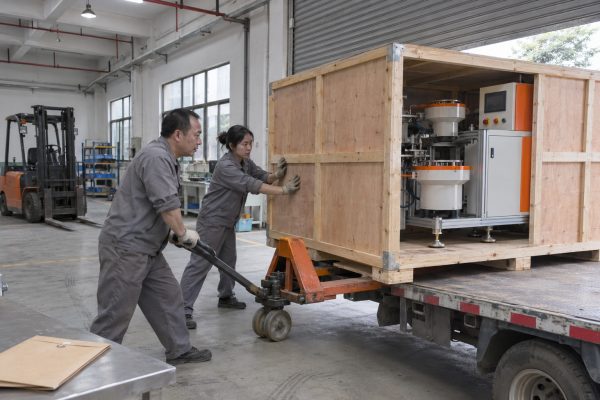
Under Incoterms 2020, EXW ends at our loading bay. Our assembly cells stand on leveling feet or casters, carry bowl feeders and a control cabinet, and need a forklift and a reinforced crate. Under a strict EXW reading, that forklift is your problem. So is the export declaration, the inland truck to Ningbo or Shanghai, and the terminal handling. Many first-time buyers assume the factory does these anyway. Some factories do, informally. Then the invoice arrives, and "factory price" turns out not to mean "ready-to-ship price."
My own rule, and the one I give every buyer, is simple. Pick the term based on three things: your international transport experience 1, your ability to clear customs at the destination, and how much logistics control you want. If you already have a trusted China-based forwarder, EXW or FCA gives you routing control and lets you consolidate our machine with cargo from other suppliers. If you do not, FOB at a named port is the safer default.
"FOB China" invites a supplier to pick a cheap, distant port that adds days of inland transit. Write FOB Ningbo or FOB Shanghai. The same applies to FCA. Name the exact address where the handover happens, because that address is the risk transfer point.
A German distributor once showed me a CIF Hamburg bill from another vendor. Destination handling fees had swallowed his freight saving. That lesson shaped how our quotations list costs today.
Watch for origin port charges, destination handling and documentation fees, unloading, demurrage, import duties and taxes, customs brokerage, and installation that sit outside the quoted term. CIF offers often hide carrier-imposed arrival fees, EXW hides export costs, and DDP can hide misclassified HS codes and underquoted tax.

| Term | Typical hidden cost | How to close the gap |
|---|---|---|
| EXW | Factory loading, inland trucking, export declaration, origin terminal charges 2 | Request each item as a separate line, or switch to FCA |
| FOB | Destination terminal charges, customs brokerage, local delivery | Ask your forwarder for a full destination quote before signing |
| CIF | Low-cost carrier "handling and documentation" fees at the port of destination, minimum-cover marine insurance | Demand the carrier name and the insurance certificate before paying the deposit |
| CIP | Transloading and final-mile delivery beyond the named place | Name the inland destination precisely |
| DAP | Unloading, cranes, riggers, import duties and taxes | Define whether "warehouse" means curbside, dock, or production floor |
| DDP | Underquoted duty, VAT that you cannot recover, storage during customs inspection | Identify the importer of record 3 and verify the HS code independently |
CIF looks like a complete answer because it produces one delivered-to-port number. But the risk transfer point is identical to FOB: on board at origin. The seller pays freight and buys marine insurance, yet you carry the transit risk and you file the claim. CIF insurance also only has to meet the minimum cover level under Incoterms 2020. For a cell full of servomotors, sensors, and a vision system, that minimum is thin. CIP requires broader cover, which is why I steer buyers of high-value lines toward CIP or independent all-risk cargo insurance.
DDP shipping tempts smaller buyers because budgeting looks simple. Here is the objection I hear: "If the seller pays everything, where is my risk?" The answer is in the customs file. A Chinese seller often cannot legally act as importer of record in the United States, Germany, or Japan. It may use a third-party importer, declare a low customs value 4, or pick a friendlier HS code to shave duty. If customs audits that entry, the liability and the back taxes land on you, not on the seller. Import VAT recovery can also become impossible because the entry is not in your name.
Compare offers on total logistics costs, never on machine price alone. Ask every supplier for separate figures for export packing, factory loading, China inland trucking, export clearance, origin terminal charges, freight, insurance, destination terminal charges, brokerage, duty, VAT, inspection fees, demurrage and detention, local delivery, unloading and lifting, installation and commissioning, electrical adaptation, storage, spare parts, bank charges, and warranty service travel. When a nominally cheaper EXW offer is built up this way, it is often more expensive than FOB, CIP, or DAP from a supplier who priced honestly.
Our workshop finished a cable lug crimping cell on schedule, then it sat crated for two weeks. Vessel booking was the buyer's job, and nobody had made it.
No Incoterm guarantees on-time delivery, but the right one removes handoff gaps. Choose FCA or FOB when your freight forwarder books reliably, DAP when you want the seller to own transport to your door, and pair the term with milestones, a maximum transit time, and liquidated damages for delay.

Delays hide at handoffs. Under EXW the handoff is at our gate. Under FOB it is at the Ningbo terminal. Under DAP it is at your dock. Every handoff is a place where one party waits for the other. The crated crimping cell above is a good example. We had met our delivery date under the contract, because FOB delivery means delivery on board. But the buyer's production manager did not care about that definition. He cared about an empty bay on his line.
If you have an international freight forwarder who already handles heavy machinery, FCA or FOB usually gives the shortest total time, because your forwarder is motivated by you. If you do not, and the seller has run the route before, DAP or DPU can be faster even if it costs more. For an oversized frame that needs permits, escort vehicles, or a crane at your site, do not sign any term without a written lifting and transport plan that lists dimensions, weight, center of gravity, and who pays for each piece of special handling.
A US procurement manager asked me over WhatsApp whether DDP would let him skip visiting our factory. My answer was no, and it surprised him.
FCA gives the best control over quality inspection because the machine must pass a Factory Acceptance Test and your agent's check before it leaves the seller's premises. EXW and FOB allow pre-shipment inspection. DAP and DDP shift inspection to arrival, so tie final payment to a Site Acceptance Test.

| Term | Natural inspection window | Who should be present | What to verify |
|---|---|---|---|
| EXW | At the factory, before your truck arrives | Your agent or a third-party inspector | FAT results, serial numbers, accessories, packing |
| FCA | At the factory, before handover to your carrier | Your agent, who can also check export compliance | FAT, packaging, shock and tilt indicators, documents |
| FOB | At the factory before trucking, or at the port | Third-party inspector | FAT report, crate condition, container loading |
| CIF / CIP | At the factory only, by separate agreement | Third-party inspector | FAT, insurance certificate, packing list |
| DAP / DPU / DDP | At arrival, after transport | Your engineers | Transit damage, then SAT |
Trade terms decide when the risk of physical loss moves to you. They say nothing about cycle time, repeatability, or whether the vibratory bowl feeders orient your part correctly. A crate can arrive without a scratch and still hold a machine that misses its target output. That is why we run a Factory Acceptance Test on every assembly cell using the buyer's own sample parts, and we record the run on video with the PLC screen visible. The buyer joins remotely or sends an inspector. Only after sign-off do we seal the crate.
The contract should list the FAT criteria in numbers: parts per minute, accuracy, reject rate, safety interlock checks. It should also give you packaging approval rights. Our precision components ride with desiccants, anti-vibration supports 5, and separate packing for the control cabinet. I recommend buyers insist on shock and tilt indicators on the crate, because a tilted crate can throw a calibrated feeder track out of alignment with no visible damage.
Here is the objection the US buyer raised: "If I pay a deposit, a balance before shipment, and the machine fails on my floor, what leverage do I have?" Under FOB, legally very little, because delivery is complete when the goods are on board. So separate the money from the Incoterm. A common and fair structure holds the final twenty percent until the Site Acceptance Test passes, and starts the warranty from that date rather than from the Bill of Lading date. That gives you quality control after transport without arguing about who caused the fault.
A cheap machine price can hide expensive logistics. We tell every buyer: match the term to your capability, specify Incoterms 2020 with an exact place, and write acceptance tests in.
1. Official ICC page providing the definitive rules and definitions for Incoterms 2020 in global trade. ↩︎
2. UNCTAD resource covering international transport costs, terminal operations, and global trade logistics standards. ↩︎
3. Authoritative CBP guide defining importer of record responsibilities for U.S. imports. ↩︎
4. World Customs Organization overview of the rules for determining the customs value of imported goods. ↩︎
5. Official site for US technical standards governing industrial equipment, measurement, and manufacturing quality. ↩︎
