

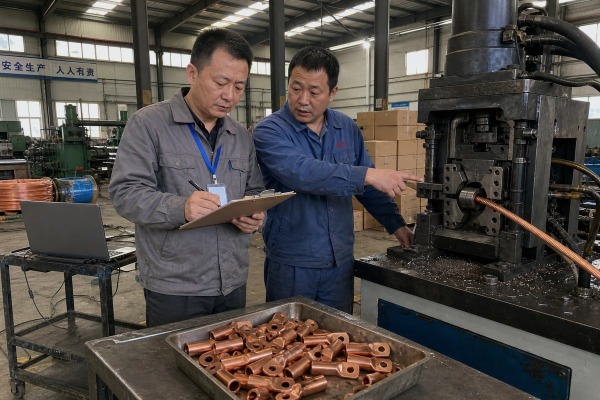
A hidden defect in a cable lug making machine can wreck your production schedule. On our Wenzhou assembly floor, we see how a proper third-party inspection prevents that pain.
To arrange third-party inspection for a cable lug making machine, define a written checklist and acceptance criteria, request the supplier’s inspection list, book an accredited agency for a pre-shipment inspection or Factory Acceptance Test, witness the testing online or on-site, and tie final payment to the report.
That is the short version. The details are where buyers win or lose money. Below, I walk through timing, standards, agency selection, and what to do when the report finds problems. Each section reflects what actually happens on our factory floor when overseas buyers inspect our equipment.
A procurement manager once booked an inspector before our lug machine finished commissioning. The visit was wasted. Timing, we learned, matters as much as the checklist itself.
The best time to schedule a third-party inspection is after the machine is fully assembled, commissioned, and able to run continuous production, typically five to seven days before shipment. For large or custom orders, add a during-production check and a formal Factory Acceptance Test.

Inspection timing is not one decision. It is a series of possible checkpoints, and you should pick the ones that match your order value and risk. When we build custom terminal-making lines, we always send the buyer our own inspection checklist and testing items first. Then we agree on which points the third-party inspector must witness. That habit came directly from disputes we saw early on: if a sensitive point is not discussed in advance, it becomes an argument later.
| Stage | When It Happens | Best For | What It Catches |
|---|---|---|---|
| Pre-production check | Before assembly starts | New suppliers, first orders | Wrong materials, missing tooling, weak factory setup |
| During-production check | Mid-build | Large or multi-machine orders | Process drift, tooling errors, schedule slippage |
| Pre-shipment inspection | After assembly and internal testing | Most single-machine buyers | Configuration errors, output defects, packing issues |
| Factory Acceptance Test | Before release, under load | High-value custom lines | Real cycle speed, feeding reliability, crimp consistency |
A cable lug making machine must run full cycles before an inspector can judge it. Machine performance testing on a half-commissioned unit proves nothing. So confirm with your supplier, in writing, that internal commissioning is finished before the agency visits. We also recommend building an Inspection and Test Plan 1 with defined hold points and witness points before assembly even begins. The hold points stop production until verification passes. The witness points let the inspector observe critical tests, such as continuous-run stability and dimensional verification of sample lugs. This structure keeps everyone honest and keeps your delivery date realistic.
Every quotation we send lists technical specifications, but specs alone do not settle disputes. We weigh which standards to test against before any inspector walks through our door.
Confirm the machine's electrical safety standards (CE, UL, or OSHA), copper terminal standards for lug dimensions and crimp quality, material certification for dies and hydraulic parts, and your own acceptance tolerances. Write all of them into the purchase contract and inspection checklist before testing begins.

Standards turn opinions into facts. Without them, "the machine works fine" means whatever the supplier wants it to mean. In our export projects to markets like the United States, Canada, and Slovakia, technical specifications compliance 2 is checked against the destination country's rules, not just the factory's habits. Confirm the applicable set before you sign, because retrofitting safety features after shipment is slow and expensive.
| Category | What to Confirm | Typical Evidence |
|---|---|---|
| Machine safety | CE, UL, or OSHA compliance; emergency stop 3 response time; light curtain function | Safety test records, compliance declaration |
| Output quality | Copper terminal standards for barrel length, hole size, burrs, crimp consistency | Measured sample lugs, dimensional verification report |
| Material integrity | Material Test Certificates for stamping dies and hydraulic cylinders | MTC documents from steel suppliers |
| Process control | Supplier's quality control plan, calibration records, first-article inspection | Internal QC files, calibration certificates |
Emergency stop behavior deserves special attention. A serious audit checks the e-stop response time and whether light curtains or guards actually halt the press station. For hydraulic lug machines, Material Test Certificates on high-stress components matter because die or cylinder failure is both a safety and a downtime risk.
Some buyers now add an energy-efficiency measurement during peak operation for ESG reporting, and an AI-readiness check confirming the PLC and sensors log data correctly for future predictive maintenance. We support both requests when they appear in the checklist. On our lines, we pre-agree the tolerance for each lug dimension with the buyer, because dimension disputes are the single most common argument after delivery.
A US procurement manager recently asked me whether SGS was his only option. My honest answer surprised him: the agency matters less than the brief you give it.
Choose an ISO 17020 accredited agency with proven industrial machinery experience, not just consumer goods. Confirm it can perform functional tests, dimensional verification, and photo-documented reporting, offers reinspection after corrections, and issues reports that state sample size, defect severity, and clear pass or fail criteria.

Not all inspection companies are equal for this job. Many agencies built their business on consumer goods like textiles and electronics. A cable lug making machine needs an inspector who understands presses, feeders, tooling, and control cabinets. SGS inspection services and similar global firms have industrial divisions, but you must request the machinery team specifically. Smaller regional agencies can also do excellent work if they hold ISO 17020 accreditation and can show past machinery reports.
| Criterion | Why It Matters | How to Verify |
|---|---|---|
| ISO 17020 accreditation | Report validity, especially in regulated markets | Ask for the accreditation certificate |
| Machinery expertise | Consumer-goods inspectors miss press and hydraulic issues | Request sample machinery reports |
| Functional test capability | Machine performance testing needs instruments and skill | Ask what tools inspectors bring |
| Report quality | Weak reports cannot support payment decisions | Review a sample report format |
| Reinspection service | Defects usually need a follow-up visit | Confirm pricing and lead time |
For complex orders, arrange a Pre-Inspection Meeting between you, the supplier, and the agency. This aligns documents, sampling rules, and witness points before anyone travels. In our experience, this one call prevents most on-site confusion. It is also where you should raise any point that could become a dispute. We always ask buyers to flag their sensitive items in advance so we can prepare test materials and instruments.
You do not always need to fly to China. We regularly host online acceptance meetings with live video, and some agencies now offer mixed-reality oversight where remote engineers watch internal mechanical movements through AR headsets in real time. A few advanced setups even run a digital twin synchronization check, comparing live sensor output against the machine's virtual model to spot calibration drift. A competent third-party audit combined with your own live witnessing gives you two independent layers of assurance.
Years of running acceptance tests taught us one hard lesson: an inspection report that finds problems is not a disaster. Ignoring it, or arguing without evidence, is.
Classify each finding as critical, major, or minor, then send the report to the supplier with photo evidence and request a written corrective action plan with deadlines. Hold final payment until a reinspection or documented video verification confirms every critical and major defect is fixed.

A failed inspection is a negotiation moment, not a crisis. The report gives you leverage precisely because payment has not been released yet. Here is the process we follow with our own buyers when a finding appears, and it works because every step produces a record.
One objection deserves a direct answer. Some suppliers argue that inspection slows delivery and adds cost, so buyers should skip it on lower-value machines. Our position is the opposite: brochure specifications cannot prove performance under real operating conditions, and one production-critical failure costs more than any inspection fee. But be fair about what the report covers. It confirms what was observed on that day. It does not guarantee lifetime reliability. Long-term performance depends on your maintenance, your operators, and the supplier's after-sales support. Treat the inspection as acceptance evidence, and keep warranty and service terms in the contract itself.
A cable lug making machine is a production-critical investment. Define the checklist, time the inspection right, pick an accredited agency, and demand documented corrections before releasing payment.
1. Wikipedia entry explaining the structure and purpose of an ITP in quality management. ↩︎
2. Official government resource for understanding technical regulations and international trade compliance. ↩︎
3. OSHA safety standards regarding the functional requirements and failure criteria for emergency stop devices. ↩︎
