

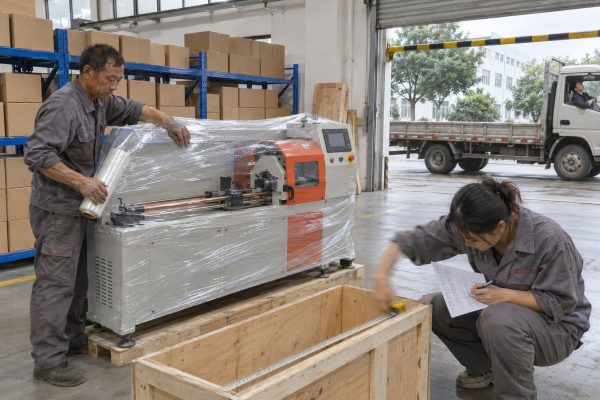
A buyer in Mexico once asked me whether our fully automatic pipe cutting machine needed a special transport permit. The truck had already been booked. Nobody had measured the crate.
A fully automatic pipe cutting machine does not automatically need a special transport permit. Permits depend on the loaded width, height, length, overhang, axle weight, and gross weight of the machine, crate, trailer, and tractor together, judged against each jurisdiction’s legal limits.
That answer sounds simple. In practice, it hides four separate questions. Dimensions, export paperwork, weight, and timing each trip up buyers in different ways. I will take them one at a time, using the same method our team in Wenzhou uses before every dispatch.
Our packing team measures every export crate twice. On one automatic tube cutting unit, the crate added more width than the control cabinet did, and that changed the truck plan.
Measure the loaded combination, not the catalog. Compare total width, height, length, and overhang against local limits. In many U.S. states the screening points are 8 feet 6 inches wide and 13 feet 6 inches to 14 feet high; other markets use 2.6 meters wide and 4.5 meters high.

Automation describes how the machine runs. It does not describe how the machine travels. A permit office only looks at freight shipping dimensions 1 and weight. One of our compact automatic cutters with a servo feeder fits inside a standard enclosed truck. A manual-feed cutoff saw with a long bed may not. Oversize load regulations never ask about the control system.
Texas guidance is clear on method. Width is measured at the widest outside points. Height runs from the roadbed to the highest point. Length runs from the foremost to the rearmost point of the vehicle or load. So the crate, skids, guards, lifting frames, and pipe supports all count. The trailer deck counts too. A machine that stands 1.6 meters tall on a high flatbed deck becomes a much taller load. The same machine on a drop-deck or low-loader trailer sits lower and may stay under highway overpass limits.
| Measurement | Common U.S. screening point | Metric point used in many markets | What pushes a pipe cutter over it |
|---|---|---|---|
| Width | 8 ft 6 in (Texas, Missouri) | 2.6 m | Export crate, side-mounted loading racks, open guard hoods |
| Height | 13 ft 6 in (Missouri) to 14 ft (Texas) | 4.5 m | Deck height plus safety hood and signal tower |
| Length and overhang | Varies; Minnesota permits up to 110 ft for certain equipment with route approval | Varies | Long feeding beds, outfeed conveyors, bundle loaders |
Sizes vary a lot. A handheld cutter may weigh only 7 to 11.5 kilograms, with a shipping weight of 13 to 18 kilograms. That is parcel freight. One listed CNC round-and-square pipe cutting machine packs at roughly 6.8 meters by 0.8 meters by 1.6 meters and weighs 240 kilograms. Its width and weight are legal almost everywhere. Its length is the risk. Long feeding beds create rear overhang, and that is why an Oversized Vehicle Movement permit is often needed for this machine type even when nothing else is oversize. A beveling unit at 137 kilograms and 965 by 737 by 660 millimeters raises no flag at all.
My rule is simple. We send the packed dimensions and gross weight in writing before quoting freight. The buyer or forwarder then checks the loaded combination against the route. Nobody books a truck from catalog figures.
A distributor in Slovakia once forwarded me a port notice. The machine had cleared customs, but the inland haulier refused to move the crate until a road permit arrived.
Overseas shipping of a fully automatic pipe cutting machine needs a commercial invoice, packing list, bill of lading, certificate of origin, harmonized tariff code, cargo insurance, customs declarations, and wood-packaging compliance. Dangerous-goods paperwork applies if lubricants, hydraulic oil, or batteries ship inside. None of these replace a road permit.

I tell every buyer to split the journey into stages. Each stage has its own gatekeeper.
Customs paperwork governs stage three. Road permits govern stages one, four, and five. An ocean bill of lading 2 authorizes the container to move through the shipping line. It does not authorize an oversize movement on a public road after arrival. This is the gap that caught the Slovakian shipment. The machine was "customs-cleared" but not "legal to haul."
| Document | Purpose | Who prepares it |
|---|---|---|
| Commercial invoice | Declares value for duty and payment | Exporter |
| Packing list 3 | States packed dimensions, gross and net weight, crate count | Exporter |
| Bill of lading or air waybill | Contract of carriage and title document | Carrier or forwarder |
| Certificate of origin | Supports tariff treatment at destination | Exporter via chamber of commerce |
| Harmonized tariff classification | Determines duty rate and import controls | Exporter with forwarder review |
| Customs declaration | Formal import entry | Importer or broker |
| Wood-packaging compliance | Confirms treated timber for crates and skids | Exporter and packing supplier |
| Dangerous-goods declaration | Covers lubricants, hydraulic oil, gas cylinders, batteries | Exporter |
| Cargo insurance coverage | Protects against loss or damage in transit | Buyer or exporter per contract |
| Oversize or overweight road permit | Authorizes public-road movement | Carrier, in each jurisdiction crossed |
The packing list matters more than most buyers think. It is the source document for freight shipping dimensions. If it lists the bare machine instead of the crated machine, every downstream permit calculation is wrong. We print crated figures on ours and confirm them again with the forwarder before the container is booked. That double check comes straight from our own experience, and it costs nothing.
Pipe cutting machines usually ship with coolant, gearbox oil, or hydraulic fluid inside. Some control cabinets carry backup batteries. These are regulated materials. If they are not declared, the forwarder may refuse the booking at the last minute. Wood crates also need the correct heat-treatment mark, or the destination may order fumigation or re-export. In markets like India, Vietnam, and Malaysia, customs holds on wood packaging are common enough that we check the stamp before the crate leaves our yard.
I weigh two options on every heavy build: ship the control cabinet attached and accept a heavier single crate, or detach it and add commissioning hours on site.
Yes. Weight decides whether you need an overweight permit, an oversize permit, or both. Authorities check gross combination weight, commonly capped at 80,000 pounds in U.S. states, and the load on each axle group. A pipe cutting machine can pass the gross limit yet still overload one axle.

Most pipe cutting machines never come close to 80,000 pounds gross. A 240-kilogram CNC cutter adds almost nothing to a tractor-trailer. That is the first objection I hear from buyers, and it is a fair one. Weight rarely triggers a permit for this product category on its own.
But axle distribution 4 can. If a dense cutting head and gearbox sit over one trailer axle group, that group can exceed its limit while the total stays legal. Missouri lists example limits of 20,000 pounds for a single axle, 46,000 pounds for a tandem group 5, and 60,000 pounds for a triple group. Other states and countries use different figures. The lesson is the same. Position matters as much as mass.
| Weight check | What is measured | Why it matters for a pipe cutter |
|---|---|---|
| Gross combination weight | Tractor plus trailer plus load | Usually legal; becomes an issue only with multiple machines or a loaded trailer |
| Single axle load | Weight on one axle | Heavy cutting head placed over one axle can exceed the limit |
| Tandem or triple group load | Weight on grouped axles | Long bed with concentrated mass at one end skews the distribution |
| Trailer machine weight capacity | Rated deck capacity | A light trailer may be rated below the crate weight even when road limits are fine |
Weight and size combine into one of several permit types. The table below is how I explain it to project managers who have never dealt with DOT permit requirements.
| Permit type | Trigger | Typical use for pipe cutting machines |
|---|---|---|
| Oversize only | Width, height, length, or overhang over the limit | Long feeding bed with rear overhang |
| Overweight only | Gross or axle-group weight over the limit | Rare; heavy base plus dense trailer load |
| Oversize and overweight | Both limits exceeded | Large multi-station systems on one trailer |
| Route-specific approval | Bridges, tunnels, low clearances | Heavy haul trucking through older urban routes |
| Single-trip permit | One movement | Most new-machine deliveries |
| Annual or blanket permit | Repeat movements that fit set criteria | Distributors moving similar loads often |
Detaching the control cabinet or outfeed conveyor can shift the load under a threshold. It can also move the center of gravity to a safer place over the axles. North Carolina's guidance asks applicants for schematics showing axle spacing, axle weights, gross weight, width, length, and overhang. We supply those figures from our own drawings and the crate layout. The buyer compares the cost of disassembly and reassembly against the permit and escort cost. On most of our builds the cabinet stays attached, because we have already sample-tested the wiring and do not want to disturb it. But I run the numbers every time rather than assume.
Choosing the trailer is part of this decision. Flatbed trailer transport works for compact units with a low center of gravity. A lowboy or step-deck is safer for a tall machine, and it keeps the height legal without a permit. The forwarder should name the trailer type before quoting.
The hardest lesson I learned about industrial machinery logistics came from a crate that sat at a port for two weeks because nobody owned the permit task.
Confirm the packed dimensions, gross weight, and volume in writing before booking. Share them with your freight forwarder, agree on who applies for permits, book route surveys and pilot cars early, and split modular machines into standard containers when possible. Written confirmation prevents most permit-related delivery delays.

I keep the process short so it actually gets done.
Steps one and three come directly from our own practice. Confirming dimensions and confirming documents with the forwarder are the two checks that catch almost everything.
The cheapest permit is the one you never need. Our automation systems are built from the customer's drawings, so we can design the loading rack to decouple from the main cutting unit. That lets a long system ship in a standard 40-foot container as two or three legal pieces. Rigging and crating services then reassemble the rack on site in hours. This is not disassembly to dodge a rule. The rack is a separate module by design, and we sample-test it that way before shipment.
| Delay cause | What goes wrong | How to prevent it |
|---|---|---|
| Nobody owns the permit | Crate waits at port | Name the responsible party in the contract |
| Width over 3.0 meters | Escort needed but not booked | Confirm pilot car requirements at quotation stage |
| Low bridge on the route | Truck turned back | Commission a route survey or a digital twin simulation of the route |
| Wrong trailer | Load too high | Specify drop-deck or lowboy in the plan |
| Travel window restrictions | Oversize moves barred at night, holidays, or bad weather | Build the window into the delivery date |
| Missing emissions paperwork | Permit refused in markets with green haulage rules | Ask the carrier about carbon reporting or alternative-fuel vehicle requirements |
Route surveys used to mean a car driving the route with a measuring pole. Many carriers now run a digital twin of the loaded trailer through 3D road data to spot overhead lines and tight urban turns before the truck leaves. For a precision cutter, I also recommend an impact and tilt sensor inside the crate. It gives a time-stamped record of any shock in transit, which protects the buyer, the carrier, and our blade and clamp calibration from arguments later. Some markets are starting to attach carbon reports or alternative-fuel requirements to transport permits, so ask early.
Automation never decides a transport permit. Loaded dimensions, weight, route, and jurisdiction do. Confirm the crated figures and documents with your forwarder in writing, then book the truck.
Interested in sourcing the products mentioned in this article? See details and request a quote here:
1. Texas DMV guidelines on how freight shipping dimensions determine the need for oversize or overweight permits. ↩︎
2. U.S. Customs and Border Protection guide on the essential documents required for international trade. ↩︎
3. Official government guide for common export documents, including detailed requirements for the packing list. ↩︎
4. Federal Highway Administration overview of federal size and weight regulations for commercial vehicles. ↩︎
5. Missouri Department of Transportation’s Motor Carrier Services page for oversized and overweight load permits. ↩︎
6. Federal Motor Carrier Safety Administration regulations and guidelines for commercial vehicle operations. ↩︎
