

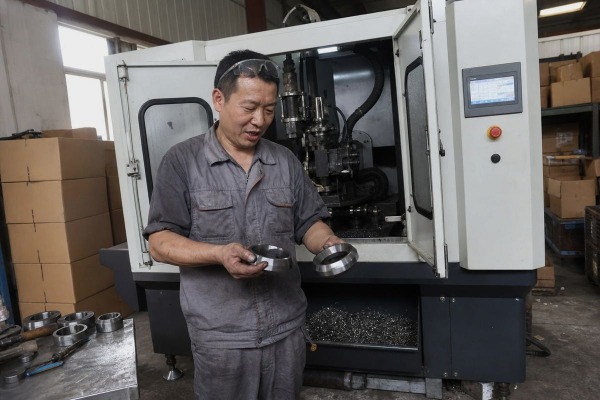
Buyers often ask me whether a fully automatic chamfering machine can handle multiple angles automated production line 1. On our production floor in Wenzhou, this question comes up almost weekly. Many factories buy a machine, then discover it only cuts one fixed chamfer angle. Their new parts need 30°, their old parts need 45°, and suddenly production stalls. That frustration is avoidable if you know what to look for before you order.
Yes, a fully automatic chamfering machine can support multi-angle processing, but only on models built for it. Angle changes are typically achieved by swapping CNC insert blades of different types and specifications, using programmable CNC control, or adjustable tool holders. Fixed-angle machines cannot do this.
The key point is simple. “Fully automatic” describes feeding, clamping, and cycle control. It does not automatically mean angle flexibility. Let me break down what actually determines multi-angle capability, based on the machines we build and export every month.
A procurement manager from Mexico once sent us three part drawings with three different chamfer angles. He assumed one standard machine would cover them all. It would not have.
Most fully automatic chamfering machines cover standard chamfer angles of 30°, 45°, and 60°, with some industrial systems reaching roughly 15° to 80°. The machines support internal chamfers, external chamfers, and flat-face chamfering, with custom angles available through specialized CNC insert blades.

The angle range you can achieve depends on two things: the machine architecture 2 and the cutting tools installed. On the machines we build, both internal and external chamfering are supported, as well as flat-face chamfering. This matters because “multi-angle” actually means two different things in practice, and buyers often mix them up.
First, it can mean multiple bevel angles on the same edge type. For example, cutting a 30° chamfer on one batch and a 45° chamfer on the next. Second, it can mean multiple chamfer locations on one workpiece. That covers the outer diameter (OD), the inner diameter (ID), and the end face. Pipe chamfering machines often handle all three in a single setup.
| Machine Class | Typical Angle Range | Chamfer Locations | Angle Change Method |
|---|---|---|---|
| Fixed-angle automatic | One angle only (often 45°) | OD or face only | Not adjustable |
| Insert-based automatic | 30°, 45°, 60° + custom | ID, OD, and face | Swap CNC insert blade 3s |
| CNC programmable | Roughly 15°–80° | ID, OD, face, dual-end | Program recipe change |
| Multi-axis systems | Wide, complex profiles | All edges, complex workpiece geometry | Servo tool path control |
For most production needs, an insert-based machine covers the common range. When we quote a customer, we always ask for part drawings first. The workpiece geometry decides which class fits. A simple bar end needs less flexibility than a tube requiring dual-end beveling with edge rounding on both the ID and OD. If your parts span many angles, tell your supplier upfront so the tooling package is specified correctly from day one.
Customization is where our engineering team spends most of its time. Nearly every export order we ship involves some adaptation to the customer’s specific parts and processes.
To customize a chamfering machine for multiple angles, specify interchangeable CNC insert blades in different types and specifications, request adjustable or modular tool holders, and provide part drawings so the supplier can configure fixturing, feeding, and processing parameters for each workpiece variant.

On our machines, angle adjustment works through the cutting tools 4 themselves. You change the chamfer angle by replacing the CNC insert blade with a different type or specification. A 30° insert cuts 30°. A 45° insert cuts 45°. This approach keeps the machine mechanically simple, which improves stability and reduces maintenance. It is also fast. An operator can swap inserts in minutes, not hours.
That last step matters most. When we developed a chamfering unit for a cable lug customer, sample testing revealed that one part needed a face chamfer combined with light deburring on the ID edge. We adjusted the tooling before shipping. Catching that after installation would have cost weeks. Good customization is really good communication before the machine is built.
Precision worries stop many buyers cold. One production manager from South Korea asked me directly: if his team swaps inserts twice a day, will the chamfers drift?
Angle switching does not degrade precision when the machine uses indexed insert seats, rigid tool holders, and repeatable clamping. Each CNC insert locates in a fixed pocket, so the chamfer angle returns to specification after every change. Poor fixturing, not switching itself, causes inconsistency.

Consistency comes from mechanical design, not from avoiding changeovers. A quality insert pocket positions the cutting edge in the same place every time. The insert itself is ground to a fixed geometry, so the chamfer angle is baked into the tool. Unlike manually adjusted grinding heads, there is nothing for the operator to eyeball. This is one reason we favor insert-based angle adjustment on our automatic machines: it removes human judgment from the angle setting entirely.
In our experience commissioning machines across ten export markets, precision problems trace back to a short list of causes. None of them is the act of switching angles.
| Risk Factor | Effect on Chamfer Quality | Prevention |
|---|---|---|
| Worn insert edge | Rough surface finishing, burrs left behind | Scheduled insert replacement |
| Loose insert screw | Angle drift, chatter marks | Torque check at every swap |
| Chip buildup in pocket | Insert sits off-position | Clean pocket before seating |
| Weak workpiece clamping | Inconsistent chamfer depth | Verify fixturing per part type |
| Spindle bearing wear | Vibration, poor edge rounding | Preventive maintenance plan |
We train customers to follow a three-minute routine: clean the pocket, seat the new insert, torque the screw, and run one test part. Measure that first part before releasing the batch. On machines with CNC control, you can also store processing parameters as recipes, so spindle speed and feed rate match each insert type automatically. With this discipline, batch-to-batch consistency holds even with daily angle changes. Automated deburring quality stays uniform too, because the cutting geometry never depends on operator skill.
Line integration is a trade-off we weigh on almost every project: standalone flexibility versus inline throughput. The right answer depends on your upstream and downstream processes.
Yes, a multi-angle chamfering machine can integrate into an existing automated line through vibratory or conveyor feeding, PLC signal handshaking, and matched cycle times. Confirm I/O compatibility, part orientation, and chip evacuation with your supplier before ordering to ensure smooth inline material processing.

Integration succeeds or fails on three technical points: feeding, communication, and timing. Our standard automatic machines already include hopper or vibratory feeding, a touchscreen HMI, and a chip-collection chute at the base. For inline use, we adapt the infeed to accept parts from your conveyor and add signal exchange so the chamfering station talks to the rest of the line.
| Integration Area | What to Confirm | Why It Matters |
|---|---|---|
| Part feeding | Orientation, feed rate, part size range | Misfed parts stop the whole line |
| Control signals | PLC I/O, ready/busy/fault handshakes | The line must pause or divert on faults |
| Cycle time | Chamfering cycle vs. line takt time | The slowest station sets line output |
| Chip management | Chute position, chip conveyor option | Chips from beveling must exit cleanly |
| Angle changeover | Insert swap time within planned downtime | Multi-angle runs need scheduled swaps |
| Footprint and utilities | Floor space, power, compressed air | The cabinet must fit your layout |
Some buyers worry that a multi-angle machine is slower than a fixed-angle unit, and for pure high-volume single-angle work, a dedicated machine can indeed be the better choice. But when your line runs mixed part families, the math flips. One flexible station replaces two or three fixed ones, saving floor space, capital, and labor. When we scoped an integration project for a customer running both pipe chamfering and solid bar work, a single insert-based station with recipe storage in the CNC control handled both families with a five-minute changeover. Plan the changeover into your production schedule, and integration becomes a strength rather than a compromise.
A fully automatic chamfering machine can support multi-angle processing when it is specified correctly. Insert blades, CNC control, and proper customization deliver internal, external, and face chamfers with consistent precision. Choose the machine architecture to match your parts, not the marketing label.
