

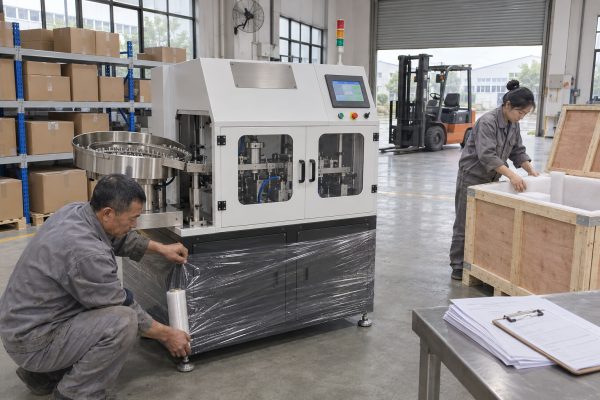
Nothing hurts more than our chamfering machine stuck at a European port. Customs clearance procedures for importing a chamfering machine into the EU decide whether it clears or stalls.
Customs clearance procedures for importing a chamfering machine into the EU require an EORI number, a commercial invoice, transport document, CN/TARIC classification, customs value assessment, an import declaration, payment of customs duty and import VAT, plus CE marking and a Declaration of Conformity before the machine enters service.
Customs is only half of the job. Product compliance is the other half. Below I walk through the four questions our European buyers ask most. I cover documents, HS codes, CE compliance, and cost control in that order.
Before any crate leaves our Wenzhou workshop, our export team lays the full document set on the table next to the machine. Missing paper costs more than missing bolts.
You need a commercial invoice with a precise machine description, packing list, bill of lading or air waybill, purchase contract, Certificate of Origin, importer EORI number, Incoterms, CE Declaration of Conformity, and technical documentation. These support the Single Administrative Document lodged electronically with EU customs.

The customs declaration itself is the Single Administrative Document. In practice, your broker files it electronically in the national customs system. But the broker can only file what you give them. Every field on that form traces back to a document in the file.
| Document | Who prepares it | Why customs cares |
|---|---|---|
| Commercial invoice | Exporter | Sets customs value 1, description, Incoterms, currency |
| Packing list | Exporter | Gross and net mass, crate count, accessories in the crate |
| Bill of lading, air waybill, or CMR | Carrier or forwarder | Proves transport, names the consignee |
| Purchase contract or PO | Both parties | Supports the declared transaction value |
| Certificate of Origin | Exporter via chamber of commerce | Confirms non-preferential origin |
| Technical description, photos, serial number | Exporter | Supports HS Code classification |
| EORI number | EU importer | Identifies the importer of record 2 |
| EU Declaration of Conformity and manuals | Manufacturer | Market surveillance and safe placing on the market |
| Dual-use screening statement or license | Exporter and importer | Only if the machine is controlled technology |
"Industrial equipment" on an invoice invites questions. Our invoices name the operation, the material, the model, the voltage, and whether the unit is new. For example, an automatic chamfering machine for metal parts, PLC controlled, 380 V three-phase, with a vibratory bowl feeder and linear feed track. We list the bowl feeder and tooling separately on the packing list. Accessories in the same crate still need to be declared.
Any business acting as importer of record inside the EU needs an EORI number. EORI number registration happens once, with the customs authority of the Member State where the importer is established. If the buyer is not established in the EU, an indirect customs representative or an EU entity must take that role.
Here is a common objection I hear. "We bought DDP, so customs is your problem." I understand the appeal. DDP makes pricing simple. But DDP only decides who pays the charges. It does not decide who legally places the machine on the EU market, and it does not transfer the compliance duties of the importer. We put the importer of record, the EORI holder, and the cost split in writing before production starts.
China has no preferential trade agreement with the EU. So our machines pay the standard third-country duty, and we supply a non-preferential Certificate of Origin. We never write a preferential origin on an invoice. Origin follows the place of last substantial transformation, not the shipping port. Even when we source control components from abroad, final assembly and testing in Wenzhou is the substantial step.
Milling cutter or abrasive wheel? That design choice changes more than chip removal. It also changes which tariff heading our chamfering machines fall under at the EU border.
Classify by principal function and cutting technology, not trade name. Milling-type metal chamfering usually falls under heading 8459, abrasive grinding or deburring under 8460, and woodworking variants under 8465. Confirm the eight-digit CN code and customs duty rates in the TARIC database, or request Binding Tariff Information.

HS Code classification is where most clearance delays start. The word "chamfering" does not appear as a heading. Customs looks at what the machine physically does and how it does it.
| Machine configuration | Likely CN heading | Note |
|---|---|---|
| Metal chamfering with milling cutters, fixed CNC or PLC machine | 8459 | Machine tools working metal by removing material |
| Metal chamfering or deburring with abrasive wheels | 8460 | Grinding, deburring, and similar machine tools |
| Hand-held portable chamfering tool | 8467 | Tools for working in the hand may be treated differently |
| Chamfering machine for wood or similar materials | 8465 | Woodworking machinery |
| Spare tooling heads, fixtures, feed tracks shipped alone | 8466 | Parts and accessories of machine tools |
| PLC cabinet or HMI shipped separately | 8537 | Electrical control equipment |
When we ship a complete machine with its bowl feeder attached, the whole unit is classified as one machine. When a customer orders a feed-track upgrade later, that part gets its own code.
If the machine is unusual or multifunctional, ask the customs authority for a Binding Tariff Information decision. It is legally binding across the EU and gives you certainty before the crate ships.
The customs value starts from the transaction value, the price actually paid. Then additions apply. Under EXW, FCA, or FOB, transport and insurance to the EU border must be added. Under CIF or DAP, much of it is already inside the price. Packing, buyer-supplied design work, and royalties tied to the sale also count.
Import VAT calculation uses a different base. It is the customs value plus duty plus, depending on the Member State, transport costs to the first destination. Standard VAT rates range from 17% to 27% across Member States. A VAT-registered importer may use postponed accounting, which helps cash flow but does not change the duty to declare correctly.
A complete chamfering machine under Chapter 84 sits outside the current CBAM product scope. But if we ship steel fixtures or frames separately under Chapter 73, the importer may need to check whether a transitional CBAM report is required.
A procurement manager in Italy once asked me why a CE sticker was not enough. His question led to the deepest review our technical files have ever had.
Your chamfering machine needs CE marking under the EU Machinery Directive 2006/42/EC, an EU Declaration of Conformity, a technical documentation file with risk assessment, and instructions in the destination country's official language. From January 2027, Machinery Regulation 2023/1230 applies, adding cybersecurity requirements for CNC and PLC-controlled machines.

Customs release and product compliance are two separate gates. A machine can clear customs with every duty paid and still be unlawful to switch on. Market surveillance authorities, not customs officers, usually catch that.
The CE mark on our control panel is only the last step. Behind it sits a technical documentation file. Ours contains the risk assessment, the electrical schematics, the control circuit design, the list of harmonised standards we applied, test records, and the signed Declaration of Conformity. The Declaration of Conformity names the manufacturer, the model and serial number, the directives applied, and the person who signed it. The importer must add their own name and address on the machine or its documents.
The physical machine has to match that file. On our cabinets, that means interlocked hinged doors, transparent safety windows for the working area, a red emergency stop at the HMI, and warning labels at pinch points. If a buyer asks for a non-standard feed system, we update the risk assessment before we update the drawings.
| Legislation | When it applies | What the file must show |
|---|---|---|
| EU Machinery Directive 2006/42/EC, then Regulation 2023/1230 from January 2027 | Every complete machine | CE mark, Declaration of Conformity, manual, risk assessment |
| Low Voltage Directive 2014/35/EU | Electrical equipment in the covered voltage range | Electrical design and test evidence |
| EMC Directive 2014/30/EU | PLC, drives, HMI, sensors | EMC assessment |
| WEEE Directive 2012/19/EU | Electronic control systems and displays | Importer registration with the national take-back scheme |
| RoHS Directive 2011/65/EU | Electrical and electronic parts | Check the exemption for large-scale stationary industrial tools |
| Dual-Use Regulation (EU) 2021/821 | Machine tools above specific positioning accuracy thresholds | Screening record; license if controlled |
| Radio Equipment Directive 2014/53/EU | Only if Wi-Fi or Bluetooth monitoring is fitted | Radio conformity evidence |
Regulation (EU) 2023/1230 replaces the Directive and applies from January 2027. It puts explicit verification duties on importers. Before placing a machine on the market, the importer must confirm the conformity assessment 4 was done, the technical file exists, the CE mark is present, and the Declaration of Conformity and instructions travel with the machine. For CNC and PLC-controlled machines it adds software integrity and cybersecurity requirements. A machine that passed under the Directive does not automatically meet every new requirement. We check the shipment date against the transitional rules on every order.
Instructions and safety information must be in the official language of the Member State where the machine is first placed on the market. Authorities are enforcing this, and failures end up in Safety Gate alerts. We deliver German, Italian, or French manuals when those are the destinations.
Used machines deserve a warning. A second-hand machine imported from outside the EU is placed on the EU market for the first time when it enters. Age does not remove the obligations. Modification history, working safeguards, and original documentation all matter.
Partly completed machinery is different again. If a chamfering unit cannot work alone and is built into a customer's line, we issue a Declaration of Incorporation and assembly instructions instead of a Declaration of Conformity. The integrator then owns the final conformity assessment.
Some buyers ask whether CE checks can wait until an authority requests them. My answer is no. Checking the file before shipment costs a day. Discovering a gap after arrival costs storage, demurrage, and sometimes rework at the port.
The hardest lesson from exporting to Germany, Italy, and France is simple. Customs problems are almost always decided before the machine leaves our factory, not after it lands.
Avoid delays by verifying HS Code classification, origin, and customs value before shipment, checking the CE file and manuals before the crate closes, defining importer of record and cost responsibility in the contract, budgeting import VAT and port charges, and arranging any special procedures like temporary admission in advance.

A high-value machine makes every day of delay expensive. Port storage, container demurrage, and a production line waiting for equipment all run at the same time. Our approach is to front-load the work.
| Cost item | Typically paid by importer under FOB | When it hits |
|---|---|---|
| Customs duty | Yes | At release |
| Import VAT | Yes, or deferred via postponed accounting | At release or in the VAT return |
| Brokerage fee | Yes | At declaration |
| Port and terminal handling | Yes | At arrival |
| Storage and demurrage | Yes, accrues daily | From free-time expiry |
| Physical inspection charges | Yes | If customs examines the crate |
| Inland transport, rigging, installation | Yes | After release |
| Compliance upgrades such as language or electrical changes | Depends on contract | After arrival if not checked earlier |
Some buyers tell me their broker handles everything. Brokers are valuable. They know the national system and file the Single Administrative Document quickly. But the importer remains responsible for the accuracy of classification, origin, and value, even when the broker typed the numbers. A broker who never saw a drawing cannot classify a milling-type chamfering head correctly. We send the technical description to the broker directly, with the buyer copied in.
Temporary admission can cover a demonstration unit at a trade fair. Customs warehousing defers duty and VAT while the machine waits for a site to be ready. Inward processing fits components imported for processing and re-export. End-use relief and returned-goods relief have strict conditions. None of these apply automatically. Each needs an authorization before the goods arrive.
Consider two orders for the same cabinet design. Order one uses milling cutters, ships complete with its bowl feeder, is new, and goes to a German plant that will operate it. It is classified under 8459, carries a Declaration of Conformity and a German manual, and pays standard duty plus German import VAT. Order two is a chamfering unit without its own controls, going to an Italian integrator for a larger line. It is partly completed machinery, ships with a Declaration of Incorporation, and the integrator takes on the final conformity assessment. Same steel, same paint, different paperwork.
A stalled chamfering machine at a European port burns money daily. Classify correctly, prepare documents, verify CE before shipment, and our EU buyers rarely meet that problem.
1. International standard for determining the transaction value of goods for duty calculation purposes. ↩︎
2. Official EU guidance on the mandatory identification number for economic operators importing goods into the European Union. ↩︎
3. Official European Commission tool for identifying correct tariff codes and duty rates for imported machinery. ↩︎
4. Official source for the new EU Machinery Regulation governing safety and compliance for industrial equipment. ↩︎
5. EU trade policy information regarding the control of dual-use technologies and machine tool specifications. ↩︎
