

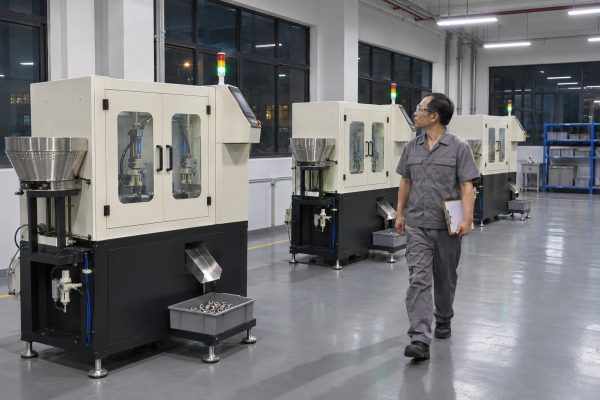
Unfilled shifts keep stalling our customers’ edge-finishing lines. Overtime bills grow, scrap rises. That is why our Wenzhou team builds the fully automatic chamfering machine: steady output from fewer hands.
A fully automatic chamfering machine eases labor shortages by handling loading, clamping, cutting, and unloading without continuous operators, so one worker supervises several units, output continues through unstaffed shifts, and skilled staff move to setup, inspection, and maintenance instead of repetitive edge work.
That is the short answer. The longer answer matters more, because the savings depend on how you measure them. Below, I walk through skill dependence, which tasks to automate, how to cost the switch, and how to keep output steady when people do not show up.
Last year our QC team measured chamfer angles from three manual operators on identical steel bushings. The spread was wide. The same parts through our PLC-controlled cell came out alike.
An automatic chamfering machine reduces dependence on skilled labor by storing chamfer dimensions, feed rates, and cycle logic in its PLC control system, so a new hire selects a recipe on the touchscreen instead of hand-tuning tools, while master machinists shift to programming, tooling, and first-piece approval.

Manual chamfering rewards muscle memory. A good operator feels when the tool bites and corrects by eye. That skill takes years to build, and it walks out the door when the person retires or quits. Deloitte's 2025 smart-manufacturing survey 1 found that 48% of manufacturers had moderate-to-significant difficulty filling production and operations-management roles, and 46% reported the same problem in planning and scheduling. The skilled labor gap is real, and it is widening.
A fully automatic machine stores the chamfer angle, depth, feed rate, and tool offset as a program. On our cells, the operator picks the part number on the color touchscreen, confirms the first piece, and starts the cycle. The PLC control system 2 repeats the same motion every time. Turnover hurts less because the process knowledge sits in the controller, not in one employee's head.
| Level | Who loads and unloads | Who controls the cut | Operator attention | Skill needed to run |
|---|---|---|---|---|
| Manual bench | Operator | Operator, by hand and eye | Continuous | High (experienced machinist) |
| Semi-automatic | Operator | Machine, fixed program | Frequent | Medium |
| Fully automatic | Hopper, vibratory bowl feeder, or robot | CNC/PLC with automatic tool compensation | Periodic | Low to run, medium to maintain |
Buyers push back here, and they should. "You removed the machinist, but now I need a PLC technician." Deloitte found that 35% of manufacturers worry about upskilling employees for advanced technology, and human capital advanced manufacturing technology 3 was the least mature area in its survey. Our answer is practical. We ship the recipes pre-loaded, keep the HMI to a few colored button icons, and train one or two of your people during commissioning. Daily tasks such as offset changes, consumable swaps, and minor fault clearing stay with the operator. Deeper electrical faults can go to a remote support call rather than a full-time specialist on your payroll. The skill demand does not disappear. It shrinks, and it becomes much easier to source.
One U.S. procurement manager recently messaged us on WhatsApp with a photo of his manual chamfering bench. He asked which of its eight steps our machine could absorb.
You can automate loading and unloading, part orientation, clamping, chamfer cutting, deburring, chip removal, in-process measurement, and reject sorting. These repetitive steps consume most manual labor hours, so moving them onto a fully automatic chamfering machine frees operators for setup, inspection, and maintenance.

Before we quote, we ask customers to list every physical touch on one part. The list is almost always the same. Load. Orient. Clamp. Set the tool. Cut. Deburr. Measure. Sort. Each touch is quick, but at high volume those seconds become full-time jobs. Here is how our standard cell takes them over.
| Manual step | Automated by | What the operator does instead |
|---|---|---|
| Loading parts | Stainless hopper, vibratory bowl feeder, or robot | Refills bulk material every few hours |
| Orienting the part | Feeder track and position sensor | Nothing per part |
| Clamping | Pneumatic gripper and fixture | Checks clamp pressure at changeover |
| Positioning the tool | PLC/CNC program | Selects the recipe on the touchscreen |
| Cutting the chamfer | Motor-driven spindle | Watches for alarms |
| Removing burrs and chips | Integrated metal deburring process and chip drawer | Empties the collection drawer at shift end |
| Measuring | In-process sensing or sample gauge | Spot-checks a few parts |
| Sorting rejects | Automatic reject chute | Reviews reject counts on the screen |
Material handling automation works when the part family is stable. CNC pipe chamfering, bushings, shaft ends, fittings, and cable lug blanks are ideal. Many customers pair the chamfer station with an end-facing machine so both operations run in one pass. Low-volume, irregular parts are a different story. If every batch is a new shape, a skilled machinist on a manual bench may still be the cheaper option, and I tell buyers that plainly.
A 2025 UKG manufacturing report 4 found that 31% of production lines had been understaffed in the previous 30 days, and 90% of manufacturers said frontline absenteeism hurt the bottom line. When the repetitive steps run on the machine, one absent operator no longer stops a station. The remaining person covers more machines, and production line efficiency holds.
Every quote we prepare forces a trade-off: a bigger feeder and robot cell cuts more labor, but it adds integration cost and commissioning time. We weigh both before promising savings.
Labor savings depend on your volume and shift pattern, so calculate them rather than assume them: measure labor hours per part before and after, multiply by fully burdened wage, then add overtime, scrap, and rework reductions. Validate the result against cycle-time compression to confirm total ROI.

I refuse to quote a universal payback period. Instead, we walk every buyer through the same quantified evaluation. Two ratios sit at the center of it: the labor cost reduction ratio and the cycle compression rate. Together they verify the comprehensive return, not just the wage line.
| Metric | Formula | Why it matters |
|---|---|---|
| Annual manual labor cost | Labor hours per part × annual volume × burdened hourly wage | Your baseline |
| Labor cost reduction ratio | (Manual labor cost − automated labor cost) ÷ manual labor cost | Shows headcount leverage |
| Cycle compression rate | (Manual cycle − automated cycle) ÷ manual cycle | Shows capacity gain for high-volume manufacturing |
| Net annual benefit | Labor + overtime + scrap/rework savings − maintenance − tooling − training | True operating gain |
| Simple payback | Total investment ÷ net annual benefit | The investment decision |
This is the most common pushback, and it is true. If you move a worker from the chamfer bench to quality auditing, the wage still exists. So count what you avoided instead. You did not hire the extra operator you were recruiting for. You stopped paying overtime to cover the night shift. Those are real dollars. Deloitte reported that 46% of manufacturers rank process automation 5 as a top-two investment priority for the next two years, with 37% saying the same for physical automation. Those buyers are doing exactly this math. Industrial automation ROI only holds up when the worksheet includes every line, so we share ours with any serious buyer.
We learned a hard lesson on an early export job: the machine ran unattended fine, but the hopper emptied mid-shift. Now we size feeders for the longest unstaffed window.
Yes. A fully automatic chamfering machine maintains output during staffing gaps because its hopper or bowl feeder, gripper, and PLC run repeated cycles with only periodic supervision, so one operator can cover several machines, night shifts can run minimally attended, and absenteeism no longer halts the line.

| Staffing situation | Manual bench | Fully automatic cell |
|---|---|---|
| Fully staffed | Normal output | Higher output; one operator per several machines |
| One operator absent | That station stops | Remaining operator covers more units; output dips only slightly |
| Night shift unfilled | No production | Minimally attended run from a full hopper; alarms sent to a phone |
| Vacation season | Overtime for everyone else | Feeders sized for longer unattended windows |
A lights-out claim is easy to make and hard to deliver. From our installations, five things must be in place before you trust an unstaffed window.
The spindle may finish a chamfer in seconds. Real throughput includes hopper refills, changeovers, tool swaps, and the occasional jam. I would rather a buyer plan around honest numbers than be surprised in month two. The same honesty applies to the technician objection: "What if the machine faults at 2 a.m. and nobody can fix it?" We answer with a spare-parts kit, remote diagnostics on the PLC, and basic preventive-maintenance training for your operator. Newer trends such as adaptive cutting control, digital-twin path simulation, and AR-guided repairs are promising, but reliable feeding and proper guarding do far more for staffing resilience than any of them.
Staffing gaps will not fix themselves. Every empty shift costs overtime and orders. A fully automatic chamfering machine multiplies the team you have—contact us at [email protected] to size one.
1. Deloitte’s industry outlook tracks the skilled labor gap and smart manufacturing adoption trends. ↩︎
2. Provides a technical overview of programmable logic controllers used in industrial automation. ↩︎
3. Updated authoritative government resource for advanced manufacturing industry information. ↩︎
4. UKG provides research on frontline manufacturing labor shortages and their impact on production lines. ↩︎
5. Statista provides market statistics and investment trends for the global industrial automation sector. ↩︎
