

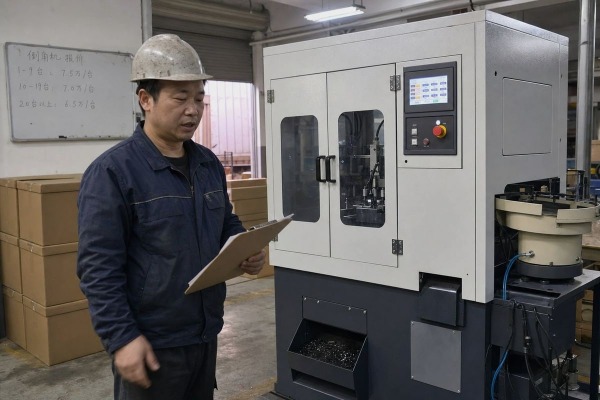
Pricing a fully automatic chamfering machine in Europe is confusing. Quotes swing wildly. Our export team in Wenzhou sees buyers overpay every month simply because nobody explained the tiers.
In Europe, a fully automatic chamfering machine typically costs €40,000–€150,000+ when purchased from European brands, with CNC and robotic cells at the top. Comparable machines imported directly from Chinese factories usually cost $8,000–$13,000, depending on configuration, feeding system, and precision requirements.
That gap is real, and it deserves an honest explanation. Below, I break down what drives the price, how customization changes the total, and what importing actually involves.
Last quarter, a Slovakian distributor sent me three competing quotes for review. Same product label, three wildly different machines. Our engineers spent an afternoon decoding the spec sheets for him.
Five factors set the price: automation level (PLC vs. full CNC), part geometry and size range, single-end versus double-end processing, feeding and clamping complexity, and brand origin. European-built machines carry a premium for CE compliance, local service networks, and European manufacturing standards.

The single biggest confusion I see is the word "automatic" itself. Suppliers use it loosely. A machine with automatic chamfering but manual loading is really semi-automatic. A true fully automatic system 1 handles feeding, clamping, chamfering, and part discharge without an operator touching the workpiece. When we build these systems, the vibratory bowl feeder and servo-driven feed system often cost as much as the cutting head itself.
Here is how the market actually breaks down, based on what our customers report and what public listings show:
| Tier | Typical Price (Europe) | What You Get |
|---|---|---|
| Used / semi-automatic | €9,900–€21,400 | Older units, manual loading, no warranty |
| Entry automatic (imported) | $8,000–$13,000 | Full auto feeding, PLC control, standard parts |
| Lower automatic (EU brands) | €40,000–€60,000 | Standardized geometry, limited integration |
| Mid-range CNC | €60,000–€100,000 | Higher precision, auto loading/unloading |
| High-end robotic cells | €100,000–€150,000+ | 5-axis, vision inspection, in-process measurement |
A machine chamfering short bolts is simple. A CNC tube end finisher handling long, thin-walled tubes needs longer supports, gentler clamping, and slower cycle logic. Larger diameters demand bigger spindles and stronger frames. Every step up in size range adds material, motor torque, and cost. Material specialization pushes prices further; hardened alloys require high-torque spindles and better cooling, often adding 20% or more.
A double-end chamfering machine 2, which finishes both ends of a workpiece in one pass, typically carries a 30–50% premium over single-end models. But it can halve your production cycle time, so the premium often pays for itself.
A tricky trade-off comes up in almost every project we quote: standard tooling versus dedicated fixtures. Our design team recently rebuilt a feeding bowl three times for one unusual terminal profile before the sample run passed.
Customization typically adds 10–40% to the base machine price. Dedicated tooling, non-standard part sizes, double-end processing, and Industry 4.0 features each raise cost. However, matching the machine exactly to your part usually lowers scrap rates and total cost of ownership.

Customization is where our workshop spends most of its engineering hours. When a buyer sends us product drawings, we reverse-engineer the process: how the part feeds, how it orients, how it clamps, and what chamfer angle and surface finish the drawing demands. Each answer changes the bill of materials.
| Customization | Typical Cost Impact | When It Is Worth It |
|---|---|---|
| Dedicated feeding bowl and tracks | +5–15% | Non-standard or asymmetric parts |
| Double-end processing | +30–50% | High-volume symmetrical parts |
| Servo-driven feed system upgrade | +8–15% | Tight length tolerances |
| Hard-alloy tooling and cooling | +20%+ | Hardened steel or carbide parts |
| IoT sensors and remote diagnostics | +5–10% | Multi-shift or unattended production |
| Extra size-change tooling sets | +5–10% per set | Frequent product changeovers |
One trend I actively recommend to smaller European workshops is modular buying. You purchase the core automatic unit now, then add robotic loaders, conveyors, or inspection stations later. Our custom industrial automation systems 3 are designed with this in mind, because it keeps the initial capital outlay manageable. Many European SMEs take this route to spread investment across two or three budget cycles.
There is also a hidden benefit of proper customization: energy efficiency. Machines specified with high-efficiency motors and variable frequency drives 4 cost slightly more upfront, but rising European energy prices make that premium recoverable. In several EU countries, such upgrades even qualify for green investment tax incentives. Under-specifying to save a few thousand dollars is the most expensive mistake a buyer can make.
Shipping a machine to Serbia last year taught me a lesson about crating. The forwarder changed vessels twice, and only our reinforced plywood crate with internal bracing kept the HMI panel intact.
Expect 30–60 days production time for a standard automatic machine, plus 30–45 days sea freight to European ports. Landed cost adds roughly 15–30% over the machine price for freight, insurance, import duty, and VAT, which is often reclaimable for VAT-registered businesses.

The headline machine price is never the final number. When our international sales team prepares a quote for a European buyer, we walk through the full landed cost line by line, because surprises at customs destroy trust faster than anything else.
Here is a typical calculation for a $10,000 fully automatic chamfering machine shipped from China to a European port:
| Cost Item | Typical Range | Notes |
|---|---|---|
| Machine (FOB) | $8,000–$13,000 | Depends on configuration |
| Sea freight + crating | $800–$1,800 | One crate, LCL or shared container |
| Marine insurance | $50–$150 | Strongly recommended |
| Import duty | 0–2.7% | Most machine tools are low-duty in the EU |
| VAT | 19–25% of CIF value | Reclaimable for VAT-registered firms |
| Local delivery + unloading | $300–$800 | Forklift or crane needed |
One point matters enormously for European buyers: insist on CE certified industrial machinery 5 with a genuine Declaration of Conformity. Customs may not check it, but your insurer and labor inspectorate will. When we prepare machines for markets like Slovakia, the CE documentation package 6 is part of the build, not an afterthought. Buyers of hydraulic pipe processing lines and high-speed beveling machine setups should apply the same scrutiny.
A Canadian production manager once messaged our WhatsApp at midnight China time about a feeder jam. Our engineer diagnosed a worn track liner from a two-minute video and shipped the part the next morning.
Choose suppliers offering remote video commissioning, complete documentation, a defined warranty with clear spare-parts pricing, and responsive engineers on WhatsApp or email. Budget 3–5% of the machine price annually for spare parts and industrial equipment maintenance costs.
After-sales support is where the price gap between European brands and direct-import machines gets debated most. European brands charge more partly because they promise a technician at your door. But in our experience serving customers from Mexico to South Korea, remote support solves the vast majority of issues faster than waiting for a site visit.
Modern metalworking automation solutions 7 make remote service practical. A machine with an HMI touchscreen and IoT-enabled diagnostics can report fault codes, tool-wear data, and cycle counts directly to the supplier. When we commission machines remotely, we schedule live video sessions, walk the operator through alignment and parameter setting, and record every session so the buyer keeps a training library.
Before you sign any contract, confirm these items in writing:
Plan for consumables from day one. Chamfering inserts, feeder liners, and clamping jaws wear predictably. For pipe deburring equipment running two shifts, we advise stocking one full set of wear parts on-site. That small inventory costs a few hundred dollars and prevents week-long stoppages. In high-wage European regions, the ROI math is compelling: an automatic machine displacing one manual station often breaks even in under 18 months, but only if uptime stays high. Support quality, not purchase price, decides that outcome.
Unclear pricing wastes budgets and delays projects. Know the tiers, calculate landed cost, and demand written support terms. Do that, and your fully automatic chamfering machine investment pays back fast.
1. Wikipedia entry defining automation, providing context for fully automatic systems in industrial manufacturing. ↩︎
2. Wikipedia overview of chamfering, providing technical context for double-end processing machines. ↩︎
3. NIST resource on industrial control systems, relevant to the design of automated manufacturing units. ↩︎
4. Authoritative definition of variable frequency drives, explaining their role in energy efficiency for industrial motors. ↩︎
5. European Commission page detailing the Machinery Directive and safety standards for industrial equipment. ↩︎
6. Official EU portal detailing technical documentation and CE compliance requirements. ↩︎
7. Current NIST MEP guide for implementing robotics and automation in manufacturing. ↩︎
