

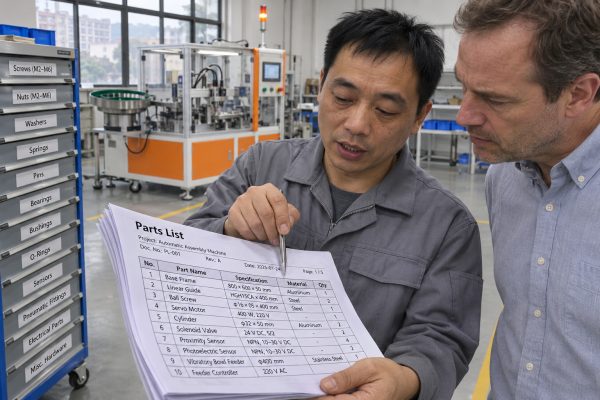
Long-term spare parts availability for an [automatic assembly machine](https://yqunique.com/how-evaluate-supplier-after-sales-service-buying-automatic-assembly-machine/) worries every buyer we quote. Our Wenzhou-built lines run for decades, yet one discontinued PLC can idle them. Planning fixes that.
Long-term spare parts availability comes from confirming five things before purchase: the supplier’s guaranteed supply period, part standardization level, inventory management plan, discontinuation substitution options, and long-term pricing. Then maintain a complete BOM, a critical spares list, and a formal obsolescence management review.
The problem is simple to state. A machine body lasts far longer than its electronics. Industrial assets often run for 20 to 40 years. Controllers, drives, and HMIs may be discontinued long before that. Below I walk through how we help buyers close that gap, from the first quotation to the day a part finally disappears.
A US procurement manager once asked us for the lifecycle status 1 of every drive in our terminal crimping line before signing. We now send that list unprompted.
Verify supply capability by requesting a full Bill of Materials with lifecycle status for each component, written supply-period commitments, evidence of standardized parts, a documented inventory and last-time-buy process, and reference customers who have run the machine for several years.

Most buyers check a supplier's price and delivery date. Very few check what happens in year eight. That is backwards. The machine price is paid once. Spare parts are paid for over the whole service life. So I treat the pre-contract stage as a supply chain risk assessment, not a shopping trip.
A brochure tells you the machine uses "brand-name servo motors." A Bill of Materials 2 (BOM) tells you the exact part number, revision, and manufacturer. That difference matters. One industry analysis found roughly 45% of tracked industrial parts were already in end-of-manufacturing or end-of-life stages. That figure is sector-specific, but it shows the scale of the issue. If a supplier cannot produce a BOM with lifecycle status, they probably do not track obsolescence at all.
When we quote a cable lug or chamfering line, we attach a BOM that covers every category: PLC, HMI, safety relays, servo drives, fieldbus modules, pneumatic valves, sensors, bearings, seals, grippers, feeder tooling, and our own custom-machined parts. Each line shows the status: active, mature, last-time-buy, or discontinued.
Our own checklist, built from years of exporting to the US, Germany, and Japan, comes down to five points. I ask buyers to confirm all of them before any deposit.
| Verification item | What to request from the supplier | Red flag |
|---|---|---|
| Supply period in years | A written number, per component class | "Many years" or "as long as possible" |
| Part standardization level | Share of components from major industrial brands with published longevity | Unbranded or house-labelled controllers |
| Inventory management | Which critical spares the supplier stocks, where, and how they are rotated | No stock list, no shelf-life tracking |
| Discontinuation substitution plan | How EOL notices are handled, including successor cross-references | Supplier learns about EOL from the buyer |
| Long-term purchase price | A price list with escalation limits for defined spares | Prices quoted only "at time of order" |
Written answers can be checked. Call the component brands and confirm the stated lifecycle. Ask for a sample end-of-life (EOL) notice the supplier has handled in the past and what they did about it. Ask for one reference customer and talk to their maintenance lead, not their sales contact. A supplier with real capability will welcome this. A supplier without it will stall.
Early on, we wrote "parts available for many years" into a quote for a German distributor. His lawyer sent it back. Vague promises protect nobody, so we learned to specify.
A spare parts agreement should define the minimum support period, guaranteed availability for listed critical parts, advance end-of-life notice with last-time-buy windows, price escalation limits, response and delivery times, repair or exchange services, documentation and software access, and transfer of obligations if the supplier changes ownership.

A spare parts agreement is easiest to negotiate before the machine ships. After shipment, you have no leverage. So I recommend buyers put spare parts terms into the original request for quotation. IEC 62550:2017 covers spare-parts provisioning for continuity of operation, and IEC 62402:2019 covers obsolescence management across the lifecycle. You do not need to quote either standard in the contract. But their logic should shape it: define the parts, define the period, define the process when a part dies.
The table below shows the clauses we now include as standard in our own export contracts. Each one closes a specific gap we have seen cause trouble.
| Clause | Why it matters | What to define |
|---|---|---|
| Minimum support period | Sets the baseline obligation | A number of years, counted from acceptance |
| Critical spares list | Names the parts that can stop the line | Part numbers, quantities, lead times, shelf life |
| EOL notice and last-time-buy window | Gives time to react before a part vanishes | Notice period in months and a buying window |
| Price protection | Prevents price shocks on captive parts | Escalation cap tied to a public index |
| Response and delivery times | Turns "fast" into a measurable target | Hours to respond, days to ship per part class |
| Repair and exchange units | Covers expensive electronics | Turnaround time, warranty, exchange stock |
| Documentation and software | Makes the part usable once it arrives | Schematics, CAD, PLC programs, parameters, licenses |
| Successor compatibility | Keeps future modules installable | Form-fit-function or supplier-funded adaptation |
| Transfer of obligations | Survives mergers and exits | Named escrow or assignment terms |
One supplier guide for semi-automatic assembly equipment 3 suggests budgeting roughly 3% to 6% of purchase price per year for consumables and wear parts. That figure will not fit every fully automatic machine. Complexity and utilization change it. But it gives buyers a starting point for the preventive maintenance budget. I encourage buyers to ask us for a priced wear-parts schedule before acceptance, so the number is based on our actual feeder tooling and tooling-change intervals rather than a rule of thumb.
Many agreements promise support but exclude "third-party components." On an assembly machine, that can mean the PLC, drives, and HMI, which are the highest-risk items. Ask what is excluded. Then negotiate a substitution duty for excluded items: if the supplier cannot deliver the original, they must qualify and offer a successor.
Every servo drive we specify forces a choice. The proprietary unit gives tighter motion. The standard unit gives more sourcing options. We weigh that on each line we build.
Choose OEM parts for safety components, controls, and anything tied to firmware or certification. Choose qualified compatible alternatives for standardized mechanical and pneumatic items like bearings, seals, valves, and sensors, but only after verifying dimensions, ratings, protocol compatibility, and effect on cycle time and quality.

The OEM vs aftermarket parts debate is usually framed as cost against trust. In my experience it is really about risk per component. Here is how the two routes compare on an automatic assembly machine.
| Factor | OEM original part | Compatible alternative |
|---|---|---|
| Traceability | Full, with serial numbers | Varies by source |
| Firmware and configuration | Guaranteed match | May need new parameters or logic |
| Safety certification | Preserved | May require formal revalidation |
| Price | Higher, sometimes captive | Usually lower |
| Lead time | Can be long for mature parts | Often shorter from distributors |
| Availability after EOL | None | Sometimes the only route |
| Technical support | From machine builder | Often limited |
| Counterfeit risk | Low | Real, especially via brokers |
Buyers often say "compatible" as if it meant one thing. It does not. I separate three cases.
A buyer in India once pushed us hard to approve a low-cost aftermarket safety relay. I understand the pressure. But a cheaper part that invalidates the machine's safety function is not a saving. It is a liability. For safety relays, safety PLCs, and light curtains, I only approve OEM or a formally revalidated equivalent. For a bearing, a seal, a standard pneumatic valve, or a proximity sensor with a standard M12 connector, a qualified alternative is sensible. We design our lines around standard industrial components 4 for exactly this reason. Part standardization is one of the five things I urge buyers to confirm up front.
Qualify alternatives while the OEM part is still available. Check dimensions, electrical ratings, response time, repeatability, environmental rating, protocol, materials, and expected service life. Then run it on the machine and compare cycle time and reject rate. Some plants now use digital twin simulations to check non-OEM logic behavior before physical installation. For mechanical items, a vault of certified 3D-printable CAD files can let you fabricate discontinued brackets or guides on site. Both approaches work only if the drawings and parameters were secured when the machine was new.
During final acceptance of a vibratory feeder line, we deliberately swapped a proximity sensor with the shipped spare. The connector pinout differed. We caught it before export.
Reduce downtime risk by stocking critical long-lead spares on site, using CMMS reorder points based on MTBF and usage, qualifying second sources and repair partners, keeping tested exchange units, running predictive maintenance, and backing up all software so replacements install without delay.

That sensor story taught me something. Holding a spare is not the same as having a usable spare. Inventory management must cover revision, firmware, connector, and configuration, not just quantity. With that in mind, here is the layered approach I recommend.
Not every part deserves the same policy. We rate every item on the BOM by consequence of failure, probability of failure, lead time, and availability of alternatives. Price is not a factor. A cheap sensor that stops the line outranks an expensive motor you can buy anywhere.
| Class | Definition | Stocking policy |
|---|---|---|
| Critical | Stops the line, safety-related, or lead time over 48 hours | On-site stock, plus a documented second route |
| Important | Reduces capacity or needs major intervention | Supplier-held or regional stock, repair contract |
| Routine | Inexpensive and widely available | Reorder on demand via CMMS trigger |
| Wear or consumable | Replaced at known intervals | Scheduled replenishment tied to preventive maintenance |
A large safety stock feels safe. It also ties up cash and ages on the shelf. Electronics degrade from moisture and dead backup batteries. Elastomers harden. So we aim stock at the overlap of high impact and long or uncertain replenishment. A CMMS can set reorder points from real usage and Mean Time Between Failures 5 (MTBF). For parts that fail once every several years, the history is too thin to forecast. Those parts need a judgment call and a documented resolution: buy and hold, last-time buy, qualify an equivalent, or set up repair.
Every machine we ship leaves with PLC programs, HMI files, drive parameters, safety configuration, schematics, and CAD on more than one medium. I ask buyers to store a copy off-site and test restoring it once a year. A part that arrives in 24 hours is useless if nobody can load the parameters.
Track critical spare availability, stockout-related downtime, actual versus quoted lead time, repair turnaround, and the share of critical parts with an approved sourcing route. Do not optimize inventory turns alone. A high turn rate can simply mean you are understocked and paying for it in lost production.
Machines outlive their parts. Ignore that and one EOL notice halts your line. Confirm supply years, standardization, inventory, substitutes, and pricing early, then review them every year.
1. US government resource for international trade standards and industrial equipment lifecycle management. ↩︎
2. Detailed explanation of BOM management and its role in manufacturing and inventory control. ↩︎
3. International organization providing safety and performance standards for industrial assembly equipment and machinery. ↩︎
4. Global organization that prepares and publishes international standards for all electrical and electronic technologies. ↩︎
5. Technical definition of the reliability metric used to predict component failure and plan maintenance. ↩︎
