

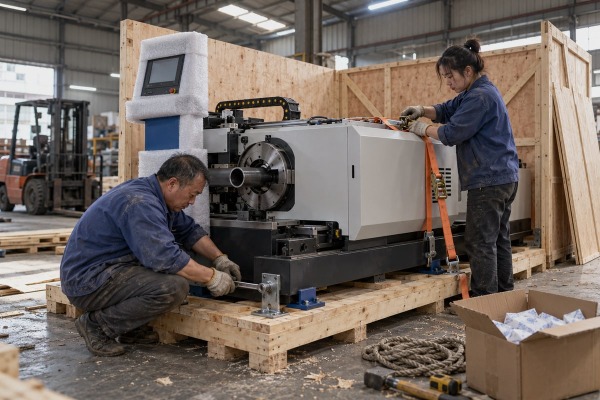
A loose bolt after one sea voyage cost our Wenzhou team days of support calls. Packaging for long-distance transport of [pipe cutting machine](https://yqunique.com/?p=5763)s fails quietly. We now engineer it.
Yes, packaging for long-distance transport of pipe cutting machines can withstand vibration, but only when it works as a complete system: a stiff skid, locked moving parts, positive restraint, matched cushioning, VCI corrosion protection, and testing against the real route rather than a generic crate.
The crate surviving is not the goal. The machine arriving ready to cut is the goal. The sections below walk through materials, testing, supplier documentation, and the crate-versus-foam decision in plain terms.
During a final packing check last year, our QC lead pressed a thumb into the foam under a control tower and it stayed dented. We changed the material that day.
Use a layered set of materials: a hardwood or steel-reinforced skid, plywood panels with diagonal bracing, polyethylene or polyurethane foam matched to the machine’s static load, rubber or wire rope isolators under heavy sections, and VCI film with desiccant for moisture and rust protection.

That dented foam had been chosen by density alone. It looked fine on paper. Under the weight of a steel cabinet, it had crept and lost its spring. So the first rule I now apply is simple. Protective cushioning materials must be matched to the static load and the fragility of the part they touch, not picked from a catalog number.
| Layer | Material we use | Job it does | Limit to watch |
|---|---|---|---|
| Skid / base | Hardwood runners, steel channel on heavier frames | Carries machine weight, takes forklift loads | Softwood deflects, absorbs water, and splits |
| Enclosure | Plywood panels on a timber frame | Resists stacking and side impacts | Racks sideways without diagonal bracing |
| Restraint | Bolts into the base frame, steel brackets, ratchet straps | Freight load securing; stops the machine shifting | Must never anchor to sheet-metal covers or doors |
| Isolation | Rubber pads or wire rope isolators | Shock and vibration damping under heavy sections | Wrong stiffness only moves the resonance frequency |
| Cushioning | PE or PU foam blocks, molded inserts | Protects edges, HMI screen, hydraulic cylinder | Takes a permanent set under long static load |
| Climate | VCI film 1, desiccant, vacuum seal | VCI corrosion protection for rails and bare steel | One pinhole defeats the whole barrier |
Our CNC pipe cutting machine has a long base cabinet, an elevated blue control tower with a touchscreen HMI, a chrome hydraulic cylinder 2, a black cable drag chain, and a jointed coolant nozzle. Each of these needs a different answer. The control tower gets a foam frame around the HMI and the red, green, and yellow buttons. The hydraulic cylinder rod gets wrapped so nothing abrades the chrome. The drag chain gets tied down so it cannot whip. The coolant nozzle arm is removed and packed in the pull-out drawer compartment. The cutting head is locked at the end of its linear rail. Then the whole frame is bolted to the skid, with the four leveling feet and their orange rubber pads lifted clear of the floor so they carry no transport load.
Immobilization stops the machine moving relative to the crate. Cushioning lowers the force that reaches the machine. You need both. I see three common mistakes. First, soft foam with no mechanical lock, so the machine walks under continuous vibration. Second, a machine bolted rigidly to the crate with no isolation, so every road input goes straight into the bearings. Third, loose fill in empty space, which settles after the first hundred kilometers.
The second mistake also causes fretting. Tiny repeated movements between the machine and its dunnage polish contact points and strip coating. On an unpainted guide rail, that stripped spot then rusts in a humid container. That is why VCI film is a mechanical issue as much as a chemical one.
A buyer once told me foam alone would be fine because the machine was “not that fragile.” I understand the thought. But foam compresses, ages, and loses resilience under several hundred kilograms of steel. It protects surfaces. It does not carry structure. The skid and the restraints carry structure.
Every test plan forces a choice between lab cost and route realism. For a one-off export to Germany, we weigh that choice differently than for a repeat order.
Test the packaged machine, not just the crate. Run a resonance search first, then a random vibration profile matched to your route under ISTA 3E or ASTM D4169, with accelerometers on sensitive components, and confirm pass or fail through torque checks, alignment measurements, and a functional cutting test.

A ten-person team does not own a shaker table. I say that openly. What we can do is design the test plan, book a third-party lab when the order justifies it, and put data loggers in every crate so the real route tells us whether our assumptions held. The method matters more than who owns the equipment.
| Test type | What it does | What it tells you |
|---|---|---|
| Sinusoidal sweep | Sweeps through fixed frequencies | Simple, but not like a real truck |
| Resonance search | Finds the resonance frequency of the machine and crate | Shows where amplification will occur |
| Random vibration 3 | Plays a broadband profile similar to road, rail, or air | Closest match to real distribution |
| Frequency response | Measures how base vibration reaches a component | Shows if the HMI or cutting head is isolated or amplified |
Resonance is the reason the search comes first. If the natural frequency 4 of the control tower sits close to the dominant truck-bed frequency, amplification can reach five to twenty times the input. A moderate road can then shake a bracket to failure. Good packaging shifts the system resonance frequency away from common vehicle ranges, and the search tells you whether it did.
Visual inspection is not enough. Hidden damage is the real danger. A crate can show no mark while fasteners inside have backed off or a sensor has lost calibration. So our acceptance list is functional. No permanent shift of the machine on the skid. No loosened restraint or fastener. No permanent set in foam or isolators. No crack in welds or brackets. No fluid leak at hydraulic fittings. No change in alignment beyond the installation tolerance. The machine clamps, positions, rotates, cuts, and communicates with the PLC exactly as it did before.
Two more tools are getting cheaper every year. IoT tri-axial loggers give a black-box record of shock, tilt, temperature, and humidity across the whole journey. That record supports insurance claims and tells a buyer whether recalibration is needed before first use. And finite element analysis can build a digital twin of the crate so the geometry is optimized before the first prototype is nailed together. Neither replaces good packaging. Both make the next design better.
One procurement manager in the United States asked me for a packing video before he asked for a price. That request changed how we document every shipment.
Require ISPM 15 heat-treated timber, a written test plan referencing ISTA testing standards or ASTM D4169 that matches your route, plus packaging design drawings, real packing photos or video, a torque and alignment record, and proof of VCI vacuum packaging before the machine leaves the factory.

He was right to ask. A certificate on a document and a strap on a machine are two different things. So I now send drawings, photos, and video as standard, and I encourage every buyer to check them item by item. Below is the list I would want to see if I were on the buying side.
| Standard or body | What it covers | When it fits a pipe cutting machine |
|---|---|---|
| ISPM 15 | Heat treatment and marking of wood packaging | Every export in timber; customs will reject unmarked crates |
| ISTA hazard framework | Shock, vibration, compression, atmospheric conditions | Use it to structure the hazard list for any route |
| ISTA 1A | Integrity test for individual packages up to 150 lb / 68 kg | Only portable cutters shipped as parcels |
| ISTA 3-Series (e.g., 3E) | General simulation with random vibration, drops, conditioning | Palletized or crated machines in truck and container freight |
| ASTM D4169 | Build-your-own distribution cycle by route and mode | Heavy industrial shipments mixing truck, rail, and port handling |
Two cautions. ISTA 1A sounds reassuring but its weight ceiling rules it out for almost every industrial pipe cutting machine. And ISTA procedures do not provide an ocean vibration profile in every case. For a sea route to the United States or Mexico, I ask for route-specific logger data or an engineering simulation rather than a parcel profile dressed up as proof.
Which components are the most vibration-sensitive? Which parts are removed and packed separately? Was the package tested with the actual machine or only a drawing? What post-test measurement decides pass or fail? Is shock and tilt being monitored in transit? Was packaging designed alongside the machine, or added after it was built? That last question matters. When packaging is an afterthought, the lifting points end up behind a panel and the restraints end up on a door hinge.
The hardest lesson our Wenzhou workshop learned about industrial crating solutions is that the question is rarely crate or foam. The real question is which layer carries the load.
Choose a reinforced wooden crate as the primary structure for any pipe cutting machine heavier than the 68 kg parcel limit of ISTA 1A, and add custom foam only for localized surface protection; foam-led packaging alone suits only compact portable cutters that ship as parcels.

| Factor | Reinforced wooden crate | Custom foam packaging | Hybrid (crate plus foam) |
|---|---|---|---|
| Best for | Machines on a skid, forklift and crane handling | Portable cutters, accessories, control units | Nearly every industrial pipe cutting machine |
| Structural support | Full; carries stacking and impact | None; relies on an outer box | Full, from the crate |
| Vibration isolation | Only if isolators are added | Some, but drifts as foam ages | Isolators under the skid, foam at contact points |
| Moisture | Timber absorbs water; needs VCI and barrier film | Closed-cell foam resists water | VCI vacuum bag inside crate |
| Weight and cost | Heavier, higher freight cost | Light, cheaper per unit | Highest engineering effort, best protection |
| Reuse | Possible with bolted panels | Rarely | Steel-frame versions are reusable |
Our pipe cutting machine with its hydraulic cylinder, control tower, and orange safety enclosure is not a parcel. It needs a skid that forks can enter, a frame that holds stacking weight, and a shape a crane can lift safely. Foam cannot do any of that. But a bare crate with the machine bolted straight to the floor transmits every rail joint into the bearings. So the crate carries the structure, isolators sit between skid and machine, and foam guards the HMI, the chrome rod, and the sheet-metal corners. That is transit damage prevention by layers, not by bulk.
“Overpackaging is safer.” It is not. A heavier crate costs more to ship, is harder to handle, and hits harder when a forklift drops it. Protection comes from engineered restraint and validated cushioning, not from extra timber.
“Bolting it down rigidly is enough.” Rigid bolting stops large movement, which is good. But without isolation it couples the machine to the vehicle floor. Sensitive assemblies need isolation between machine and skid, while still being held against big displacement. Both at once.
For repeat exports, reusable steel frames with replaceable cushioning modules cut waste and cost over time. The trade-off is higher upfront engineering and the hassle of return logistics. Modular, adjustable tensioning systems are replacing static timber blocking because they let us align the restraint with the true center of gravity of an asymmetric machine. And sustainability pressure is real. Buyers in Germany and France ask about reduced plastic and timber. We can lighten the package, but only with better engineering, never by thinning the skid or skipping the VCI bag.
Vibration damage hides inside a perfect crate. Ask for drawings, photos, and video, check every layer, and test for the real route. Then the machine arrives ready to cut.
Interested in sourcing the products mentioned in this article? See details and request a quote here:
