

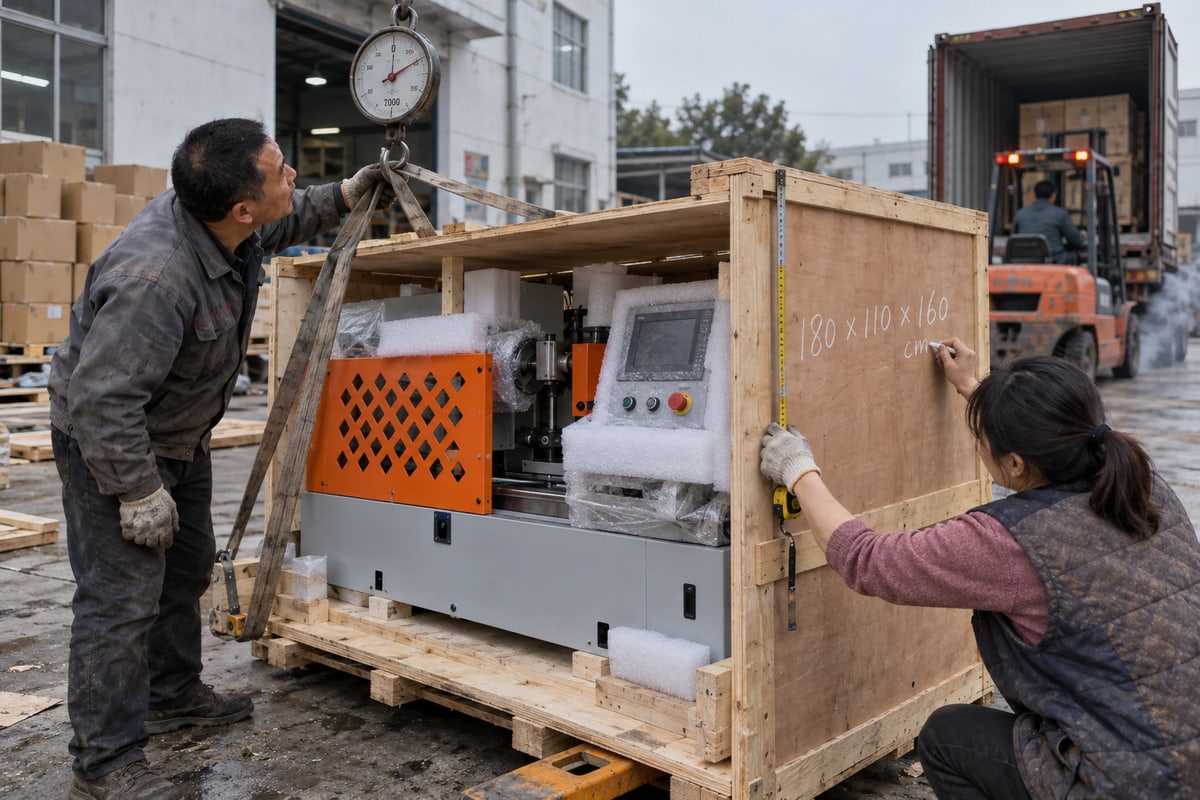
A buyer’s automatic pipe cutting machine from Europe sat in port for weeks because international logistics was an afterthought. We ship cutting lines to Germany and Italy, so I knew why.
Choose international logistics for an automatic pipe cutting machine from Europe by confirming packed weight and dimensions, calculating total door-to-door landed cost, picking sea FCL for cost, rail for speed, air only for spare parts, fixing Incoterms 2020 rules, and insuring the machine all-risk until it is installed.
That is the short version. The long version is what I walk every procurement manager through before a machine leaves our Wenzhou floor. The same logic works in reverse when you buy from a European builder. Let me break it into four questions.
A US procurement manager once sent me two European quotes on WhatsApp. One was EXW, one was DAP. He assumed the EXW machine was the cheaper deal.
Before sourcing an automatic pipe cutting machine from Europe, check the full landed cost: export packing, origin handling, main freight, marine cargo insurance, customs brokerage, duties under the correct Harmonized System code, VAT or GST, port storage, inland delivery, unloading, and installation. Compare quotes only on identical Incoterms.

The EXW quote was lower on paper. It was not lower in reality. Once we added local trucking in Germany, export declaration, port handling, and ocean freight shipping 1 to the US, the DAP offer was close to the same number. And the DAP seller carried the risk until the truck reached his gate. That is the trap I see most often. Buyers compare a machine price. They should compare a landed cost.
I use one formula with every customer, whether they buy from us or from a European competitor:
Total landed cost = machine price + export packing + origin handling + inland transport + export clearance + main carriage + insurance + destination handling + customs brokerage + duties + VAT or GST + port storage + inland delivery + unloading + installation + commissioning + contingency.
Ask your freight forwarding services provider for a door-to-door landed estimate. Do not accept a port-to-port rate. Port-to-port hides destination terminal fees, free-time limits, and demurrage. Those are the charges that surprise people.
Incoterms set where cost and risk move from seller to buyer. They do not cover installation, training, warranty, or ownership. You must write those into the contract separately.
| Incoterm | Seller handles | Buyer handles | My view for machinery |
|---|---|---|---|
| EXW | Makes machine available at factory | Export clearance, all transport, import | Looks cheap, often costs more for overseas buyers |
| FCA | Export clearance, delivery to buyer’s carrier | Main carriage, insurance, import | Most practical balance of control and simplicity |
| CPT / CIP | Arranges carriage (CIP adds insurance) | Import clearance, duties, risk after handover | Clarify the exact risk transfer point |
| DAP | Delivers to named destination | Import clearance, duties, taxes, unloading | Good when buyer has a local broker |
| DDP | Everything including import and duties | Receiving only | Risky if seller cannot act as importer of record |
| FOB / CIF | Sea-only terms, risk at ship’s rail | Varies | Poor fit for containers handed over at a yard |
The cheapest Incoterm is often the most expensive choice. EXW gives an experienced buyer full control. But if you have never arranged an export declaration in Italy, FCA is safer. DDP sounds simple, but a European seller may not have a tax structure in the US or Mexico to recover import VAT. That cost then lands in your price without being itemized.
Fix the Harmonized System code 2 during the quoting phase, not after the crate is on the water. In Europe the TARIC classification follows the machine’s principal function and cutting technology. Confirm it with a licensed customs broker, not from the supplier’s invoice description. Then check whether a free trade agreement between the EU and your destination lowers import tariffs and taxes. You will need proof of preferential origin to claim it. If the machine is for a short-term project, ask about temporary admission or an ATA Carnet to defer duty and VAT.
One more cost item buyers forget: a used or refurbished machine. The purchase price is lower, but inspection, compliance upgrades, missing manuals, and spare-parts risk all add cost. Evaluate it on total ownership, not acquisition price.
Every quote I prepare for a German or Italian customer forces one trade-off: ocean freight savings versus weeks of logistics lead times. The same trade-off applies when you buy from Europe.
Use sea freight, ideally a full container (FCL), for a complete automatic pipe cutting machine when cost matters more than time; choose a flat-rack or open-top container if it is oversized. Use rail for inland Europe–Asia routes under schedule pressure. Reserve air freight for urgent spare parts and control components.

Here is how I lay the options side by side before I recommend anything:
| Mode | Best for | Relative cost | Lead time | Handling exposure |
|---|---|---|---|---|
| Sea FCL (standard or high-cube) | Complete machine, cost priority | Low | Longest | Low, container sealed at origin |
| Sea flat-rack / open-top | Machine too long, wide, or tall for a box | Medium | Longest | Medium, exposed cargo |
| Breakbulk / Ro-Ro | Very large lines, multi-crate shipments | Medium to high | Long | Higher, project handling |
| Rail (China–Europe express) | Inland Europe–Asia routes with a deadline | Medium | Medium | Medium, terminal transfers |
| Road (within Europe) | EU to EU, EU to UK | Medium | Short | Low, door to door |
| Air | Sensors, servo drives, tooling, warranty parts | Very high | Days | Low |
I keep three simple rules on my desk. They come from our own export work to Europe, and they hold just as well in reverse.
Our cutting machines ship with a control tower, a hydraulic cylinder assembly, a cable drag chain, and a separate crate of tooling. Those packages must arrive together. Less-than-container load mixes your crates with other shippers’ cargo. That means extra handling at consolidation warehouses and a higher chance one crate goes missing or gets knocked. A dedicated container keeps the set intact and sealed from the factory door.
Before I request any ocean quote, I confirm packed dimensions, gross and net weight, number of crates, lifting points, and center of gravity. Some forwarders now run a 3D digital model of the crate to plan lashing points and prevent structural stress during transfers. Ask for it. It is cheap compared with a bent linear rail.
Road freight inside continental Europe deserves a note. It is usually the most practical option for EU-to-EU moves and for exports to the UK. But “road freight” is not one price. A tautliner, a low-loader, or a flatbed each costs differently. Oversized loads need permits and sometimes escort vehicles. UK-bound shipments now also need customs clearance documentation 3 at the border.
On sustainability, sea and rail generally produce lower emissions per machine than air. Some carriers offer biofuel vessels or offset programs, which helps ESG reporting. But a slow mode with extra inland legs can erase that benefit. Weigh it honestly against your downtime cost.
One lesson from our early exports: a crate without an ISPM 15 mark 4 can stop a shipment at the border. I now check heat-treatment stamps before any machine leaves Wenzhou.
The main delay risks for heavy machinery shipping are wrong tariff codes, missing customs clearance documentation, non-ISPM 15 wood packaging, incomplete CE marking paperwork, oversized-load permits for the final road leg, port congestion, and commissioning engineers who arrive before customs release. Plan each one before dispatch.

Most delays are not caused by the ship. They are caused by paper, timber, and the last ten kilometers. I group the risks into four buckets and assign an owner to each one before the purchase order is signed.
| Risk | What goes wrong | Who should own it | Mitigation |
|---|---|---|---|
| Documentation | Missing invoice detail, wrong HS code, no EORI | Supplier + your broker | Full document set approved before crating |
| Wood packaging | No ISPM 15 heat-treatment mark | Supplier | Require stamped crates and photos of the mark |
| Compliance | CE file incomplete or wrong framework | Supplier + your engineering lead | Declaration of Conformity and manuals before shipment |
| Final mile | Low bridge, weak floor, no crane | You + rigging contractor | Route survey and lifting plan |
| Timing | Engineer lands before customs release | You + supplier service team | Tie engineer travel to estimated time of clearance |
Your customs clearance documentation set should include the commercial invoice, packing list, transport document, export and import declarations, the agreed Harmonized System code, country of origin, customs value, your EORI or equivalent importer number, any import permits, proof of preferential origin if a trade agreement applies, product compliance papers, the insurance certificate, and the wood-packaging treatment evidence. I ask the supplier to send the full set as PDFs before the crate is closed. If a page is missing then, it is a quick fix. If it is missing at the port, it is storage and demurrage.
CE marking compliance is a procurement issue, not just an engineering one. Machinery placed on the EU market before 20 January 2027 follows the current Machinery Directive 2006/42/EC. From 20 January 2027 the EU Machinery Regulation 2023/1230 5 becomes mandatory and replaces it. If your delivery or installation could fall near that date, write into the contract which framework applies. Request the EU Declaration of Conformity, the risk assessment, operating and maintenance manuals, electrical schematics, pneumatic and hydraulic diagrams, spare-parts list, test records, and serial-number confirmation.
Remember that CE marking covers the EU market. If you are importing to the US, Mexico, or India, you still need to meet local workplace safety, guarding, emergency-stop, and electrical rules. A CE certificate on its own is not proof of compliance anywhere.
International transport can succeed while delivery fails at the factory gate. Run an inland route survey for the last leg. Check truck access, turning radius, door height, floor loading, overhead clearance, and crane or forklift capacity against the heaviest crate. Secure oversized-load permits early. Then prepare power, compressed air, foundation, and a clean temporary storage area.
Two more habits that save weeks. First, insist on a Factory Acceptance Test at the European plant using your own pipe samples before you authorize crating. Second, synchronize the commissioning engineer’s flight with the estimated time of clearance, not the vessel’s arrival date. Standby fees for a technician waiting on customs are real money.
Before any cutting machine leaves our floor, our QC team photographs the crate open and closed, adds desiccant, and fits a tilt indicator on the control cabinet.
Require export-grade timber crates with ISPM 15 marks, vapor-barrier wrap, desiccant, rust inhibitor, internal bracing, and marked lifting points, plus pre-dispatch photos. Then buy all-risk marine cargo insurance at replacement value, covering every leg from loading to final positioning, with consequential loss added where production downtime is costly.

A pipe cutting machine is not one lump of steel. The touchscreen HMI, the servo motors, the linear rail, the hydraulic cylinder, and the coolant nozzles each fail in a different way during transit. Our packing spec treats them separately. Ask your European supplier for the same.
| Component | Transit threat | Packaging measure |
|---|---|---|
| Control tower and HMI screen | Shock, moisture, screen cracking | Foam-lined cover, vapor barrier, screen protector, shock indicator |
| Linear rail and cutting head | Vibration, misalignment | Locked travel, internal bracing, rust inhibitor on exposed steel |
| Hydraulic cylinder and pneumatics | Corrosion, fluid leak | Capped ports, drained or sealed lines, desiccant bags |
| Servo motors and sensors | Condensation, impact | Separate crate or sealed bag inside the main crate |
| Tooling and blades | Loss, damage to other parts | Separate labeled crate, listed on the packing list |
| Whole machine | Tipping, uneven lift | Reinforced skid, marked lifting points, center-of-gravity label, tilt indicator |
Insist that the crate is designed for both forklift and crane handling. Then confirm your site can actually lift the heaviest package. I have seen a perfect crate wait on a truck because the receiving plant’s forklift was rated too low.
Standard carrier liability 6 is limited by weight, not by value. It will not replace a machine. So I treat marine cargo insurance as a separate purchase and work through these questions:
All-risk cover at replacement value is my default. Under CIP the seller must insure, but the minimum level may not match your needs, so review the certificate. Under FCA or DAP you buy your own, which gives you control over the claims process.
Train the receiving team before the truck arrives. Photograph every crate before opening. Check shock and tilt indicators and record their state. Note any visible damage on the delivery receipt before signing. Keep all packaging until the claim is closed. Notify the forwarder and insurer the same day. A claim with photos and a signed delivery note usually settles. A claim with a clean signature and no photos usually does not.
Finally, link your final payment to documented milestones: delivery, inspection, and acceptance. Do not pay the full balance before the machine ships. That keeps the supplier’s packing and service teams engaged until the machine is cutting pipe on your floor.
A good machine can still fail at the port gate. Plan landed cost, mode, documents, packaging, and insurance together, and your European pipe cutting machine reaches production on schedule.
Interested in sourcing the products mentioned in this article? See details and request a quote here:
