

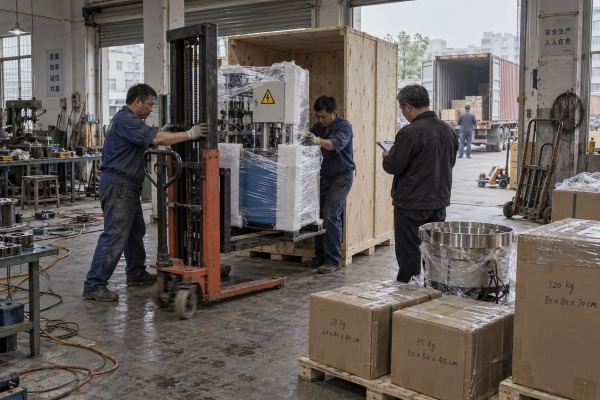
A Mexican buyer once asked our Wenzhou team for the lowest EXW price on a cable lug making machine, then faced surprise port charges before choosing Incoterms properly.
Choose Incoterms when buying a cable lug making machine by matching each term to your logistics ability: pick FCA if you control freight with your forwarder, DAP if you can clear import customs and unload, and DDP only after verifying the seller can legally act as importer of record.
That buyer was not careless. He simply compared invoice prices, not delivered prices. The gap between those two numbers is where most machinery import budgets fall apart. In this article I will walk through the trade-offs we see every week when we ship terminal-making equipment to the United States, Germany, India, Japan, and other markets. The goal is simple. You should finish reading with a clear way to divide costs and responsibilities between you and your supplier.
Every quotation we prepare in Wenzhou forces one trade-off: more control for the buyer means more tasks for the buyer. Control is never free.
The Incoterm giving you the most control is FCA, because you nominate the freight forwarder and carrier while the seller handles export clearance. EXW gives even more control, but it pushes export formalities and factory loading onto you, which few overseas buyers can manage.

Incoterms® 2020 contains 11 rules. Seven of them work for any mode of transport: EXW, FCA, CPT, CIP, DAP, DPU, and DDP. Four are written for sea or inland-waterway transport 1 only: FAS, FOB, CFR, and CIF. A cable lug making machine from our workshop usually travels crated inside a 20-foot or 40-foot container. The vibratory bowl feeder, dies, and spare parts often ship as separate packages in the same container. That is multimodal cargo. It is handed to a carrier at an inland terminal, not lifted over a ship's rail. So the first filter is simple. If your machine goes into a container before the vessel, the any-mode rules describe the real handover point better than the maritime rules.
Cost responsibility and risk responsibility are two separate questions. A seller can pay the freight while you carry the transit risk. The table below shows how each rule divides the main tasks.
| Rule | Who books main freight | Export clearance | Import clearance | Transfer of risk | Buyer control |
|---|---|---|---|---|---|
| EXW | Buyer | Buyer | Buyer | At seller's factory, before loading | Maximum |
| FCA | Buyer | Seller | Buyer | When goods are handed to buyer's carrier | High |
| FOB | Buyer | Seller | Buyer | On board the vessel at loading port | High (sea only) |
| CIF / CIP | Seller | Seller | Buyer | On board (CIF) or at first carrier (CIP) | Low |
| DAP | Seller | Seller | Buyer | At named destination, ready for unloading | Low |
| DDP | Seller | Seller | Seller | At named destination, ready for unloading | Minimal |
I ask every new buyer these questions before I issue a proforma invoice:
Your answers turn a vague preference into a defensible decision. Then write the result into the quotation in full, for example "FCA Supplier's Factory, Wenzhou, Incoterms® 2020." The rule, the named place, and the version must all appear. In my experience, EXW should not be sold as the cheapest option. It fits importers with an established agent in China. It does not fit a first-time buyer.
A German engineering manager asked me last spring why our CIF Hamburg quote was higher than FOB Ningbo. I showed him the freight and insurance lines.
Under FOB Ningbo you book and pay the ocean freight from China; under CIF the seller pays freight and minimum marine insurance to your port of discharge. In both cases risk transfers when the machine is loaded on board, so CIF does not shift transit risk to the seller.

| Item | FOB (Free On Board) | CIF (Cost, Insurance and Freight) |
|---|---|---|
| Transport mode | Sea or inland waterway only | Sea or inland waterway only |
| Ocean freight | Buyer's freight forwarder books and pays | Seller books and pays to port of discharge |
| Marine insurance | Buyer arranges | Seller arranges minimum cover (Institute Cargo Clauses 3 C level) |
| Transfer of risk | On board at the loading port | On board at the loading port |
| Bill of lading | Issued through buyer's forwarder | Issued through seller's forwarder |
| Destination charges | Buyer | Buyer |
| Customs clearance 4 at import | Buyer | Buyer |
| Visibility of surcharges | High | Lower |
This is the point that surprised the German buyer. Under CIF we pay the ocean freight. We buy the insurance. But the moment the container is on board at Ningbo, the risk is his. If the vessel hits a storm and the control cabinet is water-damaged, he files the claim, not us. The insurance under CIF is also only a minimum cover. For a machine with a PLC, touchscreen, pneumatic actuators, and precision crimping tooling, minimum cover rarely matches the replacement value. CIP is different. Incoterms® 2020 raised the CIP insurance requirement to all-risks cover at the Institute Cargo Clauses A level. So if you want seller-arranged freight for a container, CIP is usually a better fit than CIF.
Many buyers write "FOB" on every order from China out of habit. Our machines do not get lifted onto a ship from a quay. They are stuffed into a container at our factory or at a container yard. The carrier receives them days before vessel loading. Under FOB, risk technically stays with us until the container is on board, but the cargo is already out of our hands. That gap creates arguments. FCA Wenzhou or FCA Ningbo terminal matches the physical handover. It is also cleaner for buyers who must report primary shipping emissions data under CBAM or internal ESG rules, because they pick the carrier and own the bill of lading.
In our FOB vs CIF comparison for that Hamburg order, the buyer chose CIP in the end. He wanted us to book the freight, but he wanted real insurance.
The costliest lesson I learned came from one word: door. A US distributor read door delivery as unloaded and installed. We read it as curbside.
Avoid hidden costs by requesting two comparable quotes, such as FCA and DAP, then building a total landed cost worksheet that adds freight, customs clearance, import duties and taxes, terminal charges, unloading, and commissioning. Name a precise delivery address and demand a written cost breakdown before ordering.

You cannot compare a DAP quote with an EXW quote until every missing cost is estimated. The table shows who normally pays each line. Fill in the amounts with your freight forwarder and customs broker.
| Cost line | EXW | FCA | DAP | DDP |
|---|---|---|---|---|
| Machine, dies, feeder, spare parts | Buyer | Buyer | Buyer | Buyer |
| Export crating and packing | Buyer (confirm) | Seller | Seller | Seller |
| Factory loading | Buyer | Seller (at seller's premises) | Seller | Seller |
| Export documents and clearance | Buyer | Seller | Seller | Seller |
| Inland haulage to port | Buyer | Buyer (unless named place is the port) | Seller | Seller |
| Main freight | Buyer | Buyer | Seller | Seller |
| Cargo insurance | Buyer | Buyer | Seller (recommended) | Seller |
| Destination terminal charges | Buyer | Buyer | Seller | Seller |
| Customs brokerage | Buyer | Buyer | Buyer | Seller |
| Import duties and taxes, VAT or GST | Buyer | Buyer | Buyer | Seller |
| Demurrage from inspection delays | Buyer | Buyer | Shared, define it | Seller |
| Final delivery to factory | Buyer | Buyer | Seller (if named place is factory) | Seller |
| Unloading, crane, rigging | Buyer | Buyer | Buyer | Buyer |
| Installation, commissioning, training | Separate clause | Separate clause | Separate clause | Separate clause |
International logistics costs change by season, route, and container size. I never put fixed freight figures in an article, because the number for a 40-foot container to Los Angeles this month will not hold next quarter.
"DAP USA" means nothing. "DAP Buyer's Warehouse, 1200 Industrial Drive, Houston, TX, Incoterms® 2020" means something. The named place decides whether final-mile trucking, terminal handling, and waiting time are inside the price. If your plant has a narrow yard or no dock leveler, say so. Our terminal-making machines sit on casters or leveling feet, but a crated unit still needs a forklift rated for its weight. If you have no forklift or overhead crane, consider DPU, where the seller must unload at the named place. Or negotiate a DAP plus positioning clause so the seller's logistics partner moves the machine onto its foundation instead of leaving the crate at your dock.
Three checks prevent most customs delays:
A supplier who answers all of these clearly is usually the supplier who ships on time.
Before any terminal-making machine leaves our Wenzhou workshop, we run a factory acceptance test and film the crimping cycle. That video has settled more disputes than any Incoterm.
No Incoterm protects you against quality defects, because Incoterms only allocate delivery costs and transit risk. DAP and DDP keep the seller responsible for transport damage until arrival, but quality, warranty, acceptance testing, and installation must be covered by separate contract clauses and a site acceptance test.

When a buyer says "the machine arrived damaged," I ask three things. Who paid the freight? When did risk transfer? Who holds the insurance and can file a claim? These are different questions, and they often have different answers. Under FCA, you paid freight, risk passed at our factory gate, and your insurer handles the claim. Under DAP, we paid freight, risk stayed with us until your yard, and our insurer handles it. Under CIF, we paid freight, but risk passed on board, and you claim on the policy we bought. Knowing this before shipment is the only real protection.
| Topic | Decided by Incoterms? | Where to cover it |
|---|---|---|
| Who pays freight | Yes | Incoterm and named place |
| Transfer of risk in transit | Yes | Incoterm and named place |
| Export and import clearance | Yes | Incoterm |
| Ownership transfer | No | Sales contract and payment terms |
| Machine output, crimping force, tolerances | No | Technical specification and acceptance criteria |
| Warranty and spare parts | No | Warranty clause |
| Installation and commissioning | No | Service clause |
| Intellectual property | No | OEM/ODM agreement |
DDP sounds like the safest choice. The seller handles everything, including import duties and taxes. The reality is more complicated. The seller must act as importer of record in your country. A ten-person team in Wenzhou can do that in some markets through a registered logistics partner, and in others we simply cannot do it legally. Before accepting a DDP offer from any supplier, ask who the importer of record will be, which broker files the entry, and how duties were calculated. A low DDP price built on a wrong tariff assumption becomes your problem when customs reassesses it.
Add these to the purchase agreement regardless of the Incoterm:
Photograph the machine and the crates before dispatch. Record serial numbers on the press, the feeder, and the control cabinet. Check the packing list against the shipment. Inspect every crate on arrival, before signing the delivery receipt, and note any damage on it. Under any Incoterm, the party with photos and a dated record wins the argument. A DDP machine with no site acceptance test can still be poorly installed. The Incoterm got it to your door. The contract makes it run.
The cheapest quote is rarely the cheapest delivered machine. Compare FCA and DAP on landed cost, give each task to the better-equipped party, and ask us to run the numbers.
Interested in sourcing the products mentioned in this article? See details and request a quote here:
1. UNECE provides the regulatory framework and standards for international inland water transport and infrastructure. ↩︎
2. Authoritative overview of marine insurance, covering the loss or damage of ships and cargo. ↩︎
3. Standardized insurance terms for cargo, essential for understanding the minimum cover requirements in Incoterms. ↩︎
4. Official U.S. Customs and Border Protection resource for basic importing and clearing goods through customs. ↩︎
5. Official U.S. government guide on the commercial invoice, a primary document used for customs control. ↩︎
