

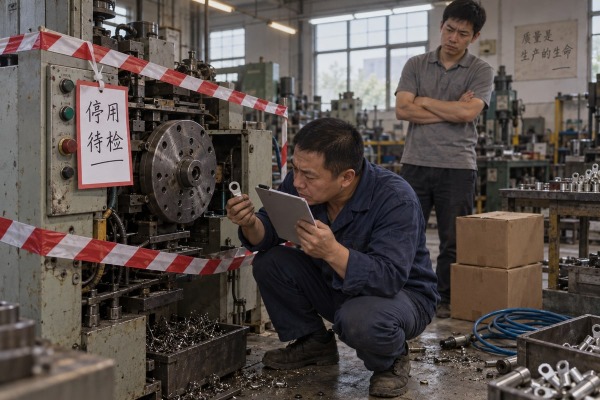
Last spring, a cable lug making machine on our Wenzhou line failed final inspection days before shipment tooling approval 1. The buyer panicked. We stayed calm because we had a [rework and release system](https://yqunique.com/?p=6061).
Freeze shipment immediately after a failed inspection, classify every defect as critical, major, or minor, agree a written rework plan with deadlines, verify each fix through re-inspection, and release the cable lug making machine only after documented pass results and written approval.
That is the short version. The longer version is what saves your delivery date. Below, I will walk through each step in the order you should actually do it.
A few years ago, our QC team caught inconsistent crimp heights on a terminal crimping machine during factory acceptance testing. Our first move was not repair. It was documentation.
First, freeze packing and loading, quarantine the machine, and document every defect in a non-conformance report. Classify each issue as critical, major, or minor by its impact on crimping strength, conductivity, and dimensional accuracy. Do not discuss timelines until the defect list is complete.

The order of these actions matters. If you talk about deadlines before you finish the defect list, the supplier will anchor the schedule to the easiest fix. So slow down for one day to move faster later.
Stop all packing and loading the moment the final inspection report shows a fail. Physically segregate the machine and any sample cable lugs it produced. Mark everything as on hold with clear labels. In our workshop, quarantined output sits in a separate marked zone so nonconforming parts can never mix with passing batches. This sounds basic. It prevents the most expensive mistake in this whole process: a defective machine slipping into a container by manual override.
Next, open a non-conformance report 2 and list each defect with photos and measurements. Then rank each one. This ranking is the backbone of your rework schedule.
| Severity | Cable Lug Machine Examples | Release Impact |
|---|---|---|
| Critical | Crimp pull strength below spec, conductivity failure, unsafe wiring | Full hold, no exceptions |
| Major | Loose tooling, dimensional tolerance drift, heavy burrs on terminals | Hold until reworked and retested |
| Minor | Cosmetic scratches, paint blemishes, label placement | May qualify for a documented waiver |
Finally, ask the supplier to begin root cause analysis 3 while the defect list is still fresh. For cable lug machinery, the usual suspects are die alignment, material feed consistency, and hydraulic or pneumatic pressure fluctuation. A defect fixed without a root cause will usually come back.
A US procurement manager once messaged me on WhatsApp: “The supplier says next week. What does next week mean?” That vague answer is exactly what you must refuse.
Work backward from your shipment date. Reserve five to seven days for re-inspection, add two to three buffer days, and give the supplier the remaining window. Put scope, deadline, responsible person, and required evidence in writing, ranked by defect severity.

My own working method is simple, and I use it whether I am the seller or the buyer of components. I list every nonconformance point for the supplier to correct one by one. I mark the importance level of each item. Then I set a hard time limit against the delivery date, and I send reminders as each milestone approaches. Suppliers respond to specific lists with specific dates. They stall on vague complaints.
Most buyers ask “how long will the fix take?” and then add that to today. Flip it. Start from the day cargo must move and subtract fixed blocks. Here is the backward schedule I use for a typical major-defect rework on a cable lug making machine:
| Milestone | Timing | Owner |
|---|---|---|
| Shipment / container loading | Day 0 | Logistics |
| Buffer for surprises | Day −2 to −3 | Buyer |
| Re-inspection and witnessed retest | Day −5 to −7 | Third-party or buyer QC |
| Rework completion, evidence submitted | Day −8 | Supplier engineering |
| Written rework plan agreed | Within 48 hours of failure | Both parties |
The corrective action plan must define five items explicitly: the scope of rework, the completion deadline, the responsible person by name, the re-inspection date, and the records to be collected during the fix. Rank the tasks so critical items get resources first. Then send a short reminder at each milestone. In my experience, a two-line message three days before the deadline prevents more delays than any penalty clause.
Here is the trade-off I weigh every time: verbal assurance is fast, but evidence is safe. When crimping strength or conductivity is involved, I always choose evidence.
Require a closed non-conformance report, root cause analysis, rework logs, fresh pull-test and conductivity data, a witnessed or recorded stability run, and a passing final inspection report. Release shipment only after every defect shows documented closure against the original inspection criteria.

Suppliers under delivery pressure will argue for release once the obvious issue is fixed. I understand the pressure; delay costs and congested floor space are real. But releasing before re-inspection just moves the risk from their factory to your production line, where it costs far more. The answer to that objection is not distrust. It is a defined evidence package that lets a good supplier prove the fix quickly.
Our quality assurance protocols use a document-to-proof mapping. Each paper must prove something specific:
| Document | What It Proves |
|---|---|
| Closed non-conformance report | Every listed defect has a matching correction |
| Root cause analysis summary | The fault will not recur after tooling calibration |
| Rework log | Who touched the machine, when, and what changed |
| Pull-test and conductivity data | Crimps meet the agreed copper lug specifications |
| Recorded or witnessed stability run | The machine holds tolerance during continuous production |
| Passing final inspection report | Independent confirmation against the original criteria |
The retest must repeat the original checklist, not a shortened version. For reworked lug batches, apply a 100% re-inspection protocol rather than sampling. More buyers now also request remote witnessed testing on video, plus batch-level serialization or QR codes on reworked output for traceability in the field. One more lever: tie the final payment to the passing retest. Money released after conformance keeps everyone honest without a single argument.
The hardest lesson from our early export years was this: every last-minute inspection crisis was really a checkpoint we had skipped weeks earlier.
Schedule in-process checkpoints at tooling approval, mid-assembly, commissioning, and final acceptance testing. Book third-party inspection five to seven days before shipment, build buffer days into your production lead time, and tie final payment to a passing retest so problems surface early, not at loading.

Prevention is mostly a scheduling discipline. A failed final inspection is rarely a surprise to the workshop floor. It is only a surprise to the buyer who checked nothing until the end. Spread your verification across the build, and the final gate becomes a formality instead of a cliff.
If rework does eat your margin, manage the ripple effects deliberately. Adjust the production master schedule so rework runs during downtime and does not choke manufacturing throughput for other orders. Send your own customers a formal Notice of Delay with a revised release date and a summary of corrective steps; silence damages trust more than delay does. On the supply chain logistics side, some of our larger clients now run a dynamic buffer in their ERP that reschedules containers from real-time rework completion rather than static estimates. Trends like digital twin simulation of recalibrated settings and feeding failure data into predictive maintenance modules push in the same direction: catch drift before it becomes a defect.
A failed inspection threatens your whole schedule. Freeze shipment, list and rank every defect, set written deadlines, demand evidence, re-inspect, and release only on documented proof.
Interested in sourcing the products mentioned in this article? See details and request a quote here:
