

A US buyer visiting our Wenzhou workshop told me his old pipe cutting machine supplier missed three deliveries. His line stopped. That pain is avoidable if you verify capacity first.
To verify a pipe cutting machine supplier’s capacity for continuous supply, check its legal identity, audit the factory on site, compare claimed output against equipment and headcount, review shipment records, confirm core component supply chains, and call three to five recent customers about delivery performance.
That is the short answer. The longer answer is a proof-based process. Below, I walk through each step the way I would run it myself, with checklists and red flags you can use right away.
Nameplate capacity is cheap to claim and expensive to prove. When we quote continuous-production orders, we weigh promised output against what our line can actually sustain across shifts.
Check real production capacity by visiting the factory for one to three days, counting active lines and workers, reviewing recent production logs, mapping bottlenecks in machining and assembly, and comparing claimed monthly output against equipment, shift patterns, and finished-goods inventory.

A brochure tells you what a supplier wants to sell. A factory audit tells you what they can actually build. In my experience, the gap between the two is where delivery failures hide. A proper manufacturing capacity assessment separates capacity into four layers, and each layer needs different evidence.
| Layer | What It Means | How to Verify It |
|---|---|---|
| Nameplate capacity | What the supplier claims it can produce | Compare the claim to line count and floor space |
| Demonstrated throughput | What was actually produced recently | Review production logs and shipment records |
| Effective capacity | Output after scrap, changeovers, and maintenance | Ask for first-pass yield and rework data |
| Supply continuity | Output held steady under stress | Check backup plans, staffing depth, and inventory |
Most buyers stop at the first layer. Do not. Ask for production logs from the last six months and match them against the claimed monthly output. If a supplier says it ships forty machines a month but the floor shows two assembly stations and eight workers, the math fails.
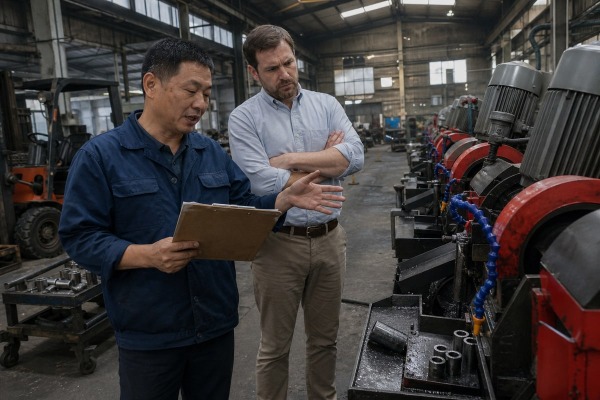
Plan one to three days on site, and insist on watching normal production conditions rather than a staged tour. For pipe cutting machines, walk the full flow: CNC machining 1, welding, frame assembly, electrical integration, and the test bench. Test-bench capacity is a common bottleneck. If finished machines queue up waiting for acceptance testing, real output is lower than claimed. A stable production system shows itself in small things: materials staged at each station, coolant lines maintained, cutting stations active, and a work order visible on every machine in progress.
A German distributor once emailed me a document checklist before ordering our chamfering machines. His requests were smarter than most, and I have borrowed his logic ever since.
Request the business license, factory ownership records, ISO 9001 certification with recent audit reports, incoming material inspection records, machine test reports, traceable QC documentation for past orders, and CE or destination-market compliance certificates covering the exact models you plan to buy.

Documents matter, but only when they connect to real production. I have seen suppliers hang an ISO 9001 certification 2 on the wall while keeping no inspection records at all. So my rule is simple: every certificate must be backed by working paperwork that a normal order would generate. This is basic vendor risk management, and it costs you nothing but an email to request it.
| Document | What It Proves | Red Flag |
|---|---|---|
| Business license | Legal identity and registered scope | Address does not match the factory location |
| Factory ownership or lease records | Real manufacturer, not a trading intermediary | Supplier avoids naming the production site |
| ISO 9001 certification plus audit reports | A quality system exists and is externally checked | Certificate is current but audit findings are hidden |
| Incoming material inspection records | Raw material procurement is controlled | No records for steel, motors, or controllers |
| Machine test and acceptance reports | Each unit passed defined checks before shipping | Reports are generic, undated, or unsigned |
| Batch QC and traceability records | Quality held steady across a full order | Only one sample report exists for a large batch |
Some procurement teams treat ISO 9001 as a pass mark and stop there. I understand the appeal, but a certificate proves a system was audited once, not that quality holds across fifty machines. Ask for the rejection and rework rate on a recent large order. A supplier with a genuinely stable quality process will share that number without hesitation. A supplier who stalls on it is telling you something too.
Early in our export business, we trusted a component vendor’s promised lead time and nearly missed a shipment to Japan. Since then, I check delivery history before believing any schedule.
Evaluate on-time delivery by reviewing twelve months of shipment records, comparing promised versus actual production lead times, calling three to five recent customers about fulfillment consistency, and checking whether the supplier tracks its own on-time rate with documented order data.

Quoted production lead times are promises. Shipment history is evidence. When I evaluate a sub-supplier for our own machines, I follow a fixed sequence, and I recommend buyers do the same with any pipe cutting machine supplier.
Some buyers argue that capital equipment orders are intermittent, so delivery consistency matters less. I disagree from experience. Even one-time machine buyers depend on continuity for spare parts 3, replacement units, and project rollouts. A supplier that ships late once will ship your urgent spare blade late too.
During a component shortage a few years back, our second sourcing channel for controllers kept our machine line moving while others stalled. Redundancy questions matter long before a crisis hits.
Ask how many production lines can build your model, whether critical components like controllers and servo systems have second sources, how much buffer inventory is held, what the surge capacity is, and how quickly a backup line can be activated.

Production scalability is not about how big a factory is today. It is about what happens when demand spikes, a worker quits, or a controller vendor stops shipping. In my own sourcing work, I check the core component supply chain 4 first, because that is where single-supplier dependence quietly builds up. Motors, CNC controllers, servo systems, blades, chucks, and guides each need at least one qualified second source. If any critical part comes from a single vendor in a single region, your supply chain resilience is only as strong as that one company.
| Question to Ask | What a Strong Answer Sounds Like |
|---|---|
| Which components have only one qualified source? | A named list, plus a plan to qualify alternates |
| How many workers are cross-trained on critical machines? | A specific share of floor staff, not a vague “most” |
| What backup power or energy arrangements exist? | On-site generators or documented grid contingency plans |
| How is CNC software and version control protected? | Off-site backups and remote diagnostic capability |
| How much spare parts availability is guaranteed post-sale? | Defined stock levels and a committed dispatch time |
| Where do laser heads and controllers actually come from? | Named regions, showing geopolitical diversity of sourcing |
Three areas get skipped in most audits. First, labor elasticity: ask what percentage of floor staff can run multiple critical machines, because one resignation should never stop a line. Second, energy resilience: regional grid instability halts production regardless of order backlog. Third, digital continuity: remote diagnostics and controlled software versions keep your installed machines supported even when travel or logistics get disrupted. Weak answers here predict future downtime better than any glossy catalog.
Unverified suppliers cost you stalled lines and lost contracts. Audit the factory, demand documented proof, check delivery history, and question redundancy before you sign. Evidence beats promises every time.
