

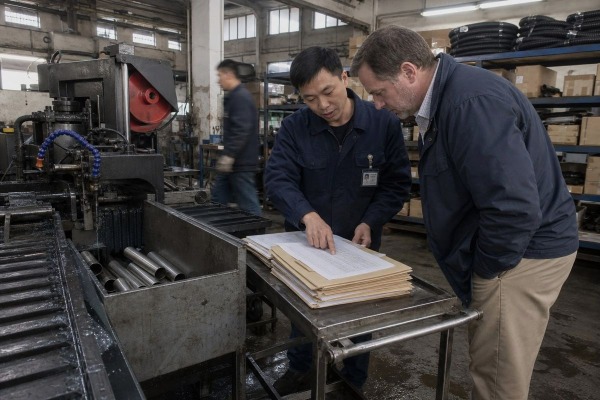
Assessing a supplier’s financial stability before buying a pipe cutting machine saved one of our buyers from a costly mistake. A cheap quote from a shaky company can bury you in delays, dead warranties, and missing spare parts. Our Wenzhou factory has seen it happen to buyers who checked specs but never checked the balance sheet.
To assess a pipe cutting machine supplier’s financial stability, request 2–3 years of audited financial statements, run a commercial credit report, verify business registration and operational history, check liquidity and debt ratios, contact trade references, and confirm production capacity matches the company’s claimed scale.
That is the short answer. Below, I walk through each step in detail, using what I have learned exporting metal processing machines to eight countries.
Last year, a procurement manager from Ohio asked us for our audit reports before he even asked for a quote. I respected that. It told me he understood real vendor due diligence.
Before signing, request audited financial statements for the last 2–3 years, recent interim management accounts, a cash-flow forecast, a debt schedule, aged receivables and payables, business registration documents, beneficial ownership details, and bank and trade credit references confirming payment behavior.

Most buyers only ask for a quotation and a spec sheet. That is not enough for capital equipment. A pipe cutting machine purchase usually involves a deposit, staged payments 1, commissioning, and years of after-sales support. Every one of those stages depends on the supplier still being solvent.
Due diligence guidance commonly recommends at least 2–3 years of audited statements 2, and 3–5 years for higher-value purchases. If the last financial audit reports are more than six months old, ask for the latest interim management accounts as well. Numbers age fast in manufacturing.
| Document | What It Tells You | Red Flag If Missing |
|---|---|---|
| Audited financial statements (2–3 years) | Profitability trends, solvency, asset base | Supplier avoids third-party scrutiny |
| Interim management accounts | Current cash position | Stale audits hiding recent trouble |
| Cash-flow forecast and debt schedule | Refinancing pressure, upcoming commitments | Hidden leverage risk |
| Aged receivables and payables | Working capital quality | Reliance on slow customer payments |
| Business registration and ownership records | Legal identity, operational history | Broker posing as a manufacturer |
| Bank and trade credit references | Real payment behavior | No verifiable trading relationships |
When distributors evaluate us, I always encourage them to look at our business registration records first. In my experience, verifying a company's registered operating years and its continuous operating capability is the single fastest filter. A company registered eighteen months ago claiming "20 years of experience" is telling you everything you need to know. I also suggest buyers confirm the registered capital, the licensed business scope, and whether the legal entity actually matches the name on the quotation. Mismatched entities are a classic warning sign in cross-border deals.
A German integrator once told me he could not get audited statements from three of our competitors. I showed him how we verify our own component vendors without ever seeing their books.
You can verify financial health externally through commercial credit reports such as a Dun & Bradstreet rating, government registry checks, litigation and insolvency records, sanctions and adverse media screening, customer reference calls, and an on-site or video audit of actual production capacity.

Many capable small suppliers, ours included, are privately held. Some buyers worry that overemphasizing polished financial disclosure will exclude good vendors. That objection is fair, but only half right. Limited transparency is itself a risk signal for expensive capital equipment with multi-year support obligations. The answer is not to lower your standards. It is to use external checks that do not depend on the supplier's cooperation.
A commercial credit risk assessment from a reputable data provider reveals payment history, liens, and legal judgments. Registry checks confirm legal identity, ownership structure, and filing status. For international suppliers, local court, tax, and insolvency records add another layer of bankruptcy risk analysis where they are available.
Here is my own first-hand method, and I apply it to every component vendor we onboard in Wenzhou. First, check whether production capacity matches the claimed company scale. A team of ten people, like ours, can honestly run a focused line of cable lug equipment and metal processing machines. It cannot honestly claim to mass-produce fifty machine categories. Second, examine the customer structure. A supplier serving diverse buyers across the United States, Japan, Germany, and India is more resilient than one dependent on a single domestic account. Third, verify supply chain stability. Ask which brands of PLCs 3, motors, and blades they source, and whether those component channels are diversified. Concentrated sourcing hides financial fragility that never appears on a balance sheet.
We once lost a bearing vendor mid-order because I ignored two early signals: sudden discount pressure and a shrinking technical team. I have kept a warning-sign checklist ever since.
Warning signs include demands for unusually large upfront deposits, sudden deep discounts, recurring losses or negative equity, slipping delivery dates, staff turnover in engineering, aged payables to their own vendors, new liens or lawsuits, and evasiveness about ownership or interim accounts.

Financial distress rarely announces itself. It leaks out through behavior long before an insolvency filing. The key is treating procurement risk management 4 as a continuous practice, not a one-time pre-award check. Buyers are increasingly moving toward continuous monitoring of critical suppliers, and for industrial equipment with expensive downtime, I think that shift is overdue.
Some signals show up in the numbers. Others show up in how the supplier acts week to week. You need to watch both.
| Category | Warning Sign | Why It Matters |
|---|---|---|
| Payment behavior | Pushing for 70–100% upfront payment | Supplier may be plugging a cash hole with your deposit |
| Pricing | Sudden aggressive discounts | Desperation to book revenue at any margin |
| Financial statements | Recurring losses, negative equity, heavy liabilities | Core solvency risk indicators |
| Working capital | Ballooning inventory or receivable days | Cash trapped, quality of earnings weakening |
| Legal | New liens, judgments, or tax disputes | Creditors are already circling |
| Operations | Slipping lead times, quieter communication | Suppliers cutting staff or losing component credit lines |
| People | Departure of key engineers or the sales contact you built trust with | Insiders often leave before public trouble appears |
The current ratio and quick ratio are useful starting points for measuring whether liquid assets cover short-term liabilities. But treat them as conversation starters, not pass/fail thresholds. Sector norms vary, and some machine builders intentionally carry heavier inventory to guarantee parts availability. What matters is the trend across the 2–3 years of statements, and whether the supplier can explain their working-capital structure. Evasive answers worry me far more than an imperfect ratio.
If you spot two or more of these signals, do not necessarily walk away. First, ask for stronger protections: staged payments tied to performance milestones, retention on the final payment until commissioning, and written spare-parts commitments.
Our support team still services chamfering machines we shipped to the United States years ago. That continuity is only possible because the company behind the machine is still standing.
A financially stable supplier can honor warranty claims, stock spare parts, retain trained technicians, and maintain control software for years. A distressed supplier cuts service staff first, delays parts shipments, and may disappear entirely, turning your machine into unsupported hardware.

Here is the thesis I want every buyer to internalize: when you buy a pipe cutting machine, you are not just buying steel, a motor, and a blade. You are buying the supplier's ability to deliver on time, install correctly, honor the warranty, and stay reachable. Financial stability is a proxy for after-sales reliability. Some buyers argue that a strong product and a local service team matter more than balance-sheet strength. I understand the appeal of that view. But product quality and financial health are not competing priorities. Technical capability gets the machine running; financial stability determines whether that capability still exists a year later when you need a coolant pump or a control-board replacement.
Equipment lifecycle costs extend far beyond the invoice. Consumables, blades, calibration, software updates, and maintenance often depend entirely on the original supplier, especially with proprietary PLC control systems like the ones we build into our own machines.
| Lifecycle Dependency | Impact If Supplier Fails Financially |
|---|---|
| Warranty claims | Unenforceable; repair costs shift to you |
| Spare parts inventory | Sold off or discontinued; long downtime searching for substitutes |
| Blades and consumables | Sourcing scramble; possible quality mismatch |
| Control software and calibration | No updates, no license support, no remote diagnostics |
| Trained technicians | Laid off; tribal knowledge of your machine is gone |
| After-sales service agreement | A contract with a bankrupt entity is worth nothing |
Two indicators tell you a lot. First, the ratio of service and aftermarket parts revenue to total sales: a healthy service-to-sales ratio signals a resilient business model that survives market volatility. Second, R&D reinvestment: a supplier funding technological development is planning to exist in five years, while one liquidating existing inventory is not. Supply chain resilience matters here too. Ask whether component sourcing is geographically diversified, because regional instability or tariffs can quietly strangle a supplier's parts pipeline and, eventually, yours.
A weak supplier turns a good machine into a liability. Check documents, credit data, operational history, and capacity before you sign, and keep monitoring afterward. If you want a supplier that welcomes vendor due diligence, contact me at [email protected].
1. Official resource for international trade methods and managing payment risks in equipment procurement. ↩︎
2. Government guide on using audited financial statements to evaluate the health of a business entity. ↩︎
3. Supplier intelligence and data analytics to verify component sourcing and supply chain stability. ↩︎
4. Overview of procurement strategies and risk management practices for industrial supply chains. ↩︎
