

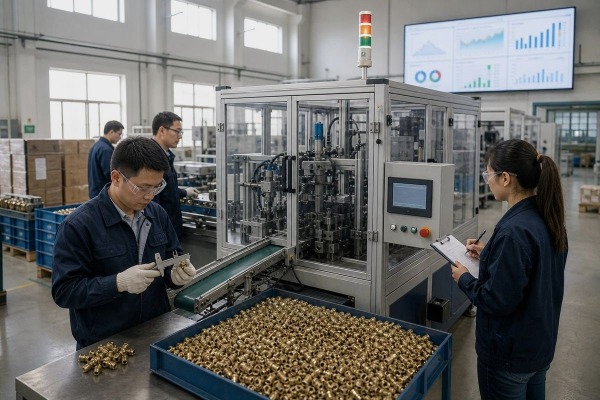
Manual chamfering was quietly killing my clients’ output. Parts piled up, workers grew tired, and defects crept in. On our production line in Wenzhou, a fully automatic chamfering machine changed everything.
A fully automatic chamfering machine can improve electrical hardware production efficiency by 50–70% in throughput, cut cycle times from 30 seconds to as little as 6 seconds per piece, reduce labor needs by up to 70%, and drop defect rates from 8% to under 0.5%.
Those numbers vary by part type and setup. Below, I break down where the gains come from, what they cost, and how fast the machine pays for itself.
Last year, a Vietnamese customer sent me a video of his workers hand-grinding tube ends. Each piece took about half a minute. Our engineers timed the same part on our double-end chamfering machine: both ends done in one pass, in seconds.
Switching to a fully automatic chamfering machine typically saves 4–6 hours of productive time per 8-hour shift on high-volume electrical hardware. Manual chamfering at 30 seconds per piece drops to roughly 6 seconds automated, a 5x speed gain that compounds across every part.

The math is straightforward, but most buyers underestimate it. In pipe and rod fabrication, manual chamfering can consume up to 30% of total processing time. That is not just cutting time. It includes picking up the part, clamping it, chamfering one end, flipping it, re-clamping, chamfering the other end, deburring, and setting it down. A fully automatic machine with an automatic loading system removes almost all of that non-value-added handling.
| Metric (8-hour shift) | Manual chamfering | Fully automatic machine |
|---|---|---|
| Cycle time per piece | ~30 seconds | 2.5–8 seconds |
| Pieces per hour | 100–120 | 600–5,000 (part dependent) |
| Pieces per shift | ~800–960 | 5,000–12,000+ |
| Operator fatigue effect | Output drops late in shift | Constant pace all shift |
| Rework time needed | Significant | Near zero |
The double-end design is what my own experience keeps confirming. A double-end chamfering machine finishes both ends of a tube in a single clamping. It does not just cut faster. It eliminates the flip, the second clamp, and the second inspection. That is why cycle time reduction from automation is far bigger than the raw cutting speed alone would suggest. On automated double-end systems, 1,000–1,200 pieces per hour is a realistic sustained rate for tube and rod hardware.
There is a fair objection here: vendor-published cycle times are often optimistic. Material hardness, chamfer depth, and part size all affect real output. That is exactly why we run sample testing on the customer's actual parts before we quote a throughput figure. A number proven on your workpiece is worth ten numbers from a brochure.
A procurement manager from the US once told me his biggest fear: replacing three grinders with one machine, then discovering the quality got worse. We loaded his terminal samples into our test machine and shipped him back 500 finished pieces to measure himself.
Yes. Automation can cut chamfering labor requirements by up to 70% while improving quality, because one operator can supervise multiple machines and CNC-controlled tooling holds tolerances below 0.07 mm with repeatable accuracy that manual grinding cannot match.

Labor cost savings and quality are usually framed as a trade-off. With chamfering, they move in the same direction. Manual deburring and beveling depend on the worker's skill, attention, and energy level. A tired hand at hour seven produces a different edge than a fresh hand at hour one. A machine does not get tired. Every chamfer angle, depth, and finish is identical from the first piece to the ten-thousandth.
For cable lugs, terminals, and busbar components 1, edge quality is not cosmetic. Burrs on conductive parts can cause poor contact, assembly jams, and even short-circuit risk. Precision edge rounding also reduces localized electromagnetic field concentrations, which supports better EMI/EMC performance 2 in high-frequency components. And in the equipment we build for terminal manufacturing, we pay special attention to copper and brass. These "gummy" conductive alloys smear rather than cut cleanly, so tool condition monitoring matters to prevent micro-burrs. There is also a safety dividend: removing manual handling of sharp metal edges can reduce workplace laceration injuries by up to 60%.
One honest caveat. If your batches are tiny and your parts change constantly, the labor savings shrink because setup time becomes a larger share of the work. Automation pays best on repeatable, medium-to-high volume parts.
Scaling is where I have seen the sharpest difference between shops. When one of our Indian distributors' customers doubled their busbar hardware orders, their manual chamfering station became the choke point overnight. The rest of the line sat waiting on finished edges.
When scaling up volume, expect 50–70% faster production throughput, output rates of 600 to 5,000 parts per hour depending on part type, and better line balance, because automated chamfering converts a manual bottleneck into a continuous, repeatable step that keeps downstream assembly fed.

The key idea is that a fully automatic chamfering machine is an efficiency multiplier, not just a faster cutter. At low volume, chamfering is one task among many. At high volume, it becomes the pacemaker of the whole line. Fix the pacemaker, and everything downstream speeds up.
| Electrical hardware type | Typical automated rate | Main scaling benefit |
|---|---|---|
| Bolts, studs, high-speed rod processing | 2,000–5,000 parts/hour | Feeds downstream threading and plating without gaps |
| Tube fittings, conduit hardware | 1,000–1,200 pieces/hour (double-end) | Both ends finished in one pass |
| Cable lugs and terminals | 600–1,500 parts/hour | Burr-free edges prevent assembly jams |
| Busbar components | Varies by size | Clean edges support conductivity and fit-up |
Consistent chamfers do more than speed up one station. In metal hardware fabrication 3, uniform edges let parts mate smoothly in automated assembly. High-speed robotic pick-and-place systems depend on this too: irregular burrs cause vacuum seal failures and misalignment, which stall the entire cell. So a consistent chamfer upstream directly raises utilization downstream.
Industrial automation integration also matters more at scale. A vibratory bowl feeder sorts and orients parts, the automatic loading system presents them to the spindles, and finished parts exit through a discharge chute into bins. Feed, clamp, cut, unload — no hands in between. Our machines pair this with CNC pipe end finishing spindles on linear guides 4, so the whole cell runs unattended for long stretches. There is even an energy angle: modern direct-drive motors reduce energy consumption per part, which helps shops chasing green manufacturing targets as volumes grow.
The honest limit: if upstream material prep or downstream inspection stays manual, the machine cannot unlock its full rate. Scaling well means looking at the line, not just the machine.
The trade-off I discuss most often with buyers is capital cost versus payback speed. Our equipment sits in the mid-to-high-end range, priced above standardized low-cost machines, so I never dodge the ROI question — I put a framework on the table instead.
Most electrical hardware producers recover the investment in a fully automatic chamfering machine within 18–36 months. Payback comes from three streams: labor reduction of up to 70%, finishing-cost reduction of as much as 50%, and near-elimination of scrap and rework.

The payback period depends on volume, wages, and your current defect rate. Rather than promise a single number, I encourage buyers to run the calculation with their own figures.
| Savings stream | How to calculate it | Typical impact |
|---|---|---|
| Labor cost savings | (Operators removed × annual wage) − automation operator cost | Often the largest stream; up to 70% labor reduction |
| Throughput gain | Extra parts per shift × margin per part | 50–70% more output on the same floor space |
| Scrap and rework | (Old defect rate − new defect rate) × parts × unit cost | Defects fall from ~8% to under 0.5% |
| Finishing cost | Reduced deburring, tooling, consumables | Up to 50% lower finishing cost |
| Safety and turnover | Fewer injuries, less hiring and training | Real but harder to quantify |
Take a shop running 900 pieces per manual shift with two workers. An automated double-end system at 1,000 pieces per hour produces the same daily volume in under an hour, or roughly 8,000 pieces per shift at full utilization. If the shop sells that added capacity, throughput gain alone dominates the payback. If it cannot sell more, labor savings and scrap reduction still typically land the payback inside three years.
Two caveats keep this honest. First, small-batch, highly variable jobs may not justify the capital cost, because setup time eats the cycle time gains. Second, ROI models are only as good as the throughput assumption. That is why our process at YQUNIQUE includes tooling design around your drawings, sample testing on your actual parts, and commissioning support — so the rate in your ROI spreadsheet is a measured rate, not a marketing one. High labor cost regions like the US and Canada usually see the fastest payback; that matches what our export customers there report.
Manual chamfering silently drains time, labor, and quality. A fully automatic chamfering machine reverses all three — delivering 50–70% faster throughput, up to 70% labor savings, and payback within 18–36 months.
1. Authoritative Wikipedia entry covering busbar design, materials, and components; replaces broken copper.org link. ↩︎
2. NIST provides authoritative standards and research on electromagnetic interference and component performance. ↩︎
3. Wikipedia overview of metal fabrication processes, including the shaping and finishing of industrial hardware. ↩︎
4. Wikipedia entry for linear-motion bearings, which are the technical basis for linear guides used in precision CNC machinery. ↩︎
