

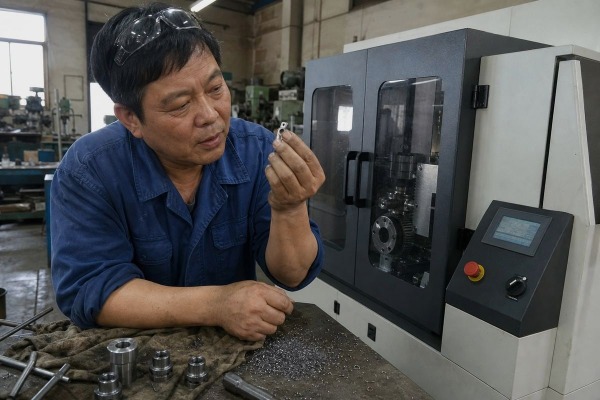
Cutting tool material and hardness decide chamfering machine quality more than most operators admit Plastic deformation 1. On our production line in Wenzhou, we learned this the hard way, one ruined edge at a time.
Cutting tool material and hardness directly control chamfer quality. Harder tools like carbide (89–93 HRC) resist wear and hold the chamfer angle, while tougher tools like HSS resist chipping. The best results come from matching tool hardness to the workpiece material, not from choosing the hardest tool.
There is a saying in our workshop: the tool does not fail, the tip does. Everything about chamfer quality traces back to that cutting edge. Let me break down why, and how you can use this knowledge.
Years of building metal processing machines have taught our team one thing: buyers ask about motors and controls first, but the cutting tip decides the final result.
Carbide tools work best for most production chamfering because they combine high hardness (89–93 HRC) with acceptable toughness. High-speed steel suits softer metals and lower volumes. CBN and ceramics handle hardened steels, while diamond tooling covers very abrasive nonferrous materials and composites.

Here is a quick comparison of the main options before we go deeper:
| Tool Material | Typical Hardness | Toughness | Best Use in Chamfering |
|---|---|---|---|
| High-speed steel 2 (HSS) | 63–70 HRC | High | Soft steels, aluminum, low volumes |
| Cemented carbide | 89–93 HRC | Medium | Production chamfering, most steels |
| Ceramics | Very high | Low | Hard, continuous cuts at high speed |
| CBN | Very high | Low–medium | Hardened steels above 45 HRC |
| PCD / diamond | Highest | Low | Aluminum alloys, composites, ceramics |
Carbide tools 3 are the workhorse in chamfering. They keep a sharp edge far longer than high-speed steel. A sharp edge means a clean bevel, less burr, and a consistent surface finish across thousands of parts. That is why almost every chamfering machine we ship to the US or South Korea leaves our factory with carbide inserts fitted as standard.
But carbide costs more upfront. Some buyers push back on this. Our answer is simple: in high-volume work, carbide outlasts HSS many times over, so the cost per chamfered part drops. HSS still makes sense if you process soft aluminum in small batches, or if your operators change tools often and want a forgiving material.
Tool coatings 4 such as TiN, TiAlN, or DLC add a hard, heat-resistant skin to both HSS and carbide tools. Coatings extend tool life and protect the edge at higher cutting speed. For stainless steel chamfering, we almost always recommend a coated carbide tip. The coating fights heat and built-up edge 5 at the same time.
A customer in Mexico once sent us photos of wavy chamfers and asked if the machine spindle was faulty. It was not. The tool tip had lost its hardness from heat.
Tool hardness keeps the cutting edge from deforming under load, which preserves the chamfer angle and produces a smooth surface finish. A tool that softens or dulls creates burrs, dimensional drift, and chatter marks. The tool must stay harder than the workpiece, even at high cutting temperatures.

Precision in chamfering is really about edge stability. The tool cuts a small bevel, so even tiny changes in edge geometry show up on the part. Here is how hardness connects to each quality outcome:
| Quality Factor | What High Hardness Does | What Happens When Hardness Is Too Low |
|---|---|---|
| Chamfer angle accuracy | Edge holds its shape, angle stays constant | Edge rounds over, angle drifts part to part |
| Surface finish | Sharp edge shears cleanly | Dull edge tears and smears the metal |
| Burr control | Clean exit cut, less deburring needed | Heavy burrs form at the chamfer edge |
| Repeatability | Thousands of identical parts | Quality degrades within one shift |
A tool that measures 65 HRC on the bench may act much softer at cutting temperature. This property is called hot hardness 6. Carbide keeps its hardness at high heat far better than HSS. That is why carbide handles higher cutting speed without losing precision. If you run a fast feed rate on HSS, the edge heats up, softens, and the chamfer finish falls apart quickly.
Here is the objection we hear most: harder is always better. It is not. A very hard tool becomes brittle. In chamfering, the tool often meets edges, corners, and interrupted surfaces. Impact loads are higher than in smooth continuous cuts. If toughness is too low, the edge chips instead of wearing gradually. A chipped edge ruins finish instantly and can scrap parts. The best chamfer quality comes from balancing hardness for wear resistance with enough toughness to survive shock. When we calibrate machines before shipment, we run sample parts with the customer’s actual material to verify this balance, not just spindle accuracy.
Rapid tool wear is the complaint I read most often in support emails from our export customers. Nine times out of ten, the machine is fine. The tool-to-material match is wrong.
Cutting tools wear out fast in chamfering when tool hardness is too low for the workpiece material, cutting speed generates heat beyond the tool's hot hardness, feed rate is unstable, or vibration causes chipping. Fixing the material match usually doubles or triples tool life.

Tool wear is never random. It follows patterns, and each pattern points to a specific cause. If you learn to read the worn edge, you can fix the root problem instead of just replacing tips. In our workshop we tell trainees: the tool does not fail, the tip does. Look at the tip, and it will tell you why.
Speed, feed rate, and coolant do not replace correct tool selection, but they interact with it. A carbide tool run at HSS speeds wastes its potential. An HSS tool run at carbide speeds dies within minutes. Coolant carries heat away and protects hot hardness, which matters most in high-speed chamfering of stainless steel. Vibration is the silent killer: chatter marks on the chamfer surface are the early warning that your setup, tool holder, or tool toughness needs attention before edges start chipping.
One lesson from a decade of OEM projects: we never quote a chamfering machine without first asking what metal, what hardness, and what volume. Those three answers pick the tool.
Match the tool to the metal: HSS or coated carbide for mild steel and aluminum, coated carbide for stainless steel, CBN or ceramics for hardened steels above 45 HRC, and PCD or diamond tooling for abrasive aluminum alloys, composites, and ceramics.

Workpiece hardness is the starting point for every selection. The tool must always be meaningfully harder than the part. But softer metals bring their own problems, like built-up edge and heavy burr formation, so material chemistry matters as much as hardness. Use this guide as your baseline:
| Workpiece Material | Recommended Tool | Key Risk to Manage | Notes on Settings |
|---|---|---|---|
| Aluminum alloys | Sharp uncoated carbide or PCD | Built-up edge, smearing | High cutting speed, polished edge |
| Mild / carbon steel | Coated carbide or HSS | Abrasive tool wear | Moderate speed, steady feed rate |
| Stainless steel | TiAlN-coated carbide | Heat, work hardening | Coolant essential, avoid dwelling |
| Hardened steel (45–60 HRC) | CBN or ceramic | Edge chipping, heat | Rigid setup, chamfered edge prep |
| Copper / brass | Sharp carbide | Burrs, soft smearing | Sharp geometry, light passes |
| Composites / ceramics | Diamond (PCD) tooling | Extreme abrasion | Diamond is the only economic choice |
On soft metals, a mediocre tool still produces an acceptable chamfer for a while. On hardened steel, there is no forgiveness. Hard-turning research shows CBN tools with chamfered edges and larger corner radius produce lower roughness on hardened surfaces. Geometry and material work together: the material decides whether the tool survives, and the geometry decides how cleanly it cuts.
Some buyers want one universal chamfer tool for everything to simplify inventory. I understand the appeal, but the evidence favors task-specific selection. A general-purpose tool compromises everywhere. When we build custom chamfering equipment for a client's product drawings, we specify the tool grade for their exact workpiece material and run sample tests before shipping. That single step prevents most quality complaints after installation. If you process several metals, keep two or three dedicated tool grades on hand rather than one compromise grade.
Chamfer quality is a balance, not a race to maximum hardness. Match tool material and hardness to your workpiece, and precision, finish, and tool life follow. Questions? Our team is ready to help.
1. Describes plastic deformation as a tool wear mechanism caused by excessive heat and load. ↩︎
2. Provides an overview of HSS properties, history, and common applications. ↩︎
3. Provides a comprehensive guide on carbide tools, their properties, and applications. ↩︎
4. Explains common cutting tool coating types, their characteristics, applications, and benefits. ↩︎
5. Explains built-up edge formation due to workpiece material adhesion and its impact on cutting. ↩︎
6. Defines hot hardness and its significance for materials at elevated temperatures. ↩︎
