

Last year a cable lug assembly machine from our Wenzhou shop sat in port for days because the export and customs documents showed two different model numbers.
Request three export and customs document sets when sourcing assembly machines from China: supplier commercial documents (contract, Commercial Invoice, Packing List, Certificate of Origin, export declaration), forwarder transport documents (Bill of Lading, insurance), and destination clearance paperwork (HS Code classification, permits, conformity certificates). Verify every document matches.
Assembly machines are not ordinary cargo. They are high value, modular, and often regulated. One wrong digit can stop a whole production schedule. Below, I walk through each document group, what to check, and how we handle it on our own shipments.
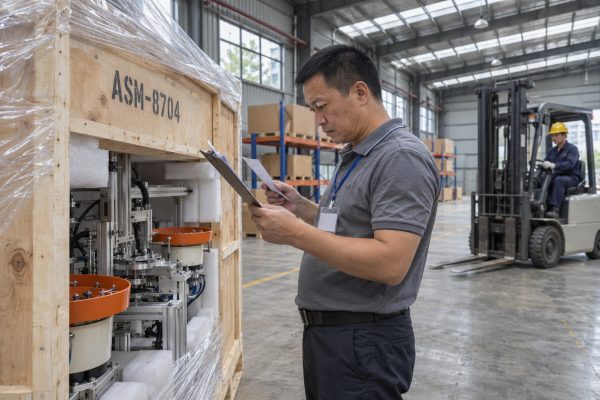
Our QC lead checks each crate's weight against the Packing List before the forklift touches it. That habit started after a weight mismatch triggered a full inspection in Hamburg.
To verify customs compliance, request the signed sales contract, Commercial Invoice, package-level Packing List, Chinese export customs declaration with release evidence, Bill of Lading or air waybill, Certificate of Origin, and insurance certificate. Check that machine name, model, quantity, value, weight, and origin agree across every document.

I sort every shipping file into three groups. Each group has a different owner. That split tells me who to call when something is wrong.
| Group | Who prepares it | Documents to request |
|---|---|---|
| Commercial documents | Supplier (factory or trading company) | Signed sales contract, Commercial Invoice 1, Packing List, Certificate of Origin, copy of the export customs declaration |
| Transport documents | Freight forwarder or carrier | Bill of Lading or air waybill, cargo manifest, insurance certificate, ISPM 15 treatment evidence for crates |
| Destination clearance documents | Buyer's customs broker | Import entry, destination HS Code 2 classification, import permits, conformity declarations, broker power of attorney |
Chinese Customs regulations list contracts, invoices, packing lists, cargo manifests, bills of lading or waybills, powers of attorney, and licenses as declaration attachments. So the supplier already has most of this file. Ask for scanned copies before you release the balance payment.
Two documents get confused often. The export customs declaration is a filing with Chinese Customs. The Bill of Lading is a carrier contract. One does not replace the other. Under Chinese Customs law, the export declaration is made before loading. Ask for the filed copy plus release evidence. It proves the machine legally left China and shows the declared value and HS code.
I check six fields on every record: machine name, model, quantity, value, gross and net weight, and country of origin. In the Hamburg case, the Packing List showed one gross weight and the Bill of Lading showed another. The gap was small. The delay was not.
| Weak description | Strong description |
|---|---|
| Assembly machine, 1 set | Automatic terminal assembly machine, model per contract, with two vibratory bowl feeders, servo press, PLC control cabinet, and safety enclosure, 1 set in 3 crates |
A buyer once told me, "Under FOB the supplier handles export paperwork, so I don't need copies." I understand the logic. But the declared value and HS code on that Chinese declaration can surface later in a valuation review. Keep the copies.
A procurement manager in Ohio once asked me on WhatsApp whether our Made in China label counted as a Certificate of Origin 3. It does not, and the difference matters.
Ask the supplier to confirm in writing whether the machine needs a MOFCOM dual-use Export License, request the Certificate of Origin from an authorized issuing body such as CCPIT or China Customs, and cross-check exporter name, invoice number, HS code, and description against the Commercial Invoice before shipment.

Origin sounds simple. In practice, it has three meanings, and each one affects a different decision.
| Term | What it means | Why it matters |
|---|---|---|
| Non-preferential origin | The country where the machine was made under standard rules | Needed for marking, trade statistics, and some import controls |
| Preferential origin | Origin under a specific trade agreement's rules | Decides whether reduced Import Duty applies |
| Country of export | The country the machine shipped from | Affects routing, sanctions screening, and transport documents |
Our machines ship from China and carry Chinese origin. But a machine shipped from China may contain imported servo drives or sensors. Origin follows the legal rules, not the port. A Korean buyer may ask for the China-Korea FTA form. A Japanese buyer may look at RCEP. A buyer in the United States or Germany has no preferential agreement with China, so the standard Certificate of Origin is what the broker wants. Preferential duty needs the right form and the right rules of origin, not just any certificate.
Most assembly machines with bowl feeders, pneumatic actuators, and a standard PLC are not controlled goods. Some high-precision or robotic components can fall under MOFCOM dual-use rules. Chinese Customs law states that restricted goods may not be released without the required licensing documents. So I give buyers a written statement: controlled or not controlled, with the HS code basis. If a supplier cannot answer that question, that is a warning sign.
One more objection comes up. "Can I reuse your Chinese HS code for import?" Partly. The HS system is harmonized to six digits worldwide. Digits beyond that are national. Use our code as a starting point, then let your broker confirm the full tariff line.
We weigh two choices on every DAP order: handle destination paperwork ourselves or hand it to the buyer's broker. The broker usually knows local rules better.
To avoid import delays, prepare a destination-specific HS Code classification confirmed by your broker, import permits, ISPM 15 wood packaging evidence, safety conformity documents like CE Certification or UL/NRTL, dangerous-goods paperwork if batteries or oils are included, and a broker power of attorney, all matching the supplier's shipping file.

Export release from China does not prove the machine is admissible in your country. That is the single most common gap I see. The crate clears Ningbo, then waits at the destination because a permit or a conformity file is missing.
| Category | What to have ready | Who usually prepares it |
|---|---|---|
| Customs entry | Import entry, HS Code classification, Import Duty calculation, valuation support, broker power of attorney | Buyer's customs broker |
| Permits and conformity | Import permits, ISPM 15 wood packaging evidence 4 CE Certification or UL/NRTL evidence, machinery safety declaration, radio approval for wireless modules | Buyer, with supplier technical file 5 |
| Packaging and hazards | ISPM 15 mark photos, fumigation or heat-treatment certificate, safety data sheets, dangerous-goods declaration | Supplier and forwarder |
| Special cases | Used-machine inspection certificate, oversized-cargo lifting plan, partial-shipment schedule, software license for proprietary PLC code | Buyer and supplier together |
Destinations differ. US ocean shipments need an Importer Security Filing before loading, and electrical panels often get asked about NRTL marks. EU buyers in Germany, France, and Italy expect a machinery declaration of conformity. India applies extra inspection to used machinery. Mexico checks NOM labeling. So I ask the buyer's broker for the requirement list before we close the frame design, not after the crates are nailed shut.
Assembly machines rarely ship as one piece. A line may arrive as a main frame, a separate control cabinet, bowl feeders on their own stands, a tooling crate, and a spare-parts box. Customs may ask whether this is one complete machine or several items with different tariff lines. Your Packing List should map each crate to each module and serial number. Installation charges, software, and spare parts should be shown clearly in the Commercial Invoice so valuation is not disputed.
Before booking, I answer these questions in writing for every machine:
Some buyers say Incoterms settle all of this. They do not. Incoterms allocate delivery tasks, cost, and risk. They say nothing about permits, product safety, or whether your documents are accurate. Newer requests follow the same logic. EU buyers now ask about emissions data in CBAM discussions, even though finished machinery is not in the current scope, and networked lines draw cybersecurity declarations. None of that comes from the shipping term.
The hardest lesson from building terminal assembly lines: a customs-perfect crate still fails if the machine inside misses its cycle rate. So we document the FAT like a contract.
Before the machine leaves the factory, request a signed factory acceptance test protocol with results against agreed specifications, a Quality Inspection Report, operating video, calibration records, a nonconformance and corrective-action list, the manufacturer's declaration of conformity, applicable EMC and low-voltage test reports, and the full technical file.

A machine can clear every customs desk and still be useless on your floor. Quality and inspection certificates protect against that outcome. I tie them to payment milestones so both sides know what is due and when.
| Milestone | Documents released to the buyer |
|---|---|
| Deposit after contract | Signed sales contract with specifications and Incoterms |
| Design approval | Layout drawings, electrical schematics, pneumatic diagrams |
| Factory acceptance test passed | FAT protocol and results, operating video, Quality Inspection Report, calibration records, nonconformance list |
| Before balance payment | Scanned Commercial Invoice, Packing List, Bill of Lading draft, Certificate of Origin, insurance certificate |
| Installation and performance acceptance | Signed acceptance certificate, warranty terms, spare-parts list, software and PLC backups |
For our bowl-feeder assembly machines, the FAT covers feed rate, cycle time, jam count over a timed run, and emergency-stop response. The buyer or a third-party inspector witnesses it. We agree in advance what counts as failure and whether corrective work must finish before shipment. Then the final payment follows the signed report.
CE Certification is not a sticker. It is a declaration for one exact configuration. Add a vision system, a robot, a laser marker, or a wireless module, and the regulatory analysis changes. Ask for the declaration and check that the model, voltage, and line layout match your machine. For the US, ask what the electrical cabinet carries in terms of NRTL evidence. A generic test report for a different model is worth nothing to your safety officer.
Request user and maintenance manuals, electrical schematics, pneumatic and hydraulic diagrams, parts lists, PLC backups and parameter files, risk assessment, safety-circuit description, and FAT results. In regulated markets, you may need these to prove conformity or investigate an accident. I treat the technical file as part of the delivery specification, not after-sales extras.
One objection I hear: "Ask for every certificate before ordering." I push back on that. Irrelevant requests delay production and tempt suppliers to hand over generic papers. Ask for what fits your market and your configuration, and use a third-party pre-shipment inspection for high-value lines.
Mismatched export and customs documents cost days and money. Build one controlled document pack, check six fields across every record, and confirm import rules before production ends.
1. The International Chamber of Commerce sets global standards for commercial trade documentation and rules. ↩︎
2. The World Customs Organization maintains the Harmonized System used for global product classification. ↩︎
3. Official Chinese agency responsible for promoting international trade and issuing certificates of origin. ↩︎
4. International standard for wood packaging materials developed to prevent the global spread of pests. ↩︎
5. Official European Commission guidance on safety requirements and technical documentation for machinery. ↩︎
