

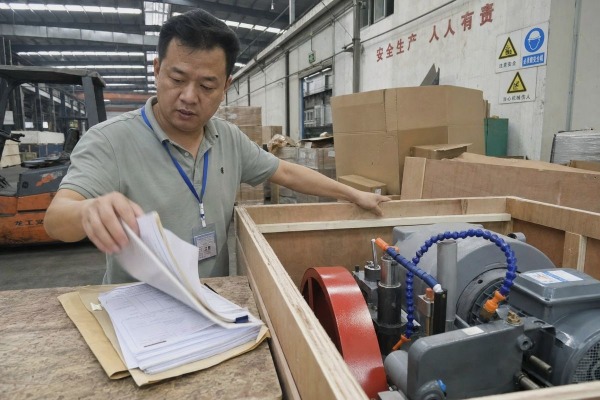
US customs clearance for pipe cutting machines can stall a whole production schedule. I have watched buyers lose weeks because one document was missing. On our production line in Wenzhou, we prepare every export file before the crate is even sealed, because a held container costs far more than the paperwork ever will.
Pipe cutting machines shipped to the US need accurate HTS Code Classification, a commercial invoice, packing list, bill of lading, and certificate of origin, plus safety evidence such as UL/NRTL electrical certification, ANSI/OSHA machine safety compliance, and laser, EPA, or battery documents depending on the machine type.
There is no single magic certificate. Clearance depends on matching the right documents to your specific machine. Let me walk you through exactly what to prepare, how to verify it, and what it costs.
A QC lesson from our export bench: before any pipe cutting machine leaves our workshop, we assemble one folder holding the packing list, bill of lading draft, confirmed HS Code, machine safety files, and electrical certification documents.
Your pipe cutting machine needs correct Harmonized Tariff Schedule classification under Chapter 84, core shipping documents (commercial invoice, packing list, bill of lading, certificate of origin), UL or NRTL electrical safety evidence, ANSI B11 machine safety documentation, and ISPM 15 stamped wooden packaging before US shipment.

Customs clearance is driven by three layers: tariff classification, product compliance, and shipment paperwork. Not one certificate. When we prepare a US-bound shipment, we confirm the HS Code first, because CBP places laser and plasma arc cutting equipment under machine-tool headings in Chapter 84 of the Harmonized Tariff Schedule. The code you declare determines your duty rate and what CBP scrutinizes.
From our own export files, the baseline packet always contains the basic US clearance documents: the commercial invoice 1, packing list, bill of lading, HS Code confirmation, mechanical safety documentation, and electrical certification files. That list comes directly from what we hand every US buyer.
Different cutting technologies trigger different compliance evidence. Here is how we match them:
| Machine Type | Extra Documents Beyond Core Stack |
|---|---|
| CNC laser pipe cutter | IEC 60825-1 laser classification certificate, radiation safety file |
| CNC plasma pipe cutter | Electrical safety report, UL/NRTL evidence, ANSI B11 machine safety file |
| Electric mechanical cutter | UL Safety Certification or NRTL Listing, OSHA-aligned guarding documentation |
| Gas-engine powered cutter | EPA Certificate of Conformity, EPA Form 3520-21 |
| Machines with lithium batteries | UN38.3 test summary, SDS/MSDS for cells |
Also confirm ISO 13849-1 functional safety documentation for automation-heavy machines with smart PLC controls, like the systems we build. And never forget ISPM 15. Every wooden crate must carry the heat-treatment stamp, or CBP can reject the whole shipment for pest concerns and force re-export.
Commercial invoice requirements deserve care too. The invoice must show accurate values, full machine descriptions, and details that match the nameplate exactly.
A US procurement manager once asked me point-blank on WhatsApp: how do I know your UL report is real? Fair question. Fake certificates circulate in this industry, and I respect buyers who check.
Verify certificates by checking the certificate number in the issuing body’s online database (UL Product iQ for NRTL Listing), confirming the model number matches the machine nameplate exactly, checking expiry dates, and requesting the full test report rather than a one-page certificate scan.

Trust is built through verification, not promises. When William, one of our long-term US distribution partners, audits our documents, he follows a simple process that any importer can copy.
Blurry scans, certificates with no verifiable number, issuing bodies you cannot find online, and suppliers who delay when asked for the report behind the certificate. Also verify the certificate of origin against the actual factory address, since origin affects duty treatment and Section 301 exposure.
The hardest email I ever received came from a first-time importer whose crate sat at the Port of Long Beach for three weeks. He had bought from another supplier who skipped the ISPM 15 stamp. That lesson shaped how we pack everything now.
Missing or mismatched documents can trigger CBP examination holds, storage and demurrage fees, reclassification with back duties and penalties, ISPM 15 rejection with forced re-export of wooden crates, or seizure in severe cases, plus OSHA-related workplace-use bans even after the machine clears.

The consequences escalate in stages, and each stage costs more than the last. Understanding this ladder helps you see why pre-shipment preparation is cheap insurance.
| Stage | What Happens | Typical Cost Impact |
|---|---|---|
| Document review hold | CBP or broker requests missing papers | Days of delay, broker fees |
| Physical “red channel” exam | Container opened and inspected | Exam fees plus demurrage per day |
| Reclassification | Wrong HTS code corrected by CBP | Back duties, possible penalties |
| ISPM 15 rejection | Unstamped wood packaging refused | Re-export or fumigation costs |
| Seizure or refusal of entry | Serious admissibility failure | Loss of goods, legal costs |
An inaccurate HTS Code Classification is the most common trigger for the red channel physical inspection. If CBP disagrees with your code, they reclassify, and for machines originating from China that can mean unexpected Section 301 tariffs of 25% on top of the base duty.
Even a machine that clears customs can face trouble on the factory floor. OSHA 29 CFR 1910.212 sets general machine guarding 3 and emergency-stop requirements. A machine without proper guarding documentation aligned to OSHA Safety Standards and ANSI B11 Machine Safety practice can be banned from workplace use, and many insurers demand NRTL-listed equipment. That is why our engineers design guards, e-stops, and electrical panels with these standards in mind from the drawing stage, not as an afterthought.
One nuance matters here. Some sources treat clearance as purely certificate-driven, as if a UL mark alone opens the gate. In reality, CBP relies first on classification accuracy and consistent shipment documentation. Certificates reduce risk and answer questions when they arise. You need both layers.
Budget conversations come up in almost every first call I have with US buyers. The honest answer involves a trade-off we weigh constantly: certifying early adds upfront cost, but skipping it multiplies risk at the port.
Plan for HTS classification confirmation before shipment, a continuous customs bond (roughly $400–$600 per year from most brokers), Importer Security Filing at least 24 hours before vessel loading, and 4–12 weeks plus several thousand dollars if the machine model needs new UL/NRTL testing.

Timing matters as much as money. Several items must be completed before the vessel sails, not after arrival, so build them into your order schedule.
| Item | Who Handles It | When It Must Be Done |
|---|---|---|
| HTS Code confirmation | Supplier + customs broker | Before production ends |
| Customs Bond Requirements | Importer via broker or surety | Before first import |
| Importer Security Filing (ISF 10+2) | Importer/broker | At least 24 hours before loading |
| UL/NRTL testing (if new model) | Supplier + test lab | Weeks to months before shipment |
| IEC 60825-1 laser file | Supplier | With machine documentation |
| EPA Form 3520-21 (gas engines) | Importer at entry | Prepared before arrival |
| ISPM 15 crate treatment | Supplier’s packing house | During crating |
| TSCA PFAS reporting check | Importer | Before entry filing |
New NRTL testing is the biggest variable. If a model already holds valid certification, you pay nothing extra. If not, testing a CNC machine can take one to three months. That is why we recommend confirming certification status before signing the purchase order, and why we quote lead times with documentation included. For our OEM/ODM projects, we align the compliance file with the customized configuration, because a modified control panel can fall outside an existing certificate’s scope.
Two newer items deserve budget lines. The EPA TSCA Section 8(a)(7) PFAS reporting rule now requires importers to report certain “forever chemicals” present in components or lubricants, so request SDS files 4 for cutting fluids and greases. And if you import regularly, C-TPAT participation reduces examination frequency, effectively giving high-value industrial equipment a green lane. Finally, keep your certificate of origin accurate; substantial transformation analysis or exclusion requests can legitimately mitigate Section 301 exposure, but only with clean origin documentation.
Missing paperwork turns a routine import into a costly hold. Match your machine’s technology to the right documents, verify every certificate, file early, and clearance becomes predictable rather than painful.
