

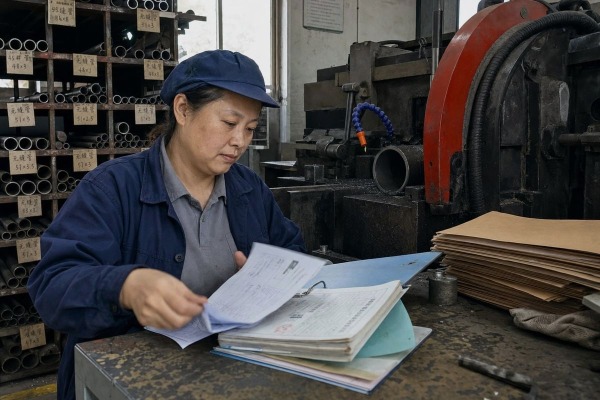
Verifying a pipe cutting machine supplier’s raw material supply chain stability saved one of our buyers from a three-month delay. On our Wenzhou production line, we learned this lesson the hard way.
To verify a pipe cutting machine supplier’s raw material supply chain stability, request material traceability records, ISO 9001 certification, and Mill Test Certificates; audit their sub-supplier list and backup sourcing plans; and track their lead time consistency and pricing history over at least six months.
That sounds like a lot of work. It is not, once you know what to ask for. Let me walk you through each step, based on what we see from both sides of the table.
A German buyer once asked our team for the steel batch records behind a chamfering machine frame. We could pull them in one afternoon. That request changed how I think about trust.
Ask the supplier to show material traceability from origin to finished machine: Mill Test Certificates for steel and alloys, batch or lot tracking records, purchase orders from named upstream mills, and incoming inspection reports. Consistent sources appear repeatedly across documents; traceable sources connect every claim to paperwork.

In our workshop, every pipe cutting machine starts with structural steel, guide rails, cutting heads, bearings, motors, and control electronics. The machine is what you see. The upstream materials are where the real supply risk hides. My personal test is simple: are the critical components stable and controllable, and is the supplier's system mature enough to prove it?
A supplier can say anything in a sales call. Documents are harder to fake consistently. Ask for Mill Test Certificates (MTCs) on structural steel and wear parts. An MTC shows the chemical composition and mechanical properties of a specific heat or batch. Then ask for the purchase orders and shipping documents that link that batch to the machine you are buying. This is chain-of-custody thinking, and it works even for standard capital equipment.
One clean certificate proves nothing. Consistency does. Request records from three or four past production runs. If the steel comes from the same named mill each time, and the bearings come from the same approved brand, that supplier has a real procurement strategy. If the sources change every quarter with no explanation, quality will drift too.
| Evidence Type | What It Proves | Red Flag If Missing |
|---|---|---|
| Mill Test Certificates | Material meets metallurgical specs | Vague "quality steel" claims |
| Batch/lot tracking records | Materials trace to specific machines | No way to isolate a defect |
| Upstream purchase orders | Named, repeatable sources | Sources change without notice |
| Incoming inspection reports | Materials verified on arrival | Defects found only at assembly |
At our factory, we keep lot control records precisely because buyers like William, a US procurement manager we work with, demand them before signing OEM contracts. Smaller suppliers may not run enterprise traceability software, and that is acceptable. But basic supplier vetting records and lot control are the minimum bar. No paperwork means no traceability, full stop.
During a regional steel price spike a few years back, our team had to activate a second guide rail source within two weeks. That experience taught me exactly which questions expose weak continuity planning.
Ask five things: How many approved alternate sources exist per critical component? What safety stock do you hold? How do you monitor Tier 2 sub-suppliers? What was your worst past disruption and recovery time? Can you guarantee delivery if prices rise mid-contract?

The core issue is this: when a shortage or price hike hits, can the supplier still deliver? That is my number-one test of whether a supplier system is mature. A supplier with no answer to that question is asking you to carry their risk. Some buyers argue that deep supply chain questions are overkill for a standard equipment purchase, and that machine performance and spare parts availability matter more. I understand the logic, but it fails in practice. A supply interruption can stop your installation, delay commissioning, and starve you of wear parts for years. The lowest-risk purchase is not the cheapest machine. It is the one whose upstream sourcing is most transparent.
Use these in order. Vague answers to the first two are your exit signal.
Also probe concentration risk. Cluster-based sourcing in established manufacturing regions improves responsiveness, and we benefit from it ourselves in Zhejiang. But if all of a supplier's backup sources sit in the same regional network 1, one localized logistics failure takes them all out at once. Geographic diversity in upstream sourcing matters as much as the number of sources.
I weigh a trade-off constantly when quoting export orders: lock in a fixed price and absorb material volatility, or pass it on and lose the buyer's trust. How a supplier handles that trade-off tells you everything.
Request 12 months of delivery data: quoted versus actual lead times, on-time delivery rate, and price revision history. Stable suppliers show lead time variance under 15 percent, documented reasons for any price change, and hedging or safety stock strategies that absorb short-term commodity spikes.

Stability is measured, not promised. The good news is that the metrics you need are operational, not macroeconomic. You do not need a commodities analyst. You need the supplier's own records, and a willingness to compare claims against numbers.
Track these across at least two or three past orders, or ask for anonymized data from other customers in your region:
| Metric | What to Look For | Warning Threshold |
|---|---|---|
| Lead time consistency | Quoted vs. actual delivery dates | Repeated slips over 2 weeks |
| On-time delivery rate | Percentage of orders delivered as promised | Below roughly 90% |
| Price revision frequency | Documented, explained changes | Surprise mid-order increases |
| Recovery time from disruption | Days to restore normal supply | No data available at all |
| Lot traceability coverage | Share of raw materials with batch records | Only "some" materials covered |
In our experience exporting to the US, Germany, and Japan, buyers care less about the lowest price and more about the price that does not move. Suppliers achieve that in a few ways. Some use commodity hedging 2 or long-term contracts with their steel mills to buffer price volatility. Some hold larger safety stocks 3 of alloys and wear parts, trading inventory cost for schedule certainty. A growing number use predictive analytics to spot supply shocks early. Ask which approach your supplier uses. Any real answer beats no answer.
Also run a basic financial risk assessment. A supplier with weak liquidity 4 cannot maintain consistent procurement from primary mills, no matter how good their intentions. Check their creditworthiness, years in operation, and payment behavior with their own upstream vendors. Production capacity planning matters here too: a supplier running at 100 percent capacity has zero buffer when your rush order or a material delay hits. We deliberately keep headroom on our own lines for exactly this reason, because a delayed machine delivery hurts our buyer's production schedule far more than it hurts our margin.
A procurement manager from Italy once sent us a document checklist before his first order. Twelve items long. We could supply ten immediately, and I respected the ask — it filtered out weaker competitors for him instantly.
Request ISO 9001 certification, Mill Test Certificates, recent third-party audit reports, business registration documents, supplier scorecards, sub-supplier lists, incoming inspection records, production capacity reports, and evidence of alternate sourcing agreements. Together, these documents prove quality assurance standards, vendor compliance, and upstream control.

No single certificate proves supply chain resilience 5. A document stack does, because the documents cross-check each other. An audit report should match what the capacity report claims. Incoming inspection records should reference the same materials named in the MTCs. When the paperwork tells one consistent story, you can trust it. When it contradicts itself, you have found your answer early and cheaply.
| Document | What It Verifies | Who Issues It |
|---|---|---|
| ISO 9001 certificate | Quality management system exists and is audited | Accredited certification body |
| Mill Test Certificates | Metallurgical properties of steel and alloys | Steel mill or material producer |
| Third-party audit report | Factory processes match claims | Independent inspection agency |
| Business registration and permits | Legal standing and financial legitimacy | Government authorities |
| Sub-supplier list | Tier 2 visibility and sourcing depth | The supplier |
| Incoming inspection records | Materials verified before production | Supplier QC department |
| Alternate sourcing agreements | Backup plans are real, not verbal | Supplier plus backup vendors |
The trend is moving fast here. Industrial buyers increasingly expect digital traceability and rapid disclosure, not a scanned PDF from three years ago. Due-diligence frameworks modeled on the OECD five-step approach are spreading beyond conflict minerals into general metals sourcing, and the same logic applies to machinery: upstream sourcing should be controlled, auditable, and resilient. ESG regulations and Carbon Border Adjustment Mechanisms are also starting to affect high-carbon material availability in Europe, so ask whether your supplier tracks the carbon profile of their steel sources if you import into the EU.
One caution from my side of the desk. If a supplier uses subcontractors or outsourced machining, the certificates of the main factory do not cover those parties automatically. Ask how subcontractors are monitored, whether they pass the same supplier audit process, and whether their output goes through the same incoming inspection. In our own operation, outsourced parts get the same QC gate as purchased materials. Any supplier who cannot describe that gate is leaving a hole in their vendor compliance story — and in your delivery schedule.
An unstable supply chain will delay your installation, drain your budget, and stall your production. Verify traceability, backup plans, delivery data, and documents — then buy from proof, not promises.
1. OECD framework for managing risks within regional supply networks and ensuring responsible sourcing. ↩︎
2. Wikipedia entry explaining financial hedging strategies used to mitigate commodity price volatility. ↩︎
3. Wikipedia entry defining safety stock as a buffer against supply chain fluctuations. ↩︎
4. World Bank resource on financial sector stability and assessing business liquidity risks. ↩︎
5. The original Trade.gov resilience page is now the official Supply Chain Center, the primary US government hub for supply chain risk. ↩︎
