

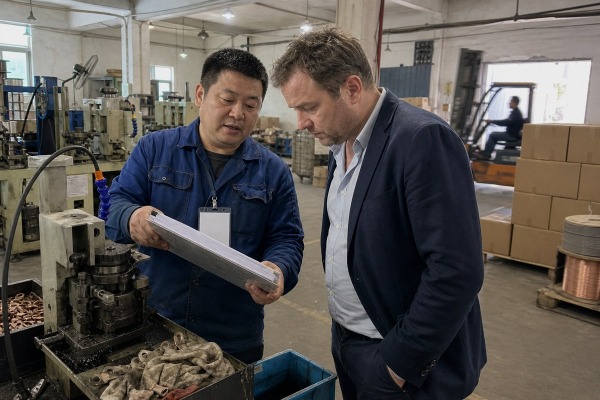
Sending a deposit to an unknown factory is scary. Buyers who contact our Wenzhou workshop always ask first: can you prove your [cable lug making machine supplier export track record](https://yqunique.com/?p=5861)?
To verify a cable lug making machine supplier’s export track record, check customs data for shipment history, request redacted Bills of Lading and invoices, authenticate ISO and CE certificates on issuing bodies’ portals, contact overseas references, and commission a third-party factory audit for high-value orders.
Export track record is not one single thing. It covers three questions. Can the supplier legally export? Has it shipped similar machines before? Were those shipments successful? This guide walks through each check, step by step, using the same methods our own international buyers use on us.
Last spring, a procurement manager from Michigan emailed us before paying anything. He wanted paperwork, not promises. His request list taught me exactly what smart buyers should demand.
Request redacted commercial invoices, packing lists, Bills of Lading or airway bills, and export customs declarations from past machinery shipments. Each document should show the exporter's legal name, dates, product descriptions, destinations, and transport details, so you can cross-check them for consistency.

Documents beat marketing claims every time. Many suppliers can show a business license. Far fewer can show shipment-level evidence tied to the exact legal entity 1 and product category. That gap is where "paper export experience" hides. So ask for two or three redacted examples of recent international shipping documents for similar machinery, then read them like an auditor.
| Document | What it proves | Red flag to watch |
|---|---|---|
| Redacted commercial invoice | Repeated exports, dates, destinations | Exporter name differs from registered entity |
| Bill of Lading or airway bill | A real shipment on a real route | Missing port details or vague product names |
| Packing list | Believable size and weight for machinery | Weights that suggest commodity goods, not machines |
| Export customs declaration | Legal clearance under the correct category | Unrelated product descriptions |
| Photos of packed goods | Real export packaging and labeling | No destination-specific markings |
Bill of Lading verification only works if you compare documents against each other. Match the company name, address, invoice numbers, Incoterms, weights, and destination country across all files. Inconsistencies often reveal export experience that is exaggerated or borrowed from another business. Also request redacted VAT invoices. These confirm the supplier is a registered manufacturer, not a middleman reselling someone else's machines.
A professional supplier should redact client names and prices. In our office, we prepare anonymized shipment summaries for exactly this reason. Redaction is not evasion. It is how a serious exporter proves history without exposing another buyer's secrets. If a supplier refuses even redacted proof, walk away.
One buyer in Mexico told me he found our shipment records in a customs database before he ever messaged us. That search saved him weeks of guesswork.
Search customs data platforms such as Panjiva or Volza for the supplier's legal name, filter shipments by your destination country, and confirm the HS codes, dates, and port of loading records match machinery exports. Then ask the supplier for matching Bills of Lading.

In my own experience, customs data analysis 2 is the fastest way to separate real exporters from polished sales pitches. When I advise buyers, I always point them to two sources first: customs records and the supplier's customer reviews on trading platforms. Both are hard to fake at scale. Trade databases pull shipment-level records showing export activity, destination markets, buyer relationships, and consistency over time.
| Signal | What it tells you |
|---|---|
| Shipment frequency | Regular exports over years, not one-off deals |
| Destination diversity | Experience with different customs regimes |
| HS Code 8462 3 entries | Real metal-forming machinery, not unrelated goods |
| Port of loading records | Logistics routes that match the factory location |
| Export volume trends | Growing or stable business, not a fading one |
Cable lug making machines typically fall under HS Code 8462, which covers metal forming and pressing machinery. If a supplier's database records show only textiles or plastic goods, the machinery track record probably belongs to someone else. Also verify the legal entity itself. For Chinese suppliers, check registration on the official GSXT registry. For Indian suppliers, confirm IEC, GSTIN, and incorporation records. The exporter name in the database must match the company you are paying.
One caution is fair here. Some buyers treat trade data as the final verdict. It is not. Databases do not cover every market or every shipment. Treat customs data as a screening tool, then confirm findings with direct document review and the supplier's Trade Assurance history on B2B platforms.
Every year, our team debates whether renewing certifications is worth the audit fees. We always renew, because serious buyers check certificate numbers before they check prices.
ISO 9001 certification proves a documented quality management system, CE marking shows compliance with EU machinery safety directives, and AEO status confirms a clean customs compliance record. Always authenticate certificate numbers directly on the issuing body's portal or the IAF CertSearch database.

Certificates are easy to claim and easy to forge. That is why authentication matters more than the certificate itself. A scanned PDF in an email proves nothing. A certificate number that resolves on the issuing body's official portal proves a lot.
| Certification | What it covers | How to verify it |
|---|---|---|
| ISO 9001 | Quality management system | Search the certificate number on IAF CertSearch or the certifier's portal |
| CE marking | EU machinery safety compliance | Request the Declaration of Conformity and test reports |
| UL listing | North American electrical safety | Check the UL online certification directory |
| AEO status | Trusted customs compliance record | Confirm with national customs authority listings |
| Export registration | Legal ability to export | Match against national business registries |
Here is an objection I hear often: "The supplier has ISO 9001 certification, so they must be a reliable exporter." I disagree, and I say that as someone whose factory holds quality documentation for equipment shipped to ten countries. Certification proves process discipline. It does not prove shipping experience. A supplier can pass a quality audit yet still fumble destination labeling, customs paperwork 4, or seaworthy packing for a heavy machine.
So combine both checks. Ask for the certificate, authenticate the number, then request a recent factory audit report from a recognized inspection body. Third-party inspection services can confirm the certificates hang in a real workshop with real CNC and forging equipment, not a rented office. For regulated markets like the EU or GCC, also confirm the supplier understands destination-specific conformity requirements. That knowledge is part of the export track record too.
Early in our export journey, I learned that a happy customer in Vietnam says more than any brochure. Now we encourage buyers to call our past clients directly.
Ask the supplier for two or three overseas references with permission to contact them, then verify order details, machine uptime, and after-sales response by video call or email. Cross-check platform reviews on Made-in-China or Alibaba and look for region-specific, detailed feedback.

References and reviews are the human layer of verification. In my view, they work best as confirmation, not as primary evidence, because references can be curated. Documents and customs records come first. Voices come second. Together they are powerful.
Here is the reference-checking process I recommend to every buyer:
If references are vague, uncontactable, or refused entirely, treat that as a serious warning. Real exporters have real friends abroad.
Verifying a cable lug making machine supplier's export track record protects your deposit. Combine customs data, verified documents, authenticated certificates, and real references before you wire a single dollar.
1. Provides a definition and legal context for the business registration mentioned in the verification process. ↩︎
2. Official resource from the World Customs Organization regarding data-driven trade facilitation and verification. ↩︎
3. Authoritative US government guide explaining the international Harmonized System used to classify machinery exports. ↩︎
4. Official Customs and Border Protection guide on the essential documentation required for international trade compliance. ↩︎
