

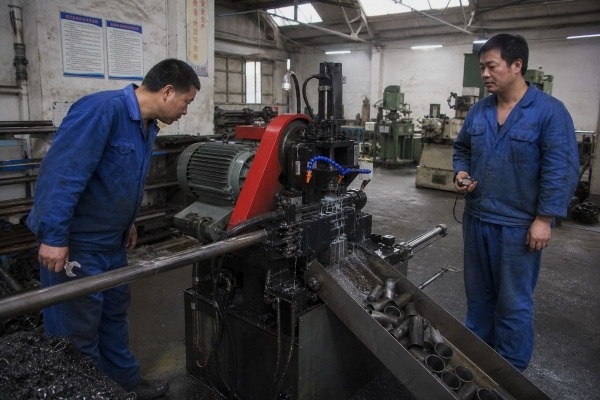
Tool-change efficiency in automatic pipe cutting machines is a question I hear constantly from buyers testing our equipment in Wenzhou. Their cutting speed looks great on paper. Yet daily output falls short. The hidden killer? Minutes lost every single time a tool swaps.
Tool-change efficiency in automatic pipe cutting machines directly determines real production output. Faster, more reliable tool changes reduce non-cutting time, raise machine utilization, cut labor intervention, and improve OEE. Even seconds saved per change compound into hours of recovered capacity across shifts.
The cutting head gets all the attention. But the time between cuts often decides your true output rate. Let me show you the math, the features that matter, and when the upgrade pays off.
Last year, an engineering manager sent our team his shift logs before ordering a machine. We calculated his tool-change time as a share of total production time. He was shocked: nearly 9% of his shift disappeared into changeovers.
A line performing 20 tool changes per shift saves roughly 18 minutes daily by moving from 60-second manual swaps to 6-second automatic changes. Scaled across a year, that recovers over 70 hours of pure cutting capacity per machine.

The math here is simple, but most factories never run it. That is why, before we quote any project, we follow a four-step process I insist on: confirm the customer's production mode 1, obtain real tool-life data from their floor, calculate the capacity loss caused by tool changes, and calculate tool-change time as a percentage of total production time. Those four numbers tell us whether an upgrade makes sense before anyone spends money.
Industry data puts automatic tool changes 2 at roughly 2–8 seconds. Manual changes commonly take 30–120 seconds, depending on machine layout and operator skill. That gap looks small per cycle. It is not small per shift.
| Scenario | Changes per shift | Time per change | Daily time lost | Annual time lost (250 days) |
|---|---|---|---|---|
| Manual swap | 20 | 60 sec | 20 min | 83 hours |
| Quick-change tooling | 20 | 25 sec | 8.3 min | 35 hours |
| Automatic Tool Changer (ATC) | 20 | 6 sec | 2 min | 8 hours |
One documented plant case makes this concrete. A shop switched from manual changing to a 60-tool chain changer and reduced series handling time from 160 minutes to 116 minutes. That is a 27% improvement from tool-change savings alone. Another pipe chamfering example reported setup time falling from 25 minutes to 2 minutes, and tool-change time dropping from 8 minutes to 10 seconds after automation.
If you cut one pipe diameter all day, tool changes are rare. But most of our export customers in the US and Germany run high-mix orders. Frequent changeovers mean the losses multiply. Setup time reduction becomes the fastest lever for production throughput optimization — faster than buying a machine with a quicker blade.
A procurement manager from Ohio once asked me to walk him through our machine on a video call — but he only wanted to see the tool station, not the cutting head. Smart buyer. He knew where the real time hides.
Look for an Automatic Tool Changer or quick-change tooling, pre-settable tool holders, smart PLC control with tool-life tracking, repeatable clamping fixtures, and cycle synchronization that hides tool changes during material loading. These features cut changeover from minutes to seconds.

Not every feature carries equal weight for every buyer. Our engineers design equipment differently for a Japanese customer running long batches versus an Indian distributor whose end users switch products hourly. Here is how I rank the features when advising on CNC tube cutting automation.
| Feature | What it does | Best for |
|---|---|---|
| Automatic Tool Changer (ATC) | Swaps tools in seconds without operator | High-mix, high-volume lines |
| Quick-change tooling | Manual swap with pre-set holders, no recalibration | Mid-volume shops without ATC budget |
| Smart PLC tool-life tracking | Predicts wear, schedules changes before failure | Continuous unattended production |
| Repeatable clamping jaws | Eliminates realignment after each change | Tight-tolerance end-prep work |
| Hidden changeover sequencing | Performs changes during material indexing 3 | Lines chasing zero-second net changeover |
First, ask about tool positioning repeatability 4, not just change speed. A fast change that needs recalibration saves nothing. Removing human error in tool calibration is what protects part accuracy across thousands of cycles.
Second, check whether the controller can hide changeovers. Modern controllers perform tool changes during material indexing or loading phases. The net changeover time approaches zero because the machine never truly stops producing.
Third, look at multi-process integration. Machines that combine cutting, beveling, and marking in one continuous operation eliminate secondary handling entirely. In precision metalworking machinery, every extra handling step is another chance for delay and error. When we develop custom automation systems for OEM clients, this integration question usually shapes the entire machine layout.
Also confirm serviceability. Corrugated cable conduits, accessible pneumatic fittings, and a clean coolant routing design make the tool station easier to maintain — which keeps those fast change times fast over years, not just at acceptance testing.
The trade-off I weigh most often in quotations is capital cost versus recovered capacity. An ATC adds real money to a machine. So before recommending it, I always calculate the customer's capacity loss from tool changes — that number decides everything.
Tool-change efficiency lowers production costs three ways: more cutting time per shift means lower cost per part, less operator intervention reduces labor overhead, and consistent automated changes cut scrap from misalignment. Together these improvements raise OEE availability significantly.

Overall Equipment Effectiveness (OEE) has three components: availability, performance, and quality. Tool-change efficiency touches all three. Machine downtime minimization improves availability. Faster cycles improve performance. Repeatable tool positioning improves quality. That is why one broad automation study reported machine utilization rising from about 58% to over 85% after full CNC automation, with production cycle times falling 25–50%.
Labor is the most underrated line item. When changes take seconds and require no hands, a single operator can oversee multiple machines simultaneously. Instead of standing by for tool swaps, workers handle inspection, loading, or programming. For our customers in the US and Germany, where skilled labor is expensive and scarce, this reallocation often justifies the industrial automation ROI by itself.
Quality savings come next. Long manual interruptions let the spindle and frame cool down, causing "first-part" dimensional drift when cutting resumes. Rapid tool changes maintain thermal stability, so the first cut after a change matches the last cut before it. Fewer out-of-spec parts means less scrap and rework.
I will not pretend automation is free of risk. Automatic systems can create their own downtime. In one documented case, an ATC failure increased setup time from 30 to 40 minutes and delayed production schedules. This is why we build our machines around stable PLC control and standard, serviceable components — and why any ROI calculation must include maintenance overhead, not just the seconds saved per change. If your real bottleneck is loading, material handling, or programming, fixing tool changes alone will not move total output much. Measure first, then invest.
A lesson our team learned early: buyers remember consistency longer than they remember speed. One distributor told us his end users forgave a slower machine but never forgave a machine that drifted out of tolerance mid-batch.
Yes. Faster automated tool-change systems improve long-term consistency by maintaining thermal stability, eliminating manual calibration variance, and delivering repeatable bevel angles and cut finishes across thousands of cycles. This consistency reduces scrap and supports reliable downstream welding and assembly.

Consistency is where tool-change efficiency stops being a speed story and becomes a quality story. Let me break down the mechanisms, because they matter for anyone running tight-tolerance tube fabrication.
| Condition | Upgrade to ATC? | Reason |
|---|---|---|
| Many tool changes per part, high-mix orders | Strong yes | Savings compound every cycle |
| Moderate-to-large batches, tight tolerances | Yes | Consistency and OEE gains dominate |
| Expensive or scarce labor | Yes | One operator runs multiple machines |
| Low volume, infrequent changes | Probably not | Time saved too small to justify capital cost |
| Bottleneck is loading or inspection | Fix that first | Tool-change automation won't move total output |
This decision logic also applies as technology advances. High-speed laser pipe cutting systems and digital twin simulation — which optimizes the physical trajectory of the tool changer arm to reduce mechanical wear — are pushing changeover losses even lower. But the fundamentals do not change: know your production mode, know your real numbers, and match the system to them.
Tool-change efficiency is not a maintenance detail. It is a production-capacity variable. Measure your changeover losses, run the math, and the right upgrade decision becomes obvious.
1. Explains the various methods and systems used to organize industrial production and manufacturing output. ↩︎
2. The central authority for international standards governing industrial automation and mechanical engineering specifications. ↩︎
3. Official resource for international trade data and standards related to industrial machinery and manufacturing. ↩︎
4. Federal agency providing technical standards and measurement science to enhance industrial performance and precision. ↩︎
