

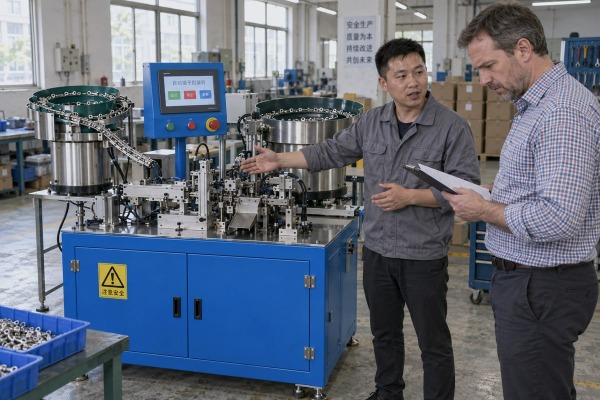
An automatic assembly machine price can swing 40% between suppliers for the same part. That gap breeds doubt. After years quoting terminal-lug systems from our Wenzhou workshop, I understand why.
A supplier’s automatic assembly machine price is fair when it matches market ranges for the same automation level—roughly $150K–$500K for simple turnkey machines, $250K–$1M for multi-station cells—and includes comparable scope: feeders, tooling, inspection, acceptance testing, training, and after-sales support at a competitive total cost.
Price alone tells you very little. Scope tells you almost everything. In this article, I will walk you through how to compare quotes on a like-for-like basis, how to judge customization charges, when a cheap machine is a trap, and which hidden costs to hunt for before you sign.
Last quarter, a procurement manager in Mexico sent me three competing quotes and asked why ours sat in the middle. The answer came down to scope, not greed.
Compare quotes on station count, cycle time requirements, feeding reliability, vision inspection depth, component brands, software ownership, warranty terms, and included services. Normalize these items first; only then does a price difference reveal whether one supplier is cheaper or simply offering less.

Two quotes with the same part name on the cover page can describe two completely different machines. Before you compare a single dollar figure, you need a common technical baseline. I always tell buyers: if you cannot explain why one quote is more expensive than another, you do not yet have comparable quotes.
Start with the big picture. Judge each quote against typical market ranges for the same automation level, not against each other in isolation.
| System Type | Typical Price Range |
|---|---|
| Semi-automatic stations | $20K–$100K, up to $150K+ depending on scope |
| Standalone automatic machines | $80K–$300K |
| Simple single-station custom cells | $250K–$400K |
| Multi-station assembly systems | $500K–$1.5M+, with many typical systems at $800K–$1.2M |
| Fully automated lines with heavy inspection and traceability | $800K to several million dollars |
A quote far outside these bands is not automatically wrong. But it demands an explanation. A higher price can be fair if it buys faster cycle time, deeper inspection, or stronger uptime engineering.
Next, put the quotes side by side and check ten cost drivers: number of stations, part complexity and tolerances, feeding reliability, robotics versus dedicated mechanisms, vision inspection depth, traceability and data logging, cycle time targets, utilities and footprint, software and HMI ownership, and after-sales terms. In our experience exporting turnkey automation solutions to markets like the US and South Korea, most price gaps disappear once these ten items are aligned.
Finally, look inside the cabinet on paper. Verify the brands of PLCs, sensors, servos, and pneumatic actuators. Premium components cost more upfront but justify that cost through reliability. When we build our terminal assembly machines, we specify components our overseas customers can source locally, because a saved $2,000 on a no-name PLC is worthless if it strands a line for two weeks.
Our engineers once spent three weeks redesigning a vibratory bowl feeder 1 because a customer’s terminal lug had an unusual flange. That tooling work appeared on the quote—and it was real.
Customization costs are justified when the supplier itemizes custom engineering hours, tooling, and testing against your specific part geometry, tolerances, and cycle time targets. If bespoke charges appear without drawings, feasibility studies, or acceptance criteria attached, question them before signing anything.

Customization is where fair pricing gets murky, because you cannot benchmark a bespoke feeder bowl on a marketplace listing. But you can still test whether the charges are honest. At our factory in Wenzhou, we build machines around customer product drawings and production processes, so I see exactly where custom money goes—and where it should not.
Ask your supplier for the ratio of custom-engineered parts 2 to standardized modular components. High levels of bespoke engineering naturally drive up the price due to design labor, and that is legitimate. But a supplier who customizes everything—including frames, guarding, and HMI screens that could be standard—inflates both cost and machine lead times without adding value to your specific product.
| Charge Type | Usually Justified | Usually Questionable |
|---|---|---|
| Feeder bowls and orientation tooling | Yes, if tied to your part geometry | If quoted as a lump sum with no part study |
| Custom engineering hours | Yes, with hour estimates and deliverables listed | If no drawings or design reviews are promised |
| Crimping or pressing tooling | Yes, when matched to your tolerances | If reused standard tooling is billed as new |
| Software modifications | Yes, for your traceability or MES needs | If basic HMI screens are billed as custom code |
| Sample testing and feasibility runs | Yes, and they de-risk your project | Rarely questionable—absence is the red flag |
Justified customization should also protect your future. Ask whether the machine frame and core modules can be re-tooled for the next product iteration, or whether you are buying a single-use asset. A slightly higher price for a modular platform 3 often beats a cheaper dedicated machine once your product changes. Likewise, ask whether the supplier offers virtual commissioning or simulation of the machine logic before build—it costs a little more but reduces expensive on-site debugging delays.
I learned early in our export business that the cheapest bid usually returns as the most expensive problem. One rock-bottom machine can quietly erase a year of labor savings.
A low-priced automatic assembly machine can be trusted only if it documents guaranteed cycle time, uptime assumptions, defect handling, and acceptance criteria. Without those commitments, the low price usually signals excluded scope, weaker components, or missing support—costs that resurface during production.

Many buyers tell me price is the main benchmark, and I understand why—when you shop multiple suppliers, price is the easiest number to compare. That objection deserves a straight answer. Price is a useful screening tool. But it is incomplete, because it ignores scope, quality, and lifecycle costs. The better measure is Return on Investment: what the machine actually earns you, per dollar spent, over its working life.
An automatic assembly machine price only makes sense next to the output it produces. A $150K machine running at 60% uptime with frequent feeding jams delivers less real production than a $220K machine running at 90%. Here is the evaluation process I recommend to every procurement manager:
The pattern I see repeatedly: unstable machine performance is the single most common pain our overseas customers report about previous low-cost purchases. Some newer systems even shift the value proposition further, using predictive diagnostic tools that monitor component wear in real time—moving you from reactive repair to proactive uptime management. A low quote rarely includes any of that. So can you trust a low price? Only after the supplier proves, in writing, that the low price still buys the output you need.
Whenever we finalize a proposal, I face a choice: quote everything transparently and look expensive, or hide line items and look cheap. Some suppliers choose the second path.
Watch for excluded feeders, tooling, guarding, installation, Factory Acceptance Testing, training, spare parts, software licenses, and freight. Also verify preventative maintenance costs, integration fees, and change-order pricing. Any machine price quote missing these items will grow substantially after you sign the contract.

The most dangerous phrase in any quote is “complete system” with no line-item detail. When I review competitor quotes that customers share with us, the missing items follow a predictable pattern. Here is the checklist I would use before approving any purchase order.
| Hidden Cost | Question to Ask the Supplier |
|---|---|
| Feeders and orientation tooling | Are all vibratory bowls and escapements included for my exact part? |
| Guarding and safety compliance | Does the price meet the safety standards of my country? |
| Factory Acceptance Testing 4 and site acceptance | What are the written acceptance criteria, reject-rate limits, and test quantities? |
| Installation and commissioning | Who travels, who pays, and how long is on-site support? |
| Training and documentation | Are operator training, manuals, and electrical drawings included? |
| Spare parts | Is a recommended spare-parts list with prices attached? |
| Software licenses | Do I own the programs, source code, and parameter files? |
| System integration services | What does connecting to my existing line or upstream equipment cost? |
| Freight, duties, and insurance | Is the price EXW, FOB, or CIF—and what changes at my door? |
| Future design changes | What is the change-order process and rate if my part is revised? |
Pay special attention to software. A quote that locks the PLC program or charges proprietary licensing fees for MES or ERP connectivity turns every future change into a paid service call. Insist on open architecture, accessible programming files, and clear ownership of drawings. On our machines, we hand over programs and documentation precisely because our customers in ten-plus export markets cannot depend on us being physically nearby. Also confirm guaranteed response times for technical support. A fair automatic assembly machine price includes the support structure that keeps the machine earning after the warranty period begins.
A fair automatic assembly machine price delivers required output, quality, and support at competitive total cost. Compare prices, but weigh after-sales service, technical capability, machine quality, and processing stability together.
