

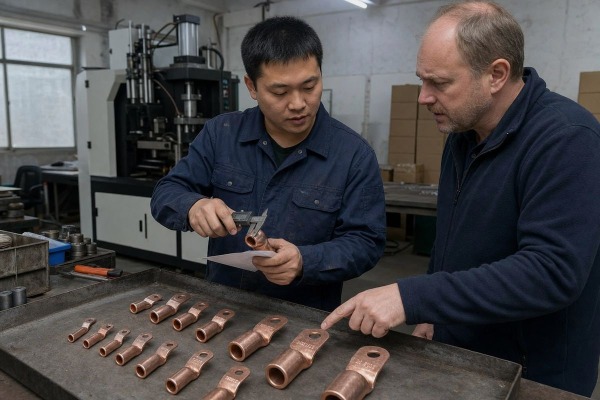
Specifying the terminal [size range](https://yqunique.com/?p=5534) for a cable lug making machine 1 trips up many buyers. Our Wenzhou workshop sees vague RFQs weekly, and vague specs lead to costly mismatches.
Specify the terminal size range by stating your minimum and maximum conductor cross-section in mm² or AWG, the bolt-hole diameters you need, the lug material, and your tooling bands. For example: copper tubular lugs from 10–120 mm² with 5–12 mm stud holes.
That one sentence covers a lot. Below, I break it into four practical questions so you can write a machine brief your supplier can actually quote against.
A buyer from Mexico once sent us a single photo of a lug and asked for "a machine that makes this size." We had to ask five follow-up questions before we could even suggest a model.
Before ordering, confirm four ranges: conductor cross-section (in mm² or AWG), lug barrel inner and outer diameter, bolt or stud-hole size (typically 5–20 mm), and overall terminal length and width. Together, these define the true working envelope your machine must cover.

The most common mistake I see is buyers quoting only the conductor size. The cross-sectional area mm2 rating matters, but it is only one dimension of the specification. A lug for a 35 mm² conductor may be offered with several different stud-hole sizes and palm geometries. Your machine must handle both the conductor side and the connection side.
Think of the terminal size range as a box with four walls, not a single number:
| Dimension | What It Means | Typical Range Examples |
|---|---|---|
| Conductor cross-section | The cable size the lug accepts | 2.5–95 mm², 6–1000 mm², 26–10 AWG |
| Barrel dimensions | Tube ID/OD and wall thickness | Varies with copper tube terminals stock |
| Bolt/stud-hole size | Hole punched in the palm | 5 mm to 20 mm |
| Terminal geometry | Length, palm width, angle | Per DIN 46235 or UL 486 |
Published equipment ranges show how widely these envelopes vary. Some tubular lug crimping systems are built for 2.5–95 mm². Others stretch to 2.5–300 mm². Full production lines can run from 6 mm² up to 1000 mm², with bolt sizes from 5 mm to 20 mm. If you only say "medium size lugs," your supplier is guessing which band you sit in.
International buyers often mix units. AWG specifications and metric mm² do not map perfectly, so state both if your market uses both. A wire gauge range of 26–10 AWG corresponds roughly to 0.12–6.64 mm², which is a completely different machine class than 25–400 mm² heavy duty electrical lugs. We always confirm the unit system in writing before engineering starts.
The trade-off we weigh most often in our engineering meetings is tooling bands versus universal claims. One controller can store many programs, but dies still live in physical size groups.
Match lug dimensions to tooling by grouping your products into size bands — commonly 10–50 mm², 70–120 mm², and 150–240 mm² — then order one interchangeable die set per band. Provide accurate drawings and physical samples so the supplier can verify each die against real parts.

Here is the practice I recommend above everything else, and it comes straight from our own project files: send accurate drawings and mail physical product samples to your supplier. When we receive a buyer's samples in Wenzhou, our engineers measure the barrel ID, wall thickness, palm width, and hole position directly. That removes guesswork and lets us match the right machine model on the first proposal instead of the third. A drawing tells us the target. A sample tells us the truth about tolerances, material batch, and surface finish.
No single die covers 6 mm² to 1000 mm². Real tooling sets split into groups such as 10–50, 70–120, and 150–240 mm². Each band shares similar forming forces and stroke lengths. Interchangeable die set 2s let one press frame serve multiple bands, but changeover time is never zero. If 80% of your volume sits in one band, dedicate a machine to it and swap tooling only for the tail sizes.
Steel quality matters more as size grows. Cheap dies lose dimensional accuracy fast at heavy tonnage, and the reject rate shows up in your customer's crimp tests, not in the supplier's demo video.
An Indian distributor emailed us last year asking for "a multi-size lug machine, best price." We replied with a one-page specification form instead of a price. He filled it in, and the machine we built has run without a size-related complaint since commissioning.
Provide your supplier with the conductor size range in mm² and AWG, bolt-hole diameters, material type (copper, tinned copper, or aluminum), applicable standards like DIN 46235 or UL 486, target output per hour, automation level, and — most importantly — accurate drawings plus physical samples.

A strong specification sentence beats a vague wish list. Compare these two requests. Weak: "We need a multi-size machine." Strong: "We need a cable lug making machine for copper tubular lugs 4 covering 10–120 mm², with provision for 6–50 mm² parts in a separate tooling set, and bolt-hole sizes from 5–12 mm." The second version forces the supplier to confirm the exact envelope, not just repeat a marketing headline.
| Specification Item | What to State | Why It Matters |
|---|---|---|
| Size range | Min and max in mm² and AWG | Sets press capacity and die design |
| Press tonnage | At least 35 tons up to ~70 mm²; 120+ tons toward 1000 mm² | Undersized presses produce weak forms |
| Material | Copper, tinned copper, aluminum | Hardness and spring-back differ during forming |
| Standards | DIN standard connectors, UL 486 | Defines barrel length and palm width tolerances |
| Bolt-hole range | e.g., 5–12 mm | Confirms punching/riveting capability |
| Automation level | Semi-auto or fully automatic | Fully automatic needs tube feeding and auto-ejection |
| Drive type | Hydraulic or servo-electric | Servo presses give sub-millimeter stroke precision for thin walls |
| Finishing | Deburring station needed? | Smooth internal barrels ease cable insertion |
Copper and aluminum behave very differently under cold pressing technology. Aluminum springs back more and galls the dies faster. If you plan to run both metals, say so up front. The hydraulic crimping force settings, die coatings, and lubrication approach all change. Batch variability matters too — changes in tube hardness or ovality can jam feeders, which is exactly why we run test batches on customer-supplied stock before shipment.
Our team learned a hard lesson early on: a machine that measured perfectly at its mid-range size drifted at the extremes. Since then, we test every machine at its smallest and largest claimed size before it leaves the factory.
Ensure multi-size precision by choosing modular quick-change tooling, a digital recipe system that stores pressure and stroke settings per size, servo or well-maintained hydraulic control, and acceptance testing at both range extremes — never only at the mid-point of the claimed envelope.

Some suppliers promote very wide nominal ranges as a headline feature. Be careful with that pitch. A broader claimed range often hides compromises in cycle time, die complexity, or consistency at the edges. The way real product lines are segmented into size bands — and the fact that tooling swaps are still required across those bands — tells you the physics does not disappear because the brochure says "universal." The broadest machine is not automatically the best machine for your portfolio.
| Feature | Precision Benefit | When It Matters Most |
|---|---|---|
| Digital recipe management | Stores pressure and stroke per size; rapid changeovers, less scrap | Frequent batch transitions |
| Servo-electric press | Sub-millimeter stroke control | Thin-walled terminal ranges |
| Adequate crimping press tonnage | Full form at max size without frame flex | Heavy duty electrical lugs near range top |
| Quick-change die stations | Repeatable die positioning after swaps | Portfolios with many sizes |
| Deburring station | Consistent smooth barrels across sizes | End-users inserting large cables |
Higher automation widens throughput, not product range. If you run many small batches across sizes, quick tooling swaps and recipe recall matter more than a fully automatic line. If you run huge volumes of a few sizes, integrated tube feeding and auto-ejection pay off. We build both configurations, and the deciding factor is always the customer's batch structure, never the size range alone.
Write acceptance criteria into your contract. Demand sample runs at the minimum size, the maximum size, and one middle size, using your own tube stock. Measure barrel dimensions, hole position, and palm width against DIN or UL tolerances on every run. A machine that holds tolerance only at 70 mm² but claims 6–240 mm² has not passed. This single clause has saved more of our customers from disputes than any other line in the contract.
Specify your cable lug making machine by portfolio, not by headline range: define mm² and bolt-hole envelopes, band your tooling, send drawings and samples, and test both extremes before acceptance.
1. Wikipedia entry providing technical context on the design and function of electrical connectors and terminals. ↩︎
2. Official site for ISO, which sets international standards for machine tools and interchangeable components. ↩︎
3. Authoritative source for material standards, including the tool steels used in industrial die manufacturing. ↩︎
4. The leading global organization that publishes international standards for all electrical and electronic technologies. ↩︎
