

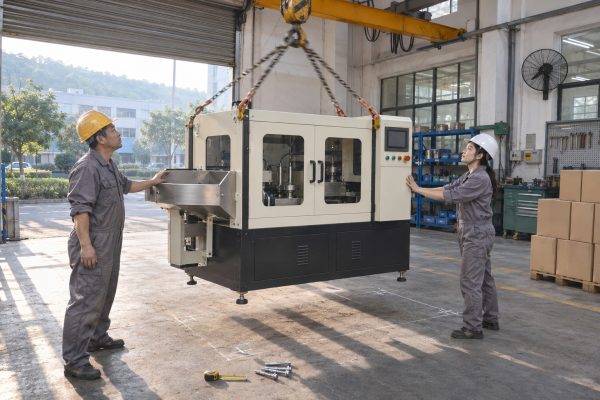
Buyers of our chamfering machines 1 often track production and shipping closely, then lose weeks on site. Installation and commissioning time for a fully automatic chamfering machine deserves the same attention.
Plan installation and commissioning time for a fully automatic chamfering machine as a staged project: site readiness before delivery, unloading, mechanical installation, utility connection, dry cycles, trial production, training, and acceptance. A standalone machine usually needs three to ten working days; integrated systems need several weeks plus ramp-up.
Below I break the job into phases, name the factors that stretch the schedule, list what to prepare before the truck arrives, and explain what a serious supplier should bring to the table.
A lesson from our Wenzhou shop: when a customer asks for a single number of days, the honest answer starts with a question about what commissioning includes.
A standalone fully automatic chamfering machine typically takes three to ten working days to install and commission when the site is ready. Industry guidance allows two to four weeks when site preparation, testing, and handover are included, and integrated lines with feeders, robots, or inspection need several weeks more.

Most schedule disputes I have seen come from one mistake. The buyer and the supplier use the same word, "commissioning," but mean different things. So before I give numbers, I want to split the work into its real pieces.
On our projects we treat these as separate activities. Each one takes real time, and each one can slip.
Commissioning is not a ceremonial power-on. It is a structured check that the machine is assembled, connected, calibrated, tested, and ready for your application.
Here is the planning model I use for a single chamfering machine with a vibratory bowl feeder and no line integration.
| Phase | Typical duration | What drives the time |
|---|---|---|
| Site-readiness verification | 1–5 working days | Done before delivery, not after |
| Unloading and positioning | 0.5–1 day | Machine mass, door access, lifting gear |
| Mechanical installation and leveling | 1–3 days | The largest block goes to precision leveling and anchoring |
| Utility and control connections | 1–3 days | Power, air, I/O checks, network |
| Tooling, fixture, feeder, and recipe setup | 1–3 days | Tooling and fixture setup grows with each part family |
| Safety inspection and dry-cycle testing | 0.5–2 days | Guards, e-stops, interlocks, full sequence without parts |
| Trial production and dimensional validation | 1–5 days | Calibration and trial runs on real production material 2 |
| Operator and maintenance training | 1–2 days | Hands-on, not slides |
| Documentation, punch list, and handover | 1–2 days | Closing open items and signing off |
Add the rows and you land at roughly three to ten working days for a well-prepared standalone machine.
One commissioning source recommends allowing two to five days for a new machine. Broader industrial guidance puts a complete single-machine project at two to four weeks. These numbers do not contradict each other. The first counts only machine startup. The second counts site preparation, production line integration, trial production, training, documentation, and formal acceptance. And after handover, ramp-up to guaranteed output can take another one to three months.
So I tell customers to plan three dates, not one. The date the machine is installed. The date it produces approved parts. The date it reaches stable commercial output. Keeping those apart gives management an honest view of cost, staffing, and risk.
One procurement manager told our team his machine arrived on the agreed date, then sat idle for over a week. The crane, not the machine, was the problem.
The biggest delays come from unfinished site utilities, access and lifting limits, missing tooling or production material, unfrozen part drawings, unready upstream equipment, and slow decisions on recipes or acceptance. Machine complexity, part variety, and network integration add days, while decision delays can add weeks.

The machine itself is rarely the slowest item. In my experience, the schedule stretches because of things around the machine. Let me break the main variables down.
| Factor | Why it adds time | Typical impact |
|---|---|---|
| Machine complexity | Multiple stations, bar or tube feeding, robotic loading, vision gauging, automatic tool compensation, conveyors, MES links | Days to weeks |
| Part and process variety | Each family needs workholding checks, tool selection, feed and speed trials, chamfer angle validation, burr checks, recipe storage | Roughly half a day to a day per family |
| Tooling and consumables | Inserts, collets, jaws, guide bushes arrive late, wrong, or untested on your material | One to several days |
| Site readiness | Power, air, floor, anchoring, or access not complete | The largest avoidable delay |
| Material availability | Substitute material gives misleading results and forces a second commissioning | Days, plus a repeat visit |
| Specification changes after FAT | New drawings or tolerances mean new tooling and new programs | Days to weeks |
| Upstream and downstream equipment | Conveyors, washers, or inspection stations not ready; network interfaces excluded from scope | Days to weeks |
| People and decisions | Operators unavailable, quality has not agreed the measurement method, nobody authorized to accept | Often longer than any technical issue |
I find it useful to separate these two groups. A technical delay is a wrong voltage, a bent feed track, or a sensor fault. These are fixable and usually visible. A decision delay is different. The machine is mechanically ready, but it sits idle because nobody can approve a recipe, accept a sample, or release the safety system. We ask every customer for a single site contact with authority to decide on access, utilities, design changes, and acceptance. That one role saves more days than any technician.
Another hidden decision delay is the definition of cycle time. Our engineers may quote cutting time. A buyer may mean load, clamp, cut, unload, and gauge. If the two sides disagree during the performance run, the test stalls. Write the definition into the acceptance document.
Here is an objection I hear often. A supplier wants a short startup to limit onsite cost. The customer wants longer trials to prove tool life and repeatability. Both are reasonable, and I side with the longer run. A machine can produce good parts for an hour and then drift as the insert wears. A credible trial needs enough runtime to show repeatability, not a handful of good samples. The fair solution is to agree the runtime and part count before the contract, so nobody argues about it on day eight.
Good equipment downtime management starts with honest buffers written into the plan, not hidden inside an optimistic finish date.
One commissioning guide suggests allowing up to a week for startup problems and nonconforming parts. I think that is realistic for most chamfering applications with more than one part family.
We weigh one trade-off on every export order: push the shipment out fast, or hold it until the customer confirms the site is ready. Holding usually wins.
Prepare the site by auditing floor load and level, door and route clearances, crane or forklift capacity, electrical voltage and breaker rating, compressed-air pressure and flow, drainage, network drops, and material staging at least two weeks before delivery. Reserve production material, tooling, operators, and quality staff for the commissioning window.

This is where my strongest advice sits. You cannot only watch the production and shipping lead time. You also need to plan unloading, entry into the building, installation, wiring, commissioning, trial production, and acceptance before the machine lands. The best time to do that is before you sign the purchase contract 3, by agreeing a complete installation and commissioning plan with the supplier. Everything below flows from that plan.
We ask customers in the United States, Germany, Mexico, and elsewhere to send evidence, not just a confirmation. Photos, drawings, and sign-offs catch problems that a verbal "we are ready" does not.
| Area | What to verify | Evidence to send the supplier |
|---|---|---|
| Floor | Level, load-bearing capacity, anchoring points, nearby vibration sources | Photos and floor drawing |
| Access | Door widths, ceiling height, turning radius, route from unloading point to final position | Measured route sketch |
| Lifting | Crane or forklift capacity, slings and attachments, rigging crew booked | Capacity rating and booking date |
| Electrical | Voltage, phase, frequency, breaker rating, isolation, grounding | Electrician sign-off |
| Compressed air | Pressure, flow, filtration, dew point at the machine connection | Gauge reading at the drop |
| Coolant, extraction, drainage | Lines in place, ventilation adequate, mist control planned | Photos |
| Network | Drops installed, IP addresses assigned, MES or plant access agreed | IT confirmation |
| Workspace | Lighting, barriers, safe installer access, storage for raw parts, finished parts, scrap, and tooling | Layout drawing |
Floor level and stability matter more than most buyers expect. Improper leveling and anchoring is the main cause of vibration-induced chamfer inaccuracies. That is why precision leveling takes the largest share of physical installation time, and it is why the floor must be ready first.
Reserve representative production material before commissioning starts. That means the correct grade, dimensions, hardness, surface condition, and batch characteristics. Using substitute material gives false confidence and often forces a second commissioning phase after the machine is already in production.
Reserve extra material for setup pieces, first-off approval, cutting-parameter trials, fault recovery, tool-life runs, deliberate repeatability runs, and scrap. Some trial parts will be off-specification. Plan for it.
Tooling deserves the same care. Receive and inspect inserts, collets, jaws, fixtures, and guide bushes before the installer arrives. Then put operators and quality staff on the calendar. A quality engineer who has already agreed the measurement method with the supplier saves a full day of debate at first-piece approval.
Our PLC programming 4 and configuration is largely completed at the factory against the customer's part list. Where a project is complex, virtual commissioning with a digital twin 5 lets us simulate PLC logic and cycle times before the physical machine arrives, and industry sources report onsite software debugging reduced by up to 40 percent. For high-mix buyers, we also pre-load and stress-test material recipes for the full expected production range during commissioning, so later changeovers do not become new downtime events.
Before any chamfering machine leaves our Wenzhou floor, our engineers run the customer's own sample parts through it and film the cycle. That video becomes the FAT record.
Expect your supplier to provide a written installation plan before contract signing, a documented Factory Acceptance Test, a named project manager, onsite technicians for leveling, wiring, PLC configuration, and trial runs, a Site Acceptance Test against agreed criteria, hands-on operator and maintenance training, manuals, spare parts, and ramp-up support.

Support is not a vague promise of "after-sales service." It is a set of defined deliverables with dates and owners. Here is how I structure it on our OEM and ODM projects.
| Item | Factory Acceptance Test (FAT) | Site Acceptance Test (SAT) |
|---|---|---|
| Location | Supplier's facility, before crating | Customer's plant, after installation |
| Purpose | Prove design and core functions meet the specification | Prove performance with real utilities, operators, and material |
| Material | Customer sample parts and tools where possible | Approved production material only |
| Checks | Loading and unloading, clamping and orientation, chamfer size and angle, cycle time, recipes, interlocks, alarms, tool change, guarding, data interfaces | Consecutive parts or production hours, tolerances and measurement method, scrap rate, tool-wear assumptions, uptime, permitted intervention, retest rules |
| What it does not prove | Behavior with your air supply, floor, operators, and upstream parts | Long-term output, which the performance run and ramp-up cover |
A passed FAT reduces the chance of finding basic sequence, tooling, or software problems after shipping. It is not a substitute for SAT, because site conditions differ. And never schedule the two back-to-back with no gap. Leave room for corrective work, replacement parts, software changes, damage inspection, and retesting.
The operator training schedule must sit before production demand starts, not after. Operators need loading, recipes, tool changes, alarms, cleaning, and safe recovery. Maintenance staff need lubrication, sensors, pneumatics, drives, calibration, and spare parts. We insist on hands-on assessment and emergency protocol 6 drills, because an automatic cell creates its highest risk during fault recovery, when someone reaches in to clear a jammed part. Commissioning must test abnormal conditions, not only the clean automatic cycle. Guard interlocks, emergency stops, lockout procedures, and stored-energy risks belong inside the schedule, not at the end of it.
For remote support, we increasingly use augmented-reality tools so an engineer in Wenzhou can guide a local technician through a calibration step in real time. During the initial run-in, recording a baseline vibration fingerprint gives you a diagnostic benchmark for later predictive maintenance.
Then comes ramp-up. Week one is supervised production with conservative parameters and frequent inspection. Week two expands approved recipes and tightens changeover. Weeks three and four increase run length and reduce intervention. The following weeks confirm stable output, tool life, scrap, and maintenance performance. Track time from power-on to first good part, parts per hour, first-pass yield, tool-change frequency, interventions per shift, and availability during the performance run.
One last objection: some buyers worry that detailed acceptance testing delays deployment. The opposite is more common. Vague criteria create disputes and premature handover, and those cost far more than two extra test days.
Underestimated installation and commissioning time quietly eats margins. Plan it before signing, split it into phases, verify the site early, and hold the supplier to three clear dates.
1. ISO provides international standards for machine tools and industrial safety requirements. ↩︎
2. Wikipedia provides a technical overview of raw production materials used in manufacturing. ↩︎
3. Trade.gov offers resources for international trade regulations and industrial purchase agreements. ↩︎
4. ISA sets the global standards for PLC programming and industrial automation systems. ↩︎
5. IEEE is the leading technical authority for digital twin technology and industrial simulation. ↩︎
6. OSHA establishes safety protocols and emergency procedures for industrial workplaces and machinery. ↩︎
