

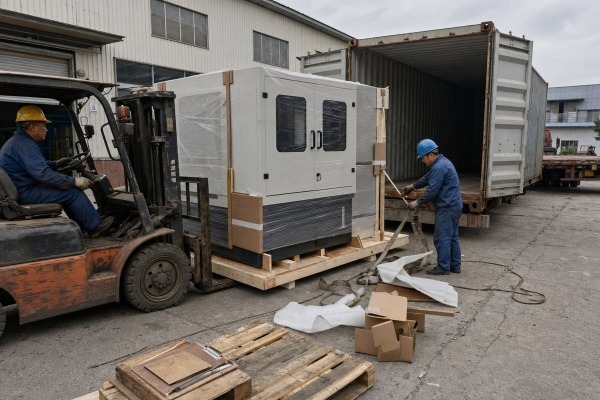
Sea freight shipping for a chamfering machine worries many buyers. I hear it weekly at our Wenzhou factory. A late machine can stall an entire production line and burn money fast.
Sea freight shipping for a chamfering machine from China to Europe typically takes 30–45 days port-to-port, and 40–55 days door-to-door. Adding 40–45 days of production time, plan roughly 3 to 3.5 months from order confirmation to arrival at your facility.
That is the short answer. But the real timeline depends on your route, your container choice, and your paperwork. Let me break it all down for you.
Last year, two identical machines left our workshop in the same week. One reached Rotterdam in 38 days. The other took 52. The difference was routing, not luck.
Transit time depends on the shipping route, FCL versus LCL choice, origin and destination ports, transshipment stops, seasonal congestion, and current rerouting around the Cape of Good Hope, which alone adds roughly 10–14 days compared with the traditional Suez Canal route.

When we quote an estimated transit time to a customer, we always explain the variables first. No single number fits every shipment. Here are the factors that matter most.
The classic Suez Canal route 1 used to define China-Europe timing. Since 2024, many carriers have rerouted around the Cape of Good Hope due to Red Sea instability. That detour adds 10–14 days. So older estimates like 25–35 days are often too optimistic now. In 2026, journeys above 50 days are not unusual on some lanes.
A chamfering machine is heavy, high-value industrial cargo. FCL and LCL shipping options behave very differently. FCL means your machine gets its own container. LCL means your cargo shares space, and it waits for consolidation before sailing and deconsolidation after arrival. That adds 5–7 days and extra handling risk.
| Factor | Typical Impact on Transit Time |
|---|---|
| Cape of Good Hope rerouting | +10 to 14 days |
| LCL consolidation/deconsolidation | +5 to 7 days |
| Transshipment at a hub port | +3 to 7 days |
| Port congestion (Rotterdam, Hamburg) | +3 to 5 days vessel waiting |
| Peak season (pre-Golden Week, Lunar New Year) | +up to 2 weeks for space/pickup |
| Bad weather or strikes | +2 to 5 days |
Direct sailings are always faster than transshipped services. A vessel that stops at Singapore or Colombo to swap containers loses days at every hub. When speed matters, we ask our freight forwarder to book direct services even if the rate is slightly higher.
A procurement manager once told me he only budgeted for the sailing time. His installation crew then sat idle for six weeks. Total delivery time is much more than the ocean leg.
Add 40–45 days of machine production, 3–7 days for packaging and export formalities, 30–45 days of ocean transit, and 3–7 days for customs clearance and unloading. Realistically, budget 80–100 days from deposit payment to arrival at a European port.

In our experience building custom metal processing equipment, production is the first and longest phase. Our chamfering machines take 40–45 days to build and test, because we make tooling, run sample tests with the customer's parts, and complete a final quality inspection before crating. The sea voyage itself then runs close to two months on many current lanes.
| Stage | Typical Duration | What Happens |
|---|---|---|
| Production and testing | 40–45 days | Machining, assembly, tooling, sample runs, QC |
| Industrial machinery packaging | 2–4 days | VCI vacuum wrapping, wooden crating, bracing |
| Export customs and loading | 2–4 days | ENS filing, export declaration, container stuffing |
| Ocean transit (port-to-port) | 30–45 days | Sailing, possible transshipment |
| Import customs clearance procedures | 1–3 days | Duty payment, HS Code classification 2 check |
| Port handling and release | 1–3 days | Unloading, terminal processing |
New ICS2 Release 3 rules require an Entry Summary Declaration 3 24 hours before loading in China. Correct HS Code classification also matters. A wrong code can trigger inspections and add days at the port of discharge. Your Incoterms 2020 4 choice affects who manages each step too. Under FOB, you control ocean booking and import clearance. Under DAP, your supplier's freight forwarder services handle almost everything, which simplifies your planning but reduces your routing control.
One more practical point. After arrival, allow a 48-hour thermal stabilization period before calibration. Precision chamfering components should reach ambient factory temperature before you attempt accurate setup.
Port selection is a trade-off we discuss with every European buyer. Our nearest export hub is Ningbo, but the best route always depends on where the machine must finally land.
Shanghai, Ningbo, and Shenzhen offer the most frequent direct sailings to Europe. Rotterdam, Hamburg, and Antwerp receive most direct services at 35–45 days. Mediterranean ports like Genoa or Barcelona can be faster from South China, sometimes reaching 28–38 days.

Route choice matters more than most buyers realize. Here is how the main lanes compare under current 2026 routing conditions.
| Origin Port | Destination Port | Estimated Transit Time | Notes |
|---|---|---|---|
| Shanghai / Ningbo | Rotterdam | 35–45 days | High frequency, direct services available |
| Shanghai / Ningbo | Hamburg | 37–47 days | Adds 1–2 days past Rotterdam |
| Shenzhen | Antwerp | 33–43 days | South China departure saves 1–2 sailing days |
| Shenzhen | Genoa / Barcelona | 28–38 days | Mediterranean often faster from South China |
| Qingdao | Rotterdam | 38–48 days | Northern origin adds sailing days |
| Shanghai | Felixstowe (UK) | 37–48 days | Adds UK customs step post-Brexit |
Pick the port of discharge closest to your factory, not just the biggest hub. A machine delivered to Rotterdam and then trucked to southern Germany may arrive later than one landed in Hamburg. Inland distance drives the final door-to-door logistics leg. Delivery to Poland, Slovakia, or Central Europe can add 2–5 days of trucking after clearance.
Also check whether your service is direct or transshipped. Some cheaper routings swap vessels at Singapore, Port Klang, or Piraeus. Each transshipment adds 3–7 days plus possible hub waiting time. When one of our Slovakian customers needed a machine urgently, choosing a direct Rotterdam service 5 over a cheaper transshipped Hamburg routing saved almost ten days. Ask your freight forwarder for the vessel schedule before booking, not just the price.
Preparation beats reaction every time. Our team learned this after one early shipment sat at a Chinese terminal for a week over a documentation mismatch. We changed our process, and it never happened again.
Book FCL early, confirm a direct sailing, file ENS documents 24 hours before loading, verify HS Code classification, use VCI vacuum packaging, avoid Golden Week and Lunar New Year peaks, and add a 5–7 day buffer to every milestone in your project plan.

Most delays are preventable. They come from paperwork errors, poor packaging, or bad timing. Here is the checklist we follow for every machine we export from Wenzhou.
A 45-day voyage through humid conditions is hard on precision equipment. We seal our machines in VCI vacuum packaging 6 inside a braced wooden crate. Without it, surface oxidation can force roughly three days of manual de-rusting after arrival. Some buyers also request IoT shock and tilt loggers. The data log lets your team confirm the machine's internal alignment quickly, cutting post-arrival inspection from days to hours.
Pre-clear customs where possible. Import clearance normally takes 1–3 days, but an incorrect declaration can double that. Then schedule trucking before the vessel docks, not after. Finally, allow the machine 48 hours to stabilize at your factory temperature before calibration. Rushing this step often causes precision complaints that have nothing to do with shipping at all.
A late machine stalls production and drains profit. The fix is realistic planning: 40–45 days production, roughly two months at sea, so budget about three months total and build in buffers.
1. Provides historical and geographical context for the primary shipping lane between Asia and Europe. ↩︎
2. Authoritative guide on the international system for classifying traded products for customs purposes. ↩︎
3. Official EU resource detailing security filing requirements for goods entering the European Union. ↩︎
4. Official source for international commercial terms defining buyer and seller responsibilities in global trade. ↩︎
5. Official site for Europe’s largest port, providing information on container services and logistics hubs. ↩︎
6. Explains the chemical protection method used to prevent rust on metal parts during long-distance transit. ↩︎
