

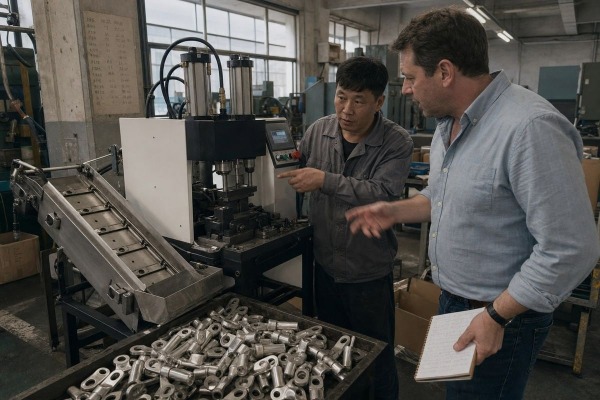
I have seen buyers pick a cable lug making machine configuration from a brochure, wire the deposit, and then discover it cannot form their largest lug CE certificates 1. The machine sits idle. The order backlog grows. At our Wenzhou factory, we tell every customer the same thing: confirm the machine’s maximum processing range against your actual product models and specifications, and list your budget and configuration needs in writing before you commit.
A cable lug making machine configuration fits your needs when its processing range covers every lug size and material you produce, its hourly output meets your real demand, its changeover time suits your SKU mix, and the supplier proves all of this with sample runs on your actual stock.
Fit is not a single spec. It is a match between the machine and your product mix, volume, and workflow. Below, I break the evaluation into four practical checkpoints you can verify before you pay.
Last year, a buyer from Mexico sent us one sample lug. We built quotes around it. Then he revealed eleven more variants. That changed the entire machine configuration we recommended.
Your machine configuration must cover every lug variant you make: outer diameter, barrel length, hole size, and material type, whether bare copper, tinned copper, or aluminum. List each SKU with full dimensions, then confirm the machine's maximum and minimum processing range covers all of them.

The first thing I ask a buyer to do is build a complete lug portfolio table. Not a rough list. A full one. Every variant matters because a machine that handles 90% of your SKUs still leaves you buying a second machine or outsourcing the rest. That destroys your cost calculation.
Here is the format we ask customers to fill in before we propose any configuration:
| Data Point | Why It Matters |
|---|---|
| Outer diameter and barrel length | Defines the die dimensions and hydraulic press tonnage required |
| Stud hole size | Determines punching tooling and positioning accuracy |
| Wire cross-section range served | Confirms the lug barrel matches the cables your customers use |
| Material (bare copper, tinned copper, aluminum) | Affects forming force, die wear, and copper tube processing settings |
| Annual volume per SKU | Tells you where speed matters and where flexibility matters |
Cable lug selection itself depends on cable cross-section 2, stud hole size, conductor material, and operating environment. So the machine must support exactly the same dimensions and materials your finished lugs need to serve. There is no shortcut around this mapping.
One buying guideline we agree with from experience: if you produce more than six lug variants, prioritize double-station or modular mold carriers over raw speed. Many variants mean frequent tooling swaps. In that case, custom mold design 3 and quick-change carriers save more money than a faster cycle time ever will. When we develop OEM equipment based on customer drawings, this variant count is the first number we ask for. It decides whether we quote a flexible multi-die setup or a high-output dedicated line.
The trade-off I weigh most often with buyers is demo speed versus real speed. A machine's rated output rarely survives contact with an actual factory schedule.
Verify production capacity by asking for lugs per hour in your exact configuration, not demo conditions. Measure your current rejection rate and time per lug: if rejection exceeds 1.5% or average time exceeds 45 seconds per lug, higher automation is justified.

Brochure capacity numbers usually assume ideal conditions: one SKU, perfect stock, no changeovers, a trained operator. Your factory has none of those luxuries all day long. So I recommend translating your real demand into machine requirements first, then testing the machine against them.
Start with three numbers from your current process: rejection rate, average time per lug including setup, and mold-change frequency per week. These reveal your true bottleneck. If your rejection rate is above 1.5%, or your average time per lug is above 45 seconds, an automated production line pays for itself faster than manual or semi-manual methods. If your goal is repeatability at scale, meaning 2,000 or more lugs per day across four or more variants with rejection at or below 1.2%, a full-automatic double-station machine with servo feed and PLC logging is the better fit.
| Your Situation | Recommended Configuration |
|---|---|
| Low volume, many changeovers | Semi-automatic with quick-change tooling |
| Medium volume, stable SKUs | Automatic single-station with PLC control system |
| 2,000+ lugs/day, 4+ variants, ≤1.2% rejection target | Full-automatic double-station, servo feed, data logging |
Do not buy more automation than your demand supports. But do not under-buy either. The cable lugs market is growing at a projected 6.3% CAGR from 2024 to 2030, with one estimate placing it at USD 6.63 billion in 2024. If your orders are trending up, size the production capacity for where you will be in two years, not where you are today. When we spec machines for exporting customers in India, Vietnam, and the US, we always ask about growth plans, because retrofitting capacity later costs far more than configuring it now.
A New Zealand customer once sent us his product drawings and asked a question I wish more buyers asked: "What should I change on your standard machine?"
Request custom mold design for your exact lug drawings, quick-change die sets with under 8-minute swaps, material handling matched to your copper or aluminum stock, voltage compatibility with your plant, and a PLC control system with timestamped logging of pressure, stroke, and faults.

A generic machine is configured for an average customer who does not exist. Your production process is specific, so the configuration should be too. Our team builds OEM/ODM equipment from customer drawings, and the customizations below are the ones that consistently determine whether a machine fits or fights the factory it lands in.
Mold change time is a major hidden cost. A full die-set swap, including alignment verification, should take under 8 minutes. Machines that need more than 15 minutes can lose over 2 hours per week in changeover alone. Ask directly: does a die change require disassembly? If yes, and you run frequent SKU changes, walk away or request modular tooling.
Push for stroke depth repeatability of ±0.05 mm or better, and feed accuracy of ≤±0.1 mm per stroke. Poor repeatability creates inconsistent lug shape, feed jams, and downstream crimping failures. If your lugs are formed from copper tube, ask whether the machine uses cold extrusion technology, which improves material grain structure and supports material waste reduction compared with heavy cutting operations.
One tension worth naming: high automation improves output, but it can reduce agility. If your product line is stable and high-volume, optimize for repeatability and logging. If it is broad with frequent changeovers, optimize for tooling flexibility and modularity. That single rule resolves most configuration debates I have with buyers.
Something I learned the hard way early in our export business: a machine that fits technically but lacks support becomes operationally unsuitable within a year.
Confirm long-term support by requesting the last three signed calibration reports, a sample run on your actual material batch, spare dies and wear parts included at purchase, documented warranty scope, verified ISO 9001 and CE certificates, and named post-purchase technical contacts.

Do not trust brochure claims alone. The proof of a supplier's seriousness sits in documents and demonstrations, not in marketing language. Here is how I suggest you separate the two.
Ask the supplier to run test samples from your actual stock batch, not a similar sample they keep on hand. Copper and aluminum stock vary in hardness and ovality between suppliers and even between batches. A machine may feed one batch perfectly and jam on another. This single test catches more configuration mismatches than any spec sheet review. Then request the last three calibration reports, signed and dated, plus a functional test video of the machine running your parts.
Check ISO 9001 4 and CE certificates through official databases, not just PDF copies. Arrange an on-site or third-party audit if the order value justifies it. On serviceability, we always advise buyers to negotiate spare dies and common replacement parts into the initial purchase, because waiting weeks for a wear part erases the efficiency the machine was bought to deliver.
| Support Item | What to Request | Red Flag |
|---|---|---|
| Calibration evidence | Last three reports, signed and dated | Only brochure accuracy claims |
| Sample validation | Run on your actual material batch | Demo with supplier's own stock only |
| Spare parts | Dies and wear parts included in the deal | Vague "parts available on request" |
| Warranty | Written scope with response times | Verbal assurances |
| Contacts | Named technical support people | Generic sales email only |
Our own after-sales team supports installation, commissioning, and tooling questions across markets from South Korea to Canada, and I can say this plainly: the buyers who ask these questions up front are the ones whose machines are still running smoothly three years later.
If a machine cannot prove itself on your real lugs, your stock, your changeover pattern, and your output target, the configuration does not fit — no matter how impressive the brochure looks.
1. CE marking indicates that products sold in the EEA meet high safety and health standards. ↩︎
2. Wire gauge standards define the cross-sectional area of electrical conductors for proper lug sizing. ↩︎
3. Molding processes are essential for creating custom components like cable lugs with specific geometries. ↩︎
4. ISO 9001 is the international standard for quality management systems in manufacturing. ↩︎
