

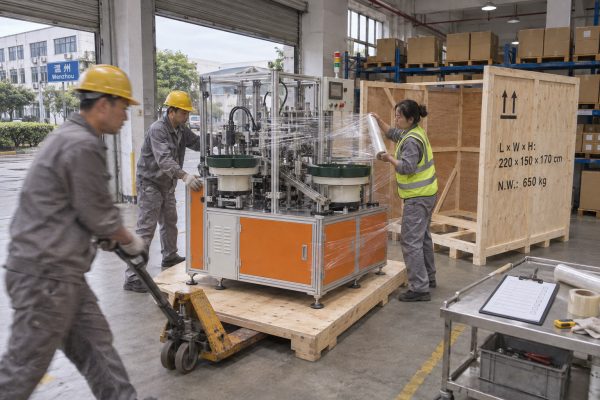
A crate leaves our Wenzhou floor in perfect shape. Six weeks later, a bent feeder bowl arrives. Knowing how to insure assembly machine shipments from China decides who pays.
To insure assembly machine shipments from China, confirm who buys cover under your Incoterm, choose all-risk marine cargo insurance valued at invoice plus freight and landed costs, and obtain a formal policy. To claim, preserve evidence, notify insurer and carrier immediately, request a survey, then submit documents.
That is the short version. The rest of this article walks through each step. I will use the same checklist we follow when our own bowl-feeder assembly lines ship to the United States, Germany, Japan, and Mexico. The four questions below cover coverage type, insured value, claim documents, and settlement speed.
A buyer in the United States once told me our CIF quote already covered him. It did, but only at the minimum clause level. That conversation changed how we quote.
Choose all-risk coverage under Institute Cargo Clauses (A), written warehouse-to-warehouse, with inland transit, temporary storage, and war and strikes extensions. Add a concealed damage or commissioning clause for precision machinery. Do not rely on carrier liability or a supplier's minimum CIF cover alone.

The first thing I ask any buyer is simple. Who is responsible for insuring this machine? The answer comes from the Incoterm on the purchase order, not from a phone call.
Under Incoterms 2020 1, the rule decides who buys the policy and where risk transfers. CIF vs FOB is the comparison most of our buyers ask about. Under FOB, risk passes to you when the crate is loaded on board at the Chinese port, and you arrange your own marine cargo insurance 2. Under CIF, we arrange the policy, but risk still passes at the loading port. CIF only obliges the seller to buy minimum cover, which is Institute Cargo Clauses (C), at 110 percent of the contract value. CIP requires the seller to buy Clauses (A) level cover to the named destination. For a machine with pneumatic valves, PLC cabinets, and calibrated bowl feeders, minimum cover is rarely enough.
Our practice is clear. When a buyer wants us to insure, we name the buyer as the insured party on the certificate. The buyer then controls the claim and receives the payment directly.
| Option | What it pays for | Fit for an assembly machine |
|---|---|---|
| Institute Cargo Clauses (A), all-risk coverage | Any physical loss or damage not expressly excluded | Best fit; broadest protection |
| Institute Cargo Clauses (B) | Named perils such as fire, sinking, collision, water entry | Partial fit; forklift drops may be excluded |
| Institute Cargo Clauses (C) | Narrow named perils only | Poor fit; CIF minimum level |
| Carrier liability under the bill of lading 3 | Capped per package or per kilogram; figures around USD 500 per package are commonly cited | Far below machine value |
| Freight forwarder liability | Limited by the forwarder's trading conditions | Covers service errors, not cargo value |
A standard policy stops at the port. Your machine does not. Ask for warehouse-to-warehouse wording so cover starts at our factory gate and ends at your plant. Add inland transit for the truck legs on both ends. Add temporary storage for consolidation warehouses and customs yards. Ask whether general average contributions are included, because a container ship casualty can trigger a cash demand before your cargo is released. Finally, ask about a commissioning or concealed damage clause. A bent cam follower may not show until the machine runs its first cycle.
One warning. All-risk coverage still excludes inadequate packaging, inherent vice, delay, and consequential loss. Software corruption and cyber events are usually excluded too, which matters for PLC-controlled lines.
Every quotation we prepare forces one trade-off. A lower declared value means a lower premium, but it also means a smaller cheque if the crate goes into the harbor.
Insure at commercial invoice value plus freight and insurance, plus a permitted uplift, often 10 percent, for duties, handling, and anticipated profit. For long-lead machines, consider replacement cost rather than purchase price. Confirm the valuation basis and deductible in writing with your insurer.

Determining the insured amount is the second item on our internal checklist. It sounds easy. It is not, because the purchase price is only part of your real exposure.
Think about what you would actually lose if the machine were destroyed. You would lose the money paid to us. You would also lose the ocean freight, the insurance premium, the import duty, the customs broker fee, the rigging crew, and the time already spent planning installation. A custom bowl-feeder line for cable lugs takes us weeks to build. A replacement would take the same time again. That delay has a cost, even if a cargo policy will not pay for it.
Let me use a hypothetical machine so the math is clear.
| Cost item | Amount (USD) | Insurable under most cargo policies? |
|---|---|---|
| Commercial invoice value | 180,000 | Yes |
| Ocean freight and inland trucking | 6,500 | Yes |
| Insurance premium | 900 | Yes |
| Import duties and taxes | 9,000 | Often, if declared and agreed |
| Rigging and installation | 4,000 | Only with a commissioning extension |
| Lost production during replacement | Variable | No, needs business interruption cover |
| Insured value at invoice plus freight plus 10 percent | 206,140 | Common formula, confirm with insurer |
The 10 percent uplift is the figure built into the Incoterms CIF rule. Many insurers accept it. Some allow more for custom equipment. Do not assume a universal formula. Ask your broker to state the valuation basis in writing before the crate leaves our yard.
Cargo insurance pays for physical loss or damage to the goods. It does not pay for the line you could not run for two months. If downtime would hurt you, price a separate delay or business interruption cover. Also check the deductible. A high deductible lowers the premium but can swallow a small claim for a damaged control panel arm.
Some buyers tell me they would rather self-insure and save the premium. For a spare parts order, that can make sense. For a single machine worth six figures, one dropped crate can wipe out years of saved premiums. Over-insuring does not help either. The insurer pays the proven loss within the policy's valuation rules, not the inflated number.
Before any machine leaves our floor, a technician films the bowl feeders running at rated cycle time. That video has settled more disputes than any email thread.
Prepare the insurance certificate, commercial invoice, packing list, bill of lading, signed delivery receipt with damage noted, dated photos and video, a damage survey report, factory acceptance and pre-shipment inspection records, serial numbers, a repair or replacement quote, and proof of payment.

A claim is a story told with paper. The adjuster was not in Wenzhou when we packed the machine. He was not on the dock when your forklift driver opened the container. Your proof of loss documentation has to put him in both places.
I split evidence into two kinds. Packaging evidence shows the crate. Product-condition evidence shows the machine inside it. A photo of a closed wooden box proves almost nothing on its own. So we record both. Our factory acceptance test sheet lists the model, serial number, PLC program version, feeder bowl sizes, and measured cycle time. We photograph the machine before preservation and again after it is bolted to the skid, wrapped in VCI film, and packed with desiccant. Industrial machinery packaging for sea freight has to fight container rain, so the VCI layer matters. Every crate uses ISPM 15 heat-treated timber 4 with the stamp visible. We then photograph loading, lashing, the container number, and the seal number.
Many buyers also hire a third-party pre-shipment inspection. We welcome it. An independent report dated before the doors close makes it very hard for anyone to argue the damage happened in our workshop.
| Document | Who provides it | Why the adjuster wants it |
|---|---|---|
| Insurance certificate or policy wording | Insurer or seller under CIF | Proves cover and names the insured |
| Commercial invoice and purchase order | Seller | Sets the value and the Incoterm |
| Detailed packing list with serial numbers | Seller | Links each crate to each component |
| Bill of lading or air waybill | Carrier via forwarder | Proves what was shipped and when |
| Pre-shipment inspection and FAT records | Seller or inspector | Proves condition before transit |
| Loading photos, container and seal numbers | Seller | Shows the cargo was sound at origin |
| Signed delivery receipt with exceptions | Buyer | Fixes the damage at arrival |
| Unpacking photos and video | Buyer | Proves concealed damage sequence |
| Damage survey report | Independent surveyor | Independent cause and cost assessment |
| Repair estimate or replacement quote | Seller or service firm | Quantifies the loss |
| Proof of payment | Buyer | Shows insurable interest |
Write specific words. "Crate 2 punctured, left side, water staining on base" is useful. "Subject to inspection" is weak. List shortages by crate number. Keep a signed copy. If the outside looks clean, unpack within days and film the opening. Keep every piece of bracing and foam. If your lawyer expects to pursue a carrier in a PRC maritime court, ask early whether notarized and legalized copies of the shipping documents are required, because that is far easier to arrange at export time than months later.
The slowest claim I ever supported stalled because the buyer repaired a control cabinet before anyone surveyed it. The insurer could not confirm the cause. Months passed.
Speed settlement by stopping all handling, photographing damage, notifying the insurer and carrier in writing within 24 to 72 hours, requesting a surveyor before any repair, submitting one complete claim package, and following up weekly with the claim number and adjuster name.

Here is the five-step sequence we give every buyer the moment they report a problem. I follow the same order myself when we handle a CIF claim on a buyer's behalf.
Deadlines come from the policy, the carrier's terms, and the transport convention 5. They are not uniform. Some carriers cite 7 to 15 days for written claims. Some policies expect notice within 24 to 72 hours of delivery. Concealed damage usually has a shorter window than people expect. Check all of them, then act on the earliest one.
A damaged machine can create three different claims at once. The cargo insurer pays physical transit damage. The carrier may owe a capped sum under the bill of lading. The supplier owes warranty on manufacturing defects. Do not sign a release with the carrier before the insurer pays, because the insurer will want its subrogation rights against whoever caused the damage. And be honest about cause. A machine that arrives intact but misses its cycle time is a warranty and acceptance issue, not a cargo loss. We would rather fix that under our own support than watch a buyer waste weeks fighting the wrong party.
Buyers sometimes ask me to just ship a replacement and skip the claim. We can, but a new custom line takes weeks to build, and the insurer may still need the survey to pay anyone. Running the claim and the replacement in parallel is faster than choosing one.
Transit damage is a cash and schedule problem, not just a freight problem. Settle the Incoterm, cover, value, and evidence plan before pickup. Then claims become paperwork, not panic.
1. Official ICC guide to Incoterms 2020 rules for international trade and risk allocation. ↩︎
2. Professional body for marine insurers providing global standards and data on cargo insurance. ↩︎
3. United Nations agency responsible for the safety and security of shipping and maritime regulations. ↩︎
4. International standard for phytosanitary measures regarding wood packaging materials in global trade. ↩︎
5. UN body providing research and legal frameworks for international transport and trade conventions. ↩︎
