

Evaluating suppliers’ sustainability when buying a chamfering machine is something buyers ask our Wenzhou factory about constantly. Choose wrong, and you inherit hidden risks for a decade.
To evaluate a chamfering machine supplier’s sustainability, verify ISO 14001 and ISO 9001 certifications, audit the factory in person, review energy efficiency data and waste management protocols, confirm long-term spare parts and after-sales support, and check delivery track records with existing customers.
That is the short answer. But each of those checks has traps. I will walk you through how to do them properly, based on how we run our own production line and how our best buyers evaluate us.
Last year, a procurement manager from the US asked us to send every certificate we held before he would even discuss pricing. That request was smart, and I will explain why.
Check for ISO 14001 certification for environmental management, ISO 9001 for quality systems, CE marking for machine safety, and ISO 14955 alignment for machine tool energy efficiency. Request sustainability reports, material disclosures, and third-party audit results to confirm the claims are verifiable.

Certifications matter because they replace trust with evidence. But not all certificates carry equal weight, and some suppliers wave expired or irrelevant documents at buyers who do not know the difference.
In my experience, buyers should sort documents into three tiers. Tier one proves systematic management. Tier two proves product-level performance. Tier three proves ethics and transparency.
| Certification / Document | What It Covers | Why It Matters for a Chamfering Machine |
|---|---|---|
| ISO 14001 1 | Environmental management system | Shows the factory controls emissions, waste, and hazardous fluids systematically |
| ISO 9001 | Quality management system | Predicts consistent machine build quality and traceable QC records |
| CE Marking | Machine safety compliance | Required for many export markets; signals design discipline |
| ISO 14955 alignment | Energy efficiency of machine tools | Confirms the machine’s energy consumption was designed, not accidental |
| EcoVadis sustainability rating | Third-party ESG scoring | Independent validation of ESG performance metrics across the supply chain |
| Sustainability report | Emissions, goals, Scope 3 emissions data | Shows transparency beyond marketing claims |
Do not stop at the PDF. Check the certificate number against the issuing body’s online registry. Confirm the scope statement actually covers machine manufacturing, not just trading. Check the expiry date. I have seen certificates issued to a different legal entity than the seller. That is a red flag, not a paperwork detail.
Here is a fair objection: small workshops often skip formal ESG reporting because audits cost money. Absence of ISO 14001 does not automatically mean poor performance. But it shifts the burden of proof. Ask for alternative evidence instead: process records, coolant disposal receipts, customer references, and a willingness to accept an on-site audit. If a supplier refuses all of these, walk away.
A buyer in Mexico once told me his previous chamfering machine sat idle for six weeks waiting on a single spare gearbox. That story shaped how we structure our own after-sales commitments.
Verify after-sales capability by confirming written spare parts availability periods, testing response times before purchase, checking remote diagnostic support, reviewing training programs, and calling existing customers in your region. A supplier’s service infrastructure predicts machine uptime better than any brochure.

After-sales support is a sustainability issue, not just a convenience issue. A machine that cannot be repaired becomes scrap. A durable, repairable chamfering machine with strong support is often more sustainable than a cheaper unit replaced every few years. That is lifecycle thinking, and it directly affects your total cost of ownership 2.
I always tell buyers: your pre-sales experience predicts your post-sales experience. Send a technical question at an odd hour. Time the response. Ask for a wiring diagram or a tooling drawing. See if the answer comes from an engineer or a salesperson reading a script. When our team handles inquiries from the US or South Korea, our engineers answer directly, because technical accuracy at this stage builds trust for the next ten years.
Prioritize suppliers offering modular machine architectures. A chamfering machine that accepts hardware or software upgrades avoids premature obsolescence and reduces electronic waste. Ask directly: can this machine be retooled for a new part size in three years, or will I need a new machine?
Three checks have never failed me when qualifying any partner: evaluate the official website first, then conduct an on-site factory inspection, then examine whether the production line and equipment themselves meet sustainability standards. I apply the same logic when buyers evaluate us.
Stable production capacity shows in a professional website with real factory content, an on-site audit revealing organized workflows and maintained equipment, documented QC and calibration records, in-house machining capability, realistic quoted lead times, and verifiable delivery references from existing export customers.

Delivery reliability is where sustainability and classic procurement criteria overlap. In recent supplier evaluation research, the most relevant economic criteria were cost, delivery, quality, flexibility, and management reporting. Delivery sits near the top for a reason: a late chamfering machine stalls your whole production plan.
The official website is your cheapest audit. I recommend checking three things. First, does it show real factory photos and videos, or only stock images? Second, does it list concrete technical specifications, tolerances, and export markets? Third, does it publish a sustainable procurement policy or any environmental commitments? A supplier hiding its factory usually has a reason.
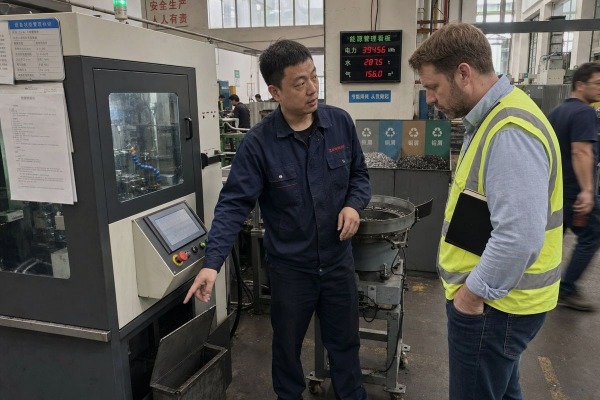
Questionnaires can be gamed. Factory floors cannot. When buyers visit our workshop in Wenzhou, they see the assembly bays, the tooling area, and the testing stations. Multiple sustainability frameworks recommend witnessed assessments over paper checks, and I agree completely.
| Audit Area | What to Look For | Warning Sign |
|---|---|---|
| Production line | Modern, maintained machining equipment; organized flow | Aged, leaking, or idle machines |
| QC station | Calibration records, measurement tools, inspection logs | No documented inspection process |
| Materials | Traceable steel and component sourcing labels | Unmarked or mixed-origin stock |
| Workforce | Trained operators, safety gear, clean conditions | Untrained temporary labor |
| Order book | Active projects matching claimed capacity | Empty floor with big claims |
This is the step most buyers skip. Ask whether the supplier’s own production line and equipment comply with sustainability requirements. A factory building “efficient” machines on wasteful, outdated equipment is contradicting itself. Look at energy use on the floor, coolant handling, chip recycling, and whether responsible sourcing standards 3 govern their component purchases.
Ask for three recent export references in markets like yours. Ask each one two questions: was the machine delivered on the quoted date, and did commissioning go as planned? A supplier confident in its lead times will hand over references without hesitation.
There is a trade-off we weigh in every custom machine design: a higher-efficiency servo system raises the quote, but it cuts the customer’s running cost for the next decade. How a supplier talks about that trade-off tells you everything.
Assess energy commitment by requesting per-cycle and standby energy consumption data, checking for ISO 14955-aligned design features like regenerative systems, reviewing waste management protocols for machining fluids, asking about take-back or recycling programs, and running a total cost of ownership analysis including energy.

Energy claims are the easiest place for greenwashing. So demand numbers, not adjectives. Ask for the machine’s energy consumption per cycle, per part, and in idle mode. A supplier who has done a life cycle assessment 4, or at least a basic carbon footprint analysis of the machine, can answer immediately. A supplier who has not will stall.
Standard ESG checklists miss machine-level detail, so use equipment-specific questions. Ask about the energy efficiency rating of motors and drives. Ask whether the design includes regenerative braking or shared-bus power systems, which align with ISO 14955 standards for machine tools. Ask about compressed-air efficiency if the machine uses pneumatics, because ours do on several models, and leaks are a silent energy drain. Some advanced suppliers now offer digital twin simulation, letting you model energy consumption against your actual production cycles before you buy. AI-driven adaptive control is another emerging feature: real-time optimization of cutting parameters extends tool life and reduces material scrap.
A chamfering machine generates chips, spent coolant, and worn tooling. Ask how the supplier’s design minimizes each. Then ask about the factory’s own waste management protocols for hazardous machining fluids. Finally, ask about end of life: is there a take-back, refurbishment, or recycling program? Even a partial answer signals lifecycle thinking.
Here is the objection I hear most: sustainability screening slows procurement and the greener machine costs more upfront. Both points are partly true. But run a TCO analysis that includes long-term energy costs, maintenance, downtime, and potential carbon pricing over the machine’s life. In our quoting experience, the efficiency premium usually pays back well within the machine’s service life, while a bargain machine with high idle consumption quietly bleeds money.
| TCO Factor | Cheap Machine | Efficiency-Focused Machine |
|---|---|---|
| Purchase price | Lower | Higher |
| Energy cost over lifecycle | High, often unmeasured | Lower, documented per cycle |
| Downtime and repairs | Frequent, parts uncertain | Lower, parts guaranteed |
| Scrap and tool waste | Higher | Reduced by adaptive control |
| Resale or upgrade value | Near zero | Modular upgrades possible |
Evaluating suppliers’ sustainability for a chamfering machine takes three steps: verify certificates and websites, audit the factory in person, and demand lifecycle data. Choose evidence over marketing, and long-term value follows.
