

Evaluating modular design for future expansion in a chamfering machine is a decision I face weekly on our production line, because a wrong choice locks buyers into rigid equipment.
To evaluate modular design for future expansion in a chamfering machine, check interface standardization, mechanical rigidity, reconfiguration speed, control-system scalability, and whether module architecture matches your likely product families. A truly modular machine adds capacity or swaps functions without redesigning the whole system.
That is the short answer. But the details matter. Below, I walk through what to look for, what to ask, and how to weigh cost against flexibility.
Last year, a buyer in Mexico asked our engineers to add a second chamfering station to a machine we shipped eighteen months earlier. The reserved mounting points made it possible.
Look for standardized mechanical and electrical interfaces, quick-change spindle units, interchangeable tool heads, reserved mounting points on the base frame, decentralized I/O architecture, universal media manifolds for air and coolant, and expandable PLC capacity. These features let you add modules without redesigning the machine.

Modularity in a chamfering machine is not one feature. It is a set of design choices that work together. When we build custom automation systems at our Wenzhou factory, we split the machine into building blocks: the feed system, the clamping unit, the chamfering head, the spindle module, debris removal, and the controls. Each block should connect through repeatable interfaces.
Here is how I break down the modules and what "good" looks like for each one:
| Module | What to Check | Why It Matters |
|---|---|---|
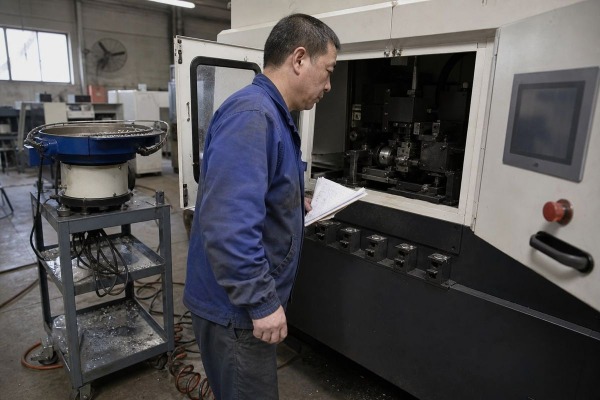
| Feed system | Vibratory bowl feeder on a separate rolling cart | Easy to swap for different part sizes |
| Clamping unit | Interchangeable jaws, standard bolt patterns | Fast changeover between diameters |
| Chamfering head | Quick-change spindle, modular tool shanks | Tooling interchangeability across angles and materials |
| Controls | Expandable PLC, reserved program interfaces | Supports future sensors and drives |
| Media supply | Universal manifolds for air, coolant, lubrication | Plug-and-play modules for auxiliary units |
| Base frame | Reserved footprint and mounting points | Room for automated material handling later |
The most relevant question is not "Can it be expanded?" It is "Can it be expanded without losing precision, stiffness, or cycle time?" Standardized bolt patterns, mounting heights, connector types, and communication protocols 1 are what make expansion predictable. Modular chamfering tools, for example, can be configured with shanks and extensions to reach over 16 inches while keeping damping close to the cutting edge. That kind of tooling extensibility only works when the interface is rigid and repeatable.
Decentralized I/O and on-machine control boxes also matter. They cut wiring complexity when you add a functional module. So a machine with distributed I/O is far easier to grow than one with a single crowded cabinet.
A trade-off we weigh on every project is stiffness versus reach. Adding a longer tool overhang or a faster spindle sounds simple, until vibration ruins your precision edge finishing.
A chamfering machine can adapt to future needs if it handles new part diameters, bevel angles, and throughput increases while keeping stiffness and accuracy. Test this by mapping your 3–5 year product family expectations against the machine's structural limits and reconfiguration speed.

Adaptability has three layers: functional fit, structural fit, and control fit. Our engineers evaluate all three before we quote a custom machine, because a failure in any one layer blocks expansion.
Start with your parts, not the machine. Ask yourself what is likely to change. More diameters? Longer bars? Inside versus outside chamfers? Different bevel angles? Industrial guidance stresses planning around 3–5 year product-family expectations. If your beveling and deburring needs will shift within that window, the machine must reconfigure for the whole part family without major retooling.
Then separate common functions from variable ones. Functions shared across all variants can stay fixed. Functions that change should be swappable modules. This split is where scalability and flexibility come from.
Research on reconfigurable machine tools treats structural stiffness 2 and error sensitivity as key evaluation criteria. That research is mature; it dates back to at least the early 2010s and keeps developing. In practice, it means you should ask for kinematic load-bearing analysis of the base frame. Will added modules increase overhang, vibration, or positional error? Can the spindle support and clamping system hold tolerance after a second high-speed spindle is bolted on?
CNC control systems must scale too. Check for reserved program interfaces, spare PLC capacity, and modular software libraries 3 with function blocks. Good control architecture lets you integrate new hardware through configuration, not custom programming. Some advanced systems even use AI-driven pathing algorithms to optimize multi-tool trajectories when upgrading from single-head to multi-head operation. Firmware synchronization protocols also prevent version conflicts between legacy and new modules.
| Adaptability Layer | Key Question | Evidence to Request |
|---|---|---|
| Functional | Can it handle my full part family? | Changeover procedure and time per part type |
| Structural | Does rigidity survive expansion? | Load-bearing analysis, vibration data |
| Control | Can the PLC and software grow? | I/O reserve list, function block library |
One lesson I learned early in our export business: buyers who ask detailed questions before the deposit get better machines. The buyers who ask after installation get expensive retrofits.
Ask about reserved PLC and I/O capacity, standardized module interfaces, documented upgrade paths, retrofitting capabilities, changeover times, spare mounting points, and remote training support. Also ask to speak directly with the supplier's engineers before and during machine production.

My strongest piece of advice comes from our own project experience: talk to the supplier's engineers early, not just the sales team. On our projects, we encourage buyers to consult our technical engineers before production starts, then join online operation training while the machine is still being built. During that training, we discuss exactly how to expand station functions later. This early communication is the single cheapest form of future-proofing, because expansion decisions made during design cost a fraction of what they cost after delivery.
Use these questions in order. They move from mechanics to controls to service:
A supplier who says "everything is expandable" without documentation is a red flag. Real industrial automation integration requires named protocols, listed spare I/O counts 4, and drawings showing reserved mounting positions. When our team quotes an OEM project, we include these details in the technical proposal, because buyers like procurement managers in the US and Canada compare quotes line by line. Precise answers signal that the supplier has actually built expandable machines, not just marketed them.
A distributor in Malaysia once pushed us hard on price, then asked why our quote was higher than a fixed-purpose machine. The answer was in the lifecycle numbers, not the sticker.
Balance cost and flexibility by comparing lifecycle cost, not purchase price. Pay for modularity only when part variation, demand uncertainty, or process changes are likely within 3–5 years. If production is stable and single-purpose, a simpler fixed machine is often the better buy.

Let me be honest about the trade-off, because I hear this objection often: modularity adds up-front design complexity, and it can be hard to justify for very stable, single-purpose production. That objection is valid. A monolithic machine may still win when the process is highly stable, the part family is narrow, and future changes are unlikely. More modules also mean more interfaces, and excessive decomposition raises failure risk, cost, and validation burden. So the goal is not maximum modularity. It is meaningful modularity.
The right tool here is lifecycle cost analysis. Compare the modular machine's higher upfront price against the cost of replacing a fixed machine when your products change. Modular systems are also easier to inspect, repair, and upgrade in sections, so maintenance accessibility lowers downtime cost over years of service.
| Cost Factor | Fixed Machine | Modular Machine |
|---|---|---|
| Upfront price | Lower | Higher (design and interface cost) |
| Capacity growth | New machine required | Incremental module purchase |
| Changeover time | Long or impossible | Short conversion times |
| Maintenance | Whole-machine downtime | Section-by-section service |
| Obsolescence risk | High if products change | Low with validated upgrade path |
| Validation burden | One-time | Repeated per new module |
I give buyers three rules. First, if the machine must handle only one part type for years, choose simplicity and save the money. Second, if part families are likely to expand, choose a modular architecture with standardized interfaces and a validated upgrade path. Third, if expansion is uncertain, take the middle road: design the base machine so critical subsystems can be added later without redesign. Reserved footprint, spare I/O, and manifold connections cost little now but preserve your options.
Also ask whether you will realistically add modules within 3–5 years. If expansion is only hypothetical, you may be paying for flexibility you never use. But if production throughput must grow in phases, modularity turns one large capital request into several smaller, easier approvals.
Buying a rigid chamfering machine risks costly replacement when products change. Evaluate interfaces, stiffness, control scalability, and lifecycle cost—and talk to your supplier's engineers early.
1. ISO establishes international standards for machine tool interfaces and industrial communication protocols. ↩︎
2. Authoritative ScienceDirect topic page providing a comprehensive engineering definition and context for structural stiffness. ↩︎
3. IEEE provides technical standards for software modularity and functional blocks in industrial control systems. ↩︎
4. NIST offers technical guidance on the capacity and integration requirements of industrial automation hardware. ↩︎
