

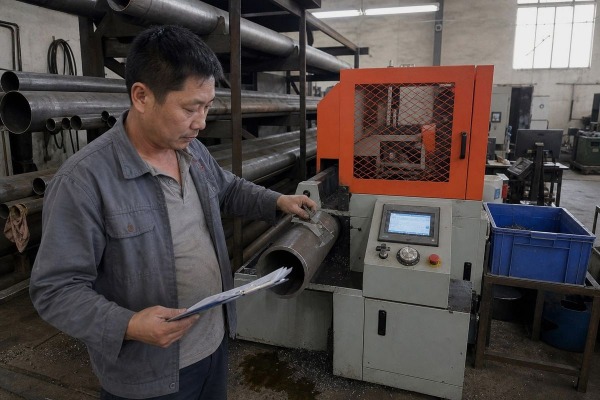
On our production line in Wenzhou, I have seen buyers order tube processing equipment that fits their average job — then fail on their biggest pipe. That mistake is expensive. Here is how a pipe cutting machine's range should really be checked.
A pipe cutting machine's range meets customer requirements when it covers the full pipe envelope — minimum and maximum outer diameter, thickest wall, all materials — while delivering the required cut quality and real cycle time, with roughly 20–30% capacity headroom above current demand.
That definition sounds simple, but each part of it needs verification. Let me walk you through the exact steps I use with our own buyers, from defining the pipe envelope to validating a supplier's claims before you pay.
A procurement manager once told me his shop cut "mostly 2-inch pipe." When our engineers audited his cut list, ten percent of his work was 6-inch heavy schedule. That ten percent decides the machine.
Identify the true range by auditing at least three months of cut lists, then recording the smallest and largest outer diameter, thickest wall, longest and shortest lengths, and every material grade. Size the machine for the toughest case, not the average, and add 20–30% growth margin.

The core mistake is asking "What size pipe do we usually cut?" instead of "What is the full spread of work this machine must handle?" Range means the machine's usable operating envelope. If it cannot process the largest and thickest pipe in the mix, it fails the requirement — even if it handles smaller jobs perfectly.
I ask every buyer to fill in a simple worksheet before we quote anything. It translates vague buying language into measurable specs.
| Envelope Item | What to Record | Why It Matters |
|---|---|---|
| Minimum OD | Smallest pipe in the mix | Small pipes can fall outside clamping range specifications |
| Maximum OD | Largest pipe, even if rare | Defines the pipe diameter capacity you must buy |
| Maximum wall thickness | Heaviest schedule cut | Drives motor power and blade choice |
| Maximum pipe length | Longest stock loaded | Determines infeed table and support needs |
| Cut length range | Shortest and longest finished pieces | Affects clamping and part ejection |
| Materials | Every grade, not just the common one | Sets material compatibility requirements |
Buyers focus on diameter and forget length. Maximum pipe length affects your infeed system, floor space 1, and whether you need automated loading systems or roller supports. A machine with perfect diameter capacity but a short bed will bottleneck long stock immediately.
I always recommend adding 20–30% headroom above current demand. A machine that starts life at full capacity has no room for new contracts, and running constantly at maximum limits accelerates component fatigue. But do not over-buy either — I cover that trade-off later.
When we calibrate machines before export, the spec sheet is only our starting point. The real test is whether the numbers hold up as a system — capacity, precision, and throughput working together.
Compare six specifications: OD capacity range, maximum wall thickness, clamping range, cutting tolerance and edge finish, real cycle time including loading and unloading, and automation level. A machine matches your production requirements only when all six pass, not just diameter.

Advertised cut speed is not the same as production throughput. This is the distinction buyers miss most often. A machine may slice through pipe quickly but lose thirty seconds per piece on manual loading, clamping, and unloading. So convert your target pieces per shift into pieces per hour, then calculate the full cycle time — not just blade contact time.
| Specification | What to Check | Common Trap |
|---|---|---|
| OD capacity | Covers your min and max diameter | Brochure lists max only, not usable minimum |
| Wall thickness limits | Handles your heaviest schedule | Motor strain and incomplete cuts on thick walls |
| Clamping range specifications | Grips smallest and largest pipe securely | Ovality on thin-wall pipe under clamp pressure |
| Cutting tolerance standards | Meets downstream welding tolerances | Spec quoted on ideal material only |
| Real cycle time | Load + clamp + cut + unload | Only blade speed is advertised |
| Automation level | Manual, semi-auto, or CNC control systems 2 | Wrong level for actual volume |
Lower-volume shops can tolerate manual or semi-automatic systems. High-volume, consistent production usually justifies CNC control systems with automated loading systems. The volume math decides this, not preference. A fully automatic line at low volume wastes capital; a manual machine at high volume misses every deadline.
The same pipe size can demand very different machines. Square cuts, miter cuts, and weld-prep bevels are separate capabilities. If your customer needs beveling capabilities with tight, repeatable geometry, verify that spec separately — and check whether the control offers kerf width compensation so finished lengths stay accurate across blade wear.
Material and wall thickness matching is, in my experience, the single most decisive factor. Our team has learned this the hard way: a machine that cuts mild steel beautifully can chatter and burn on duplex stainless at the same diameter.
Verify by sending the supplier your exact material grades and heaviest wall schedules, then requesting witnessed test cuts on your own sample stock. Check finish quality, tolerance, cycle time, and motor load at maximum thickness — a paper spec is not proof.

A published range is usually measured under ideal conditions: clean carbon steel, moderate wall, fresh blade. Your reality may be abrasive plastics, high-tensile alloys, or out-of-round pipe. Material compatibility is where technically sufficient ranges become practically insufficient. Different materials demand specific blades, feeds, or laser powers, and the wall thickness limits that apply to carbon steel do not automatically transfer to harder grades.
Here is the process we run with our own overseas buyers, and it works in reverse when you evaluate any supplier:
Vibration, chip removal, and changeover time only show up in live trials. A machine that looks suitable on paper may struggle exactly where your production is hardest. When we ship equipment to the United States or Germany, we record test cuts on the customer's specified material before packing — because a return shipment costs everyone far more than a demo.
A distributor in the US once asked me for references before ordering. I connected him with two existing buyers running similar pipe schedules. That conversation closed the deal faster than any brochure could.
Find validation through supplier case studies matched to your industry, video evidence on YouTube showing full cycles on similar pipe, B2B platform transaction reviews, direct reference calls with existing users, and factory visits or live-streamed demos cutting your sample material.

Marketing copy tells you what a machine can do at its best. Real feedback tells you what it does on a Tuesday afternoon after six months of use. Both matter, but only the second one predicts your outcome. The key is filtering evidence by relevance: a glowing review from a shop cutting thin PVC says nothing about your heavy-wall stainless work.
| Evidence Source | Strength | Weakness |
|---|---|---|
| Supplier case studies | Detailed, application-specific | Curated; ask for cases matching your pipe envelope |
| YouTube demos | Shows real cycle time and finish | May hide setup time and failed cuts |
| B2B platforms (e.g., Made-in-China reviews) | Verified transactions | Short, rarely technical |
| Direct reference calls | Honest, operational detail | Supplier controls who you talk to |
| Factory visit or live video audit | You choose the test conditions | Requires time and travel or scheduling |
When you reach an existing user, skip "Are you happy?" Ask instead: What diameters and wall thicknesses 4 do you actually run? Has the machine ever failed at its stated maximum? How is spare-parts response? What broke first? Answers to those questions map directly to your risk.
We publish machine run videos on our own YouTube channel precisely because buyers like William — a typical procurement manager we serve — want to see a full load-cut-unload cycle before committing. Ask any supplier for an unedited video cutting your specified material at your maximum wall. A confident supplier will do it. A hesitant one just told you something important.
Buying on brochure numbers risks a machine that fails your hardest job. Define the full pipe envelope, verify six core specs, test-cut your toughest material, and demand real-world evidence.
Here is the simple rule I give every buyer: a pipe cutting machine's range meets customer requirements only when it covers your complete size and material envelope, produces the required cut quality, achieves the necessary cycle time under real conditions, and fits your floor space, power supply, and budget. Not the widest range available — the smallest range that covers current work plus reasonable growth. If you want help mapping your cut list to a machine spec, our engineering team runs this exercise with buyers every week, and we always start with your toughest pipe, not your easiest.
1. NIST provides guidelines for optimizing factory floor space and layout for industrial efficiency. ↩︎
2. Wikipedia provides a comprehensive overview of CNC technology and its application in modern manufacturing. ↩︎
3. Trade.gov offers resources for businesses to improve manufacturing efficiency and reduce changeover time. ↩︎
4. ISO standards define the nominal wall thicknesses and dimensions for industrial piping systems. ↩︎
