

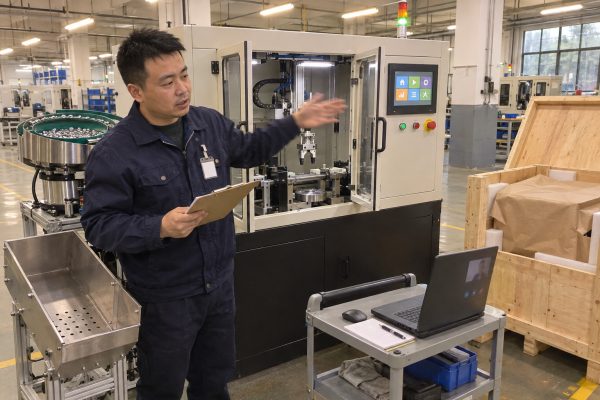
Buyers of our automatic chamfering machines in Germany and France now ask about localized technical support in Europe before price. Skip that check, and a bargain becomes an idle machine.
To confirm localized technical support in Europe for a chamfering machine supplier, request the name and address of its European service entity, named field service engineers, a written SLA with on-site arrival times, proof of spare parts stocked in Europe, local-language documentation, and references from customers in your country.
That list sounds simple. In practice, most of it hides behind sales talk. Below, I break down what to check, how to verify it, and which questions expose weak support before you sign anything.
One lesson from shipping into Italy stuck with me: a distributor who quotes well is not a distributor who repairs well. Sales coverage and service coverage are different things.
Before signing, look for a European after-sales service network with physical service hubs, employed or authorized field service engineers, local-language communication, spare parts stocked inside Europe, installation and commissioning capability, preventative maintenance schedules, and a written escalation route from the local partner to the manufacturer.

The phrase "European support" covers four very different structures. Start by finding out which one your supplier actually runs.
| Support model | Who physically repairs the machine | Main strength | What you must verify |
|---|---|---|---|
| Direct manufacturer service | Manufacturer's own engineers based in Europe | Clear escalation, central control of parts and decisions | Real physical presence, local inventory, arrival times |
| Authorized distributor | Distributor technicians as first line | Local language, proximity, local invoicing | Written authorization, technical depth, number of same-model machines supported |
| Independent service partner | Third-party engineering firm | Wider geographic reach | Training, software access, drawings, genuine parts, warranty responsibility |
| Remote-only | Factory specialists via video, email, VPN | Low cost, fast for minor faults | Cannot do alignment, mechanical repair, or safety inspection |
Remote support is a layer. It is not a substitute for a local engineer. Our own team in Wenzhou is ten people, so when a German buyer asks who stands at the machine, I cannot point to a Munich warehouse. I point to the partner responsible for on-site work, the remote diagnostics built into our PLC, and the spare parts kit shipped with the machine. A supplier who cannot explain its structure this plainly is hiding something.
Ask for the legal name and street address of the European entity. Then ask for the GPS coordinates of the nearest spare parts warehouse and service hub. Check the address yourself. Is it a workshop, an office, or a registered mailbox? Ask for the names or job titles of the regional field service engineers, the countries each one covers, and how many installations they have completed in your country. These are not rude questions. They are the only questions that separate a sales office from a service operation.
A portable pipe chamfering tool needs replacement cutters and basic troubleshooting. Our automatic chamfering machine is different. It has a vibratory bowl feeder 1, a pneumatic gripper, a servo spindle, safety interlocks on the swing doors, and a touchscreen PLC. Any of those can stop production. The more a machine depends on controls, sensors, drives, and custom tooling, the more local engineering capability matters. Judge the network against your machine, not against a brochure.
When equipment goes to Germany, France, or Italy, confirm three things. Can the supplier communicate in the local language when a fault happens? Can it send a European technician to site? Can it deliver parts and remote diagnosis quickly? English-only phone support during a spindle alignment is a real risk. So is an English-only manual on a French shop floor.
A French procurement manager once asked me a blunt question: if the gripper jams on a Friday, who stands at the machine on Monday? That question deserves a precise answer.
Verify on-site technical response time by demanding a Service Level Agreement that defines acknowledgement, remote diagnosis, and arrival times in working hours, then test it: call the published service number with a technical question, ask which engineer travels from where, and check references for real breakdown experiences.

Response time guarantees only mean something when each term is defined. I recommend a short verification routine before any order.
This exercise takes an hour. It reveals more than three sales meetings.
| What the brochure says | What it often means | What to put in the SLA |
|---|---|---|
| 24-hour support | An email inbox is monitored | Acknowledgement within a defined number of business hours |
| Rapid remote diagnosis | Someone will schedule a video call | Remote troubleshooting started within a defined period |
| European service | A distributor with no stock or repair authority | Named entity, named engineers, on-site arrival within defined working days |
| Parts available | Parts exist at the factory outside Europe | Critical spares dispatched from EU stock within a defined time |
Ask whether the technicians are direct employees or third-party contractors. Both can work well, but responsibility differs. Then ask a practical question: do the field service engineers hold valid A1 social security certificates 2 for the EU countries they serve? A technician stopped at a site inspection for missing paperwork is a work stoppage you did not plan for.
Modern remote troubleshooting capabilities matter. Ask whether the supplier offers encrypted VPN access or an Industry 4.0 interface to the PLC, how data access is controlled, and what happens when remote access cannot fix the fault. On our machines, a technician can read the HMI alarm history remotely in minutes. That shortens diagnosis. It does not replace someone physically replacing a sensor.
I have watched a small fabricator buy a low-cost machine with remote-only support and wait weeks for a proprietary control board. The price difference vanished in lost production. Spare parts availability and on-site technical assistance belong in the same conversation as response time.
Here is a distinction I explain on every EU shipment: the CE file proves the machine may enter the market, but no certificate proves anyone will service it.
No certificate alone confirms technical support coverage in Europe. CE conformity documents, an EU Authorized Representative, written distributor authorization, named service partners, training records, and a signed SLA together provide evidence; verify each in writing rather than accepting generic claims of worldwide service.

Compliance and after-sales support are separate things. Both matter. Mixing them up is a common buyer mistake.
Machinery placed on the EU market must meet essential health and safety requirements. Today that means the Machinery Directive 2006/42/EC. The new Machinery Regulation (EU) 2023/1230 3 applies from 20 January 2027. Under these rules, the supplier must deliver an EU Declaration of Conformity 4, instructions for safe adjustment and maintenance, and specifications for spare parts that affect operator safety. Every machine we ship into Germany, France, or Italy needs that file before customs.
What CE does not prove: fast breakdown response, local spare parts, competent commissioning, long-term software support, or available technicians. A clean technical file is a sign of supplier maturity. It is not a service plan.
A non-EU supplier should be able to name its EU-based Authorized Representative 5 or responsible economic operator. This party handles regulatory questions and safety escalations inside Europe. If the supplier cannot name one, ask how a safety incident would be handled.
| Evidence | Strength | Why it matters |
|---|---|---|
| Brochure saying "worldwide service" | Weak | No named person, place, or commitment |
| Written distributor authorization letter | Medium | Confirms who may repair under warranty |
| Named service partner list with countries covered | Strong | Verifiable by phone and site visit |
| Local-language manuals, schematics, software keys supplied to your team | Strong | Right-to-repair access for your own maintenance staff |
| Regional training centre or on-site user training programs | Strong | Operators certified without flying to the factory |
| Signed SLA with escalation matrix | Strongest | Contractual, measurable, enforceable |
Two more checks matter in Europe. First, ask whether the supplier provides circuit diagrams and software passwords so your internal team can perform first-line repairs. Second, ask about power quality. Some European utilities require on-site verification that high-frequency drives do not inject harmonic distortion into the grid. A supplier familiar with the local market will have an answer about EN 61000 harmonic limits. One who looks puzzled has not supported many machines locally.
Localized technical support in Europe is built from these documents and relationships, not from a logo on a nameplate.
During factory acceptance testing on one chamfering line, I swapped in a worn insert and let the buyer watch us diagnose it. That demonstration taught them more than any brochure.
Ask who performs installation, which parts are stocked in Europe, how fast an engineer arrives, whether software backups and passwords are supplied, what preventative maintenance and training are included, and what happens after warranty. Then request a live support demonstration and two customer references.

I organize buyer questions by category. Each category exposes a different kind of weakness.
| Category | Key questions |
|---|---|
| Coverage | Which countries are served directly, which through distributors, which languages, and are weekends or shutdown periods covered? |
| Personnel | How many engineers serve the region, are they employees or partners, and can one engineer handle mechanical, electrical, software, and tooling faults? |
| Installation | Is commissioning included, who does leveling, alignment, wiring checks, and guarding inspection, and what happens if acceptance tests fail? |
| Breakdowns | What are the acknowledgement, remote diagnosis, and on-site arrival targets, and are travel, labor, and consumables included? |
| Parts | Which inserts, cutters, spindles, bearings, sensors, drives, and safety components sit in EU stock, and is next-day delivery within the Schengen Area realistic? |
| Software | Are PLC and HMI backups, passwords, and parameter files supplied, and are updates included after warranty? |
| Maintenance | Are preventative maintenance schedules based on hours, cycles, or calendar time, with checklists and lubrication specifications? |
| Training | Are user training programs delivered on site in the local language, and can additional staff be trained later? |
Vague answers score zero. I suggest a weighted scorecard and adjust the weights to your risk.
| Category | Suggested weight |
|---|---|
| Local engineering capacity | 20% |
| Spare parts availability in Europe | 15% |
| Response-time commitments | 15% |
| Installation and commissioning | 15% |
| Documentation and compliance | 10% |
| Training | 10% |
| Remote diagnostics and software support | 5% |
| Customer references | 5% |
| Warranty clarity | 5% |
A small workshop may weight price higher. A continuous production line should push parts and response time higher still.
Ask two or three customers in your country or industry. Keep the questions concrete. How long did installation take? How fast did the supplier respond to the first serious fault? Were parts available? Were recurring problems fixed permanently? What costs surprised you? Would you buy again?
Before final selection, give each finalist a simulated cutter-wear problem. Ask how they diagnose it, which parts they would need, who would attend, and how they escalate if the first fix fails. When we run factory acceptance testing (FAT) for European buyers, we welcome this test. It separates a polished sales process from a working support system, and it makes localized technical support in Europe something you can measure instead of something you hope for.
Treat European support as a measurable part of total cost of ownership. Verify people, parts, response times, and documents before you sign, then write them into the contract.
1. Technical explanation of the common industrial automation component used in chamfering machines. ↩︎
2. Official EU portal explaining social security forms for workers posted across European borders. ↩︎
3. Official European Commission page for the machinery sector, covering current directives and new regulations. ↩︎
4. Official EU guidance on the required conformity documentation for machinery entering the European market. ↩︎
5. Original URL is 404. This official EU Commission page defines the legal role and responsibilities of an Authorized Representative. ↩︎
