

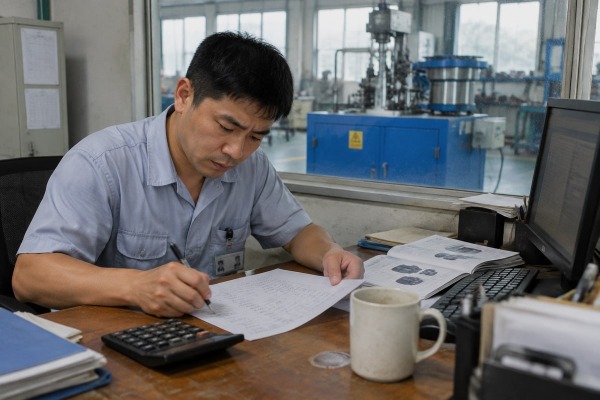
When buyers ask about the total procurement cost for an automatic assembly machine, many focus only on the sticker price — and that mistake costs thousands later.
To calculate total procurement cost for an automatic assembly machine, add the base machine price, customization and tooling fees, installation and commissioning expenses, shipping and duties, operator training, spare parts, utility setup, and a 10–15% contingency allowance for unforeseen project costs.
The purchase price is only the starting point. This guide walks through every cost factor you need to budget — from the first quote request to the day your line runs at full speed.
On a recent terminal lug machine project, our engineering team listed every cost line before quoting — the final number surprised even our experienced buyer.
Include the base machine price, engineering and customization, tooling and fixtures, controls and software, installation and commissioning, freight and duties, facility preparation, operator training expenses, spare parts inventory, compliance testing, and a contingency buffer of 10–15%.

Here is the formula we share with every prospective buyer:
Total Procurement Cost = Machine Price + Customization + Tooling/Fixtures + Controls/Software + Installation/Commissioning + Freight/Duties + Facilities/Utilities + Training + Spare Parts + Compliance/Validation + Contingency
This is not just theory. Every line item in that formula represents a real invoice that lands on your desk at some point during the project. The purchase price of the core machine — your capital expenditure 1 — often represents only 30–50% of the ten-year total cost of ownership. That means the money you spend after the purchase order is signed can actually exceed the machine price itself over time.
| Cost Component | Typical Range (% of Machine Price) | Notes |
|---|---|---|
| Base machine price | 100% (reference point) | Varies $150K–$2M+ depending on complexity |
| Customization & engineering | 10–40% | Driven by product geometry and process steps |
| Tooling & fixtures | 5–20% | Product-specific grippers, dies, jigs |
| Controls & software | 5–15% | PLC, HMI, vision systems, traceability |
| Installation & commissioning | 10–30% | Site readiness is the biggest variable |
| Freight, duties, logistics | 5–15% | Higher for offshore purchases |
| Facility & utility prep | 3–10% | Power, compressed air, guarding, floor work |
| Training | 1–5% | Operator, maintenance, engineering staff |
| Spare parts (initial kit) | 2–5% | Wear items, sensors, key components |
| Compliance & validation | 2–10% | Factory acceptance testing 2, documentation |
| Contingency | 10–15% | Scope changes, unforeseen integration issues |
These percentages are approximate. On a $750,000 machine, you might realistically add $150,000–$250,000 in integration, installation, and startup costs. That is why we always encourage buyers to think of total procurement cost as a project budget, not a purchase order number.
Many procurement managers compare quotes by looking at the bottom-line machine price. But a $400,000 quote that excludes factory acceptance testing, controls programming 3, and shipping is not cheaper than a $500,000 quote that includes all three. At our facility in Wenzhou, we build detailed cost breakdowns into every proposal so buyers see exactly what is covered and what is not. This approach saves weeks of back-and-forth and prevents budget surprises later.
Consider this: turnkey automated assembly machines often fall in the $150,000–$500,000 range for configured systems, while custom multi-station lines can run $800,000–$1.2 million or more. The wide range exists because different quotes include different scope. A bare machine and a fully installed, validated system are two completely different products — even if they look identical on the factory floor.
The opportunity cost of facility footprint also matters. The square footage your machine occupies could serve other production purposes. Include that floor space cost in your lifecycle analysis, especially in high-rent industrial zones.
A customer in Mexico once sent us product drawings and asked for a quick price — but the real budget conversation started after we discussed tooling complexity.
Customization and tooling are the largest cost variables in any automatic assembly machine project. Custom fixtures, grippers, product-specific dies, and unique process sequences can add 10–40% to the base machine price, depending on part geometry and production requirements.

Every automatic assembly machine we build starts with a customer's product. The product shape, material, tolerances, and assembly sequence determine how much custom engineering goes into the machine. A simple press-fit operation on a symmetrical part needs basic tooling. A multi-step assembly with orientation detection, crimping, inspection, and rejection needs far more. This is why two machines that look similar from the outside can have very different price tags.
Here is how different levels of customization affect the budget:
| Customization Level | Example | Estimated Cost Impact |
|---|---|---|
| Standard configuration | Off-the-shelf feeder bowls, generic tooling | Minimal — included in base price |
| Moderate customization | Custom grippers, product-specific fixtures, adjusted cycle time | +10–20% of base price |
| Heavy customization | Unique process stations, vision-guided assembly, multi-product changeover capability | +25–40% of base price |
| Full custom design | Ground-up machine for a novel product or proprietary process | Price determined entirely by scope |
Tooling includes everything that touches or handles the product: feeder bowl tooling, orientation nests, grippers, crimping dies, pressing fixtures, and inspection gauges. When we design an assembly machine for terminal lugs or pneumatic pipe fittings, the tooling package alone can represent a significant portion of the total project cost. This is because each product variant may need its own set of fixtures.
System integration fees also rise with customization. A machine with multiple vibratory bowl feeders 4, a central rotary indexing table, pneumatic actuators, and a vision inspection system requires extensive PLC programming and sensor calibration. Our engineers spend considerable time on controls integration for these complex builds. The more stations and the tighter the cycle time, the higher the programming and debugging cost. A four-station rotary system, for instance, might land between $350,000–$500,000 — and much of that reflects integration complexity rather than raw hardware.
Buyers who produce multiple product variants should ask about changeover cost early. If your machine needs to switch between three different assemblies, each changeover kit — new tooling, new feeder bowl liners, updated PLC recipes — adds to the total budget. We recommend discussing all product variants at the quoting stage, not after the machine is built.
One important trade-off here: a machine designed for quick changeover costs more upfront but saves production time and reduces machine downtime costs over its lifecycle. A machine designed for a single product is cheaper to build but locks you into one configuration. We have seen buyers regret choosing the single-product path when their product line expanded a year later and they needed expensive retrofits.
The trade-off between a lower upfront price and full lifecycle support becomes painfully clear once a machine arrives at your plant and the real expenses begin.
Hidden post-installation costs include utility upgrades, extended commissioning time, productivity loss during ramp-up, preventive maintenance costs, software license renewals, spare parts replenishment, operator retraining after staff turnover, and unplanned downtime during the learning curve — often adding 15–25% beyond the original purchase budget.

When a new automatic assembly machine arrives, it does not produce at full capacity on day one. There is a ramp-up period. Operators learn the controls. Maintenance staff study the machine. Engineers fine-tune cycle times and reject rates. During this period, your actual output is below target. That gap between expected and actual production is a real cost, even though it never appears on an invoice.
From our experience shipping machines to the United States, India, Vietnam, and other markets, the ramp-up period typically lasts two to six weeks depending on machine complexity and operator experience. We provide remote technical support and on-site commissioning assistance to shorten this window, but buyers should still budget for reduced output during startup. The site acceptance test marks the formal handover, but true production-speed operation usually takes additional time beyond that milestone.
Many buyers overlook the cost of preparing their facility for the new machine. An automatic assembly machine needs stable power supply, clean compressed air, network connections for data logging, proper lighting, and sometimes climate control. If your factory's electrical panel cannot handle the new load, you need an upgrade. If your compressed air system runs at lower pressure than the machine requires, you need a new compressor or a booster.
Floor preparation matters too. Some machines require a level concrete pad or vibration-dampening mounts. Machine guarding and safety fencing may be required by local regulations. Environmental and regulatory compliance costs — including safety re-certifications and, in some jurisdictions, emission tracking — also add up. These facility costs are part of your total procurement cost even though the machine vendor did not cause them.
After the machine is running, several recurring costs begin:
Our advice — and this comes from years of building and supporting these machines — is to consider after-sales service quality, technical capability 5, machine build quality, and processing stability as a complete package. The cheapest machine is rarely the cheapest to own. A machine that runs reliably with responsive technical support will always outperform a bargain machine that breaks down and leaves you waiting weeks for parts.
Years of exporting custom assembly machines taught our team one hard lesson: two quotes that look similar on paper can differ by 30% in real cost once you account for what each one includes.
To compare quotes accurately, normalize every proposal to the same scope by listing all included and excluded items, converting prices to landed cost with freight and duties, confirming whether factory acceptance testing and site acceptance test are covered, and adding identical contingency and training line items to each option.

The biggest mistake buyers make is comparing raw numbers from different suppliers without checking what each number includes. One supplier quotes $350,000 for a four-station rotary assembly system. Another quotes $280,000. The second looks cheaper — until you discover it excludes controls programming, vibratory bowl tooling, shipping, and factory acceptance testing. Once you add those items, the lower quote may actually cost more. We have seen this happen repeatedly with buyers who later came to us after a frustrating experience with an incomplete scope.
Use this table when reviewing any supplier quote. Mark each item as included or excluded, then calculate the true comparable cost:
| Item to Verify | Supplier A | Supplier B | Supplier C |
|---|---|---|---|
| Base machine price | ✓ / ✗ | ✓ / ✗ | ✓ / ✗ |
| Custom tooling & fixtures | ✓ / ✗ | ✓ / ✗ | ✓ / ✗ |
| PLC/HMI programming | ✓ / ✗ | ✓ / ✗ | ✓ / ✗ |
| Vision system (if applicable) | ✓ / ✗ | ✓ / ✗ | ✓ / ✗ |
| Factory acceptance testing (FAT) | ✓ / ✗ | ✓ / ✗ | ✓ / ✗ |
| Shipping & insurance (CIF/FOB) | ✓ / ✗ | ✓ / ✗ | ✓ / ✗ |
| Import duties & customs brokerage | ✓ / ✗ | ✓ / ✗ | ✓ / ✗ |
| Installation & commissioning | ✓ / ✗ | ✓ / ✗ | ✓ / ✗ |
| Site acceptance test (SAT) | ✓ / ✗ | ✓ / ✗ | ✓ / ✗ |
| Operator training | ✓ / ✗ | ✓ / ✗ | ✓ / ✗ |
| Initial spare parts kit | ✓ / ✗ | ✓ / ✗ | ✓ / ✗ |
| Warranty scope & duration | ✓ / ✗ | ✓ / ✗ | ✓ / ✗ |
| Documentation & manuals | ✓ / ✗ | ✓ / ✗ | ✓ / ✗ |
Fill in this table for each supplier. Any item marked as excluded is a cost you will pay separately. Add those costs to the quoted price to get the true landed, installed total.
Offshore suppliers — including capable manufacturers like us in China — may offer headline prices 30–50% below local equivalents in North America or Europe. But the landed cost gap narrows once you factor in international freight 6, crating, customs brokerage, import tariffs, and the cost of remote commissioning support. For some buyers, the savings are still significant and worthwhile. For others, especially on smaller or less complex machines, the gap nearly disappears.
The key is to do the math honestly. When we quote a machine for a buyer in the United States or Canada, we provide a detailed cost breakdown that includes FOB price, estimated ocean freight, and a clear list of what falls within our scope versus what the buyer handles locally. This transparency helps the buyer compare our proposal against a domestic option on equal terms — no guessing, no hidden gaps.
Price comparison is necessary but not sufficient. The real question is return on investment. A more expensive machine that runs at higher uptime, produces fewer rejects, and comes with responsive technical support will generate more value over its lifecycle than a cheaper machine with frequent breakdowns and slow spare parts delivery.
When evaluating return on investment, factor in these dimensions:
We always tell our buyers: consider after-sales service, technical expertise, machine quality, and processing stability together. A machine is a long-term production partner, not a one-time purchase. The supplier relationship matters as much as the hardware itself. Choosing the cheapest quote without evaluating these factors almost always leads to higher total cost of ownership in the long run.
Calculating total procurement cost for an automatic assembly machine means budgeting the full project — from vendor quote through installation, ramp-up, and long-term operation — not just the sticker price.
1. Authoritative guide on cost estimating and capital expenditure analysis from the Government Accountability Office. ↩︎
2. International standards organization providing frameworks for quality management and industrial equipment testing protocols. ↩︎
3. Leading professional association for electrical and electronics engineering standards, including industrial control systems. ↩︎
4. National institute providing technical standards and research for industrial automation and manufacturing systems. ↩︎
5. International Trade Administration resource for evaluating supplier technical capability and global manufacturing standards. ↩︎
6. Official U.S. Federal Maritime Commission resource for international ocean transportation and freight regulations. ↩︎
