

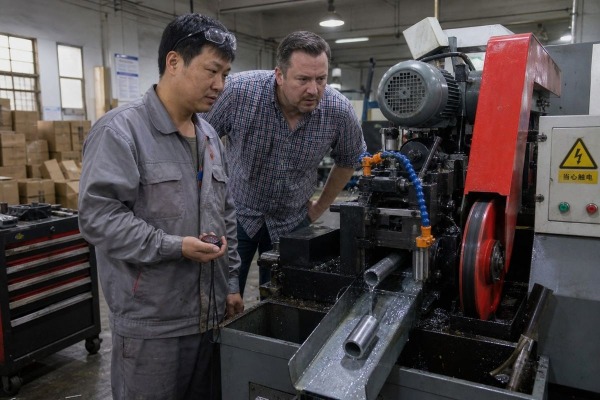
Last year, a buyer asked me if our [fully automatic pipe cutting machine](https://yqunique.com/?p=5686) could hit his takt time. His current line kept missing shipments, and every delay cost him real money.
A fully automatic pipe cutting machine meets takt time requirements only when its complete operating cycle—loading, clamping, cutting, unloading, and changeover—runs at or below the takt time calculated from available production time divided by customer demand. Cutting speed alone never guarantees compliance.
That answer sounds simple. In practice, it requires three steps: get the customer’s real production demand, calculate the required takt time 1, and measure the machine’s true cycle time. Let me walk you through each one.
During a factory acceptance test 2 at our Wenzhou workshop, a German engineering manager once timed our machine himself with a stopwatch—from tube feed to part drop. I respected that. It is exactly what every buyer should do.
Verify cycle time by requesting a timed video of the full cycle with your exact pipe specification, reviewing PLC cycle logs, running a factory acceptance test with your own material, and confirming sustained hourly output—not just a single fast demonstration cut.

The gap between advertised speed and real output is where most buyers get burned. A supplier may quote the cutting stroke only. But your production throughput 3 depends on the full sequence: bar loading, feeding, clamping, cutting, part release, and discharge. Each step adds seconds. Those seconds decide whether the machine fits your takt.
Here is the process I recommend to every procurement manager before signing a purchase order.
| Verification Method | What It Proves | What It Misses |
|---|---|---|
| Single demo cut | Peak cutting speed | Loading, unloading, changeover |
| Timed full-cycle video | True per-part cycle | Long-run stability |
| PLC cycle logs | Consistency over hundreds of cycles | Your specific material behavior |
| Factory acceptance test with your material | Real-world performance | Shift-long fatigue factors |
| Sustained shift output data | Overall equipment effectiveness | Nothing—this is the gold standard |
The published research supports this caution. One study measured 120 seconds for manual cutting versus 80 seconds automated on a 1000 mm pipe. Another reported a 75% time reduction with automated pipe cutting. Those gains are real. But they were measured on complete cycles, not blade strokes. Demand the same measurement standard from any supplier you evaluate.
The hardest lesson our team learned came from an early project in Japan. The machine cut beautifully, but the customer's manual bundle feeding upstream throttled the entire line. We redesigned the infeed within a month.
Actual takt performance depends on loading and unloading method, changeover frequency, material variation, blade or laser wear, coolant and chip management, downtime for maintenance, and downstream bottlenecks—not just the machine's rated cutting speed.

Takt time is a demand-side number. You calculate it by dividing net available production time by required output. If your customer needs 900 parts in a 450-minute shift, takt is 30 seconds per part. Lean manufacturing metrics treat that as a ceiling. Your full process cycle must stay under it, every hour, all shift.
Most misses come from time nobody counted. Here are the factors I check first when a buyer tells me their line cannot keep pace.
| Factor | Typical Impact | How to Reduce It |
|---|---|---|
| Manual bar loading | 10–60 seconds per bar | Automated bundle loading systems |
| Changeover between diameters | 5–30 minutes each | Modular zero-point clamping fixtures |
| Blade wear on a high-speed circular saw | Gradual cycle creep plus stoppage | Scheduled blade changes, wear monitoring |
| Chip and coolant maintenance | Micro-stoppages | Auto chip conveyors, filtered coolant |
| Secondary deburring | Extra station, extra takt burden | Integrated deburring and chamfering units |
| Downstream packing constraints | Machine waits, output starves | Line balancing, buffer design |
Two of these deserve emphasis. First, changeovers. Shops running mixed pipe diameters or short runs lose more time to setup than to cutting. Modular zero-point clamping systems can make diameter changes nearly instantaneous, which effectively removes setup from the takt calculation. Second, secondary processing. A rough cut that needs manual deburring adds a whole extra operation. High-precision automated cuts that come off the machine clean prevent that bottleneck entirely.
There is also a fair objection worth addressing. Some engineers argue that buying a faster cutter is always the answer to a takt gap. The cautionary view—and I agree with it—is that takt is a system-level metric. A cutter running at 7 seconds per part still misses a 30-second takt if changeovers, feeding, and inspection push the effective cycle to 40 seconds. Cycle time optimization must cover the whole industrial fabrication workflow 4, not one station. Automation improves your odds. Line balancing decides the outcome.
A procurement manager from the United States once messaged me on WhatsApp with a simple request: his takt was 12 seconds, and no standard machine on the market matched his cut length and infeed layout. That inquiry became a three-month co-development project.
Yes. Reputable suppliers can customize servo feed rates, spindle speed, loading automation, clamping fixtures, discharge design, and PLC logic to match a specific takt time. OEM/ODM development typically starts from your part drawing and target cycle time.

Customization is where a takt gap gets closed. Our team in Wenzhou builds non-standard equipment around a customer's target cycle, and the process is more structured than most buyers expect. It starts with two numbers: your calculated takt time and the standard machine's measured cycle. The difference tells us what to engineer.
Different levers close gaps of different sizes. Here is how we typically prioritize them.
| Customization Lever | Time Saved | Best For |
|---|---|---|
| Automated bundle loading | Eliminates manual bar handling | High-volume continuous runs |
| Servo-driven feed and positioning | Faster, repeatable length setting | Tight precision cutting tolerances |
| Dual-clamp or multi-tube cutting | Cuts multiple pipes per stroke | Small-diameter, high-quantity parts |
| Integrated chamfering station | Removes a separate operation | Parts needing finished ends |
| Auto discharge and sorting | Removes manual unloading | Lines feeding directly to assembly |
| Custom PLC logic and IoT signals | Synchronizes pace with downstream stations | Industry 4.0 integrated lines |
That last row reflects a real trend. With IoT integration, a cutting machine can adjust its pace dynamically based on real-time signals from downstream assembly stations, so it neither starves nor floods the line. Material-specific parameter tuning matters too—optimizing blade speed or laser pulse rate for a specific alloy shaves fractions of a second from every cut, and at high volumes those fractions compound into real manufacturing capacity planning headroom.
One honest trade-off: more automation raises the machine's price and lengthens delivery. For short runs with frequent product changes, a semi-automatic machine with fast-change fixtures sometimes beats a fully automatic line on total cost. We tell buyers this plainly. Matching automation level to your actual demand pattern is the customization decision, not maximizing automation for its own sake.
Delivery day is not the finish line. I have seen machines that passed acceptance tests, then drifted out of takt within six months because nobody supported blade sourcing, wear parts, or PLC troubleshooting. Supplier selection prevents that slow failure.
Choose a supplier who documents guaranteed cycle times in the contract, provides PLC-based performance logging, stocks wear parts, offers responsive remote diagnostics, trains your operators, and has verifiable export experience supporting machines across multiple time zones.

Consistent takt performance over years is a service question as much as an engineering question. When we ship equipment to the US, Germany, Japan, or Mexico, the machines that keep their pace are the ones backed by structured after-sales support. Here is what to demand before you commit.
Get the numbers in writing. The contract should state the guaranteed full-cycle time for your specific part, the sustained hourly output, and the acceptance test criteria. Vague phrases like "high speed" protect nobody. A supplier confident in their machine will sign specific numbers.
After delivery, four things keep the machine on pace:
Ask for references in your region. Ask how they handled a past machine failure abroad. Watch their machines run on their YouTube channel and compare footage against spec claims. A supplier serving procurement managers at medium and large manufacturers understands that a missed takt on your side becomes a missed shipment for your customer. That understanding shows in how they answer these questions—concise, specific, and documented.
A fast cut is not a met takt. Verify the full cycle, calculate real demand, customize where gaps remain, and choose a supplier who supports the pace long after delivery.
1. Authoritative resource for calculating the required takt time to synchronize production with customer demand. ↩︎
2. Explains the role of acceptance testing in verifying that industrial equipment meets its functional specifications. ↩︎
3. Definition of production throughput as the rate at which a system generates its products over time. ↩︎
4. NIST MEP provides technical assistance and resources to improve industrial fabrication workflows and manufacturing efficiency. ↩︎
