

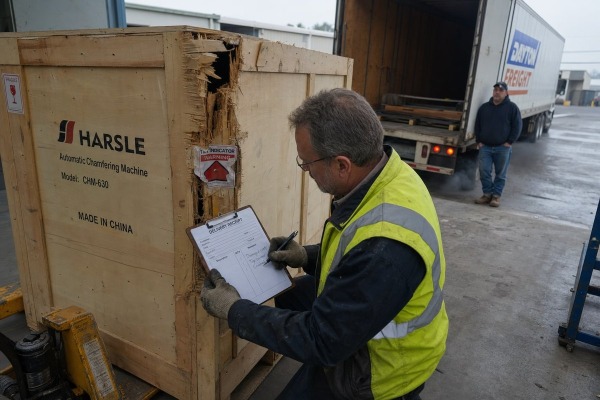
A damaged automatic chamfering 1 machine at delivery can freeze your whole production plan industrial machinery appraisal 2. I have shipped these machines from our Wenzhou factory for years, and I know how stressful that moment feels.
To file a claim for a damaged automatic chamfering machine, document the damage before moving the machine, note it on the delivery receipt, keep all packaging, notify the carrier and insurer in writing immediately, and submit a claim package with photos, invoices, and a repair estimate.
That is the short answer. But industrial machinery claims are won or lost on evidence, timing, and paperwork. Let me walk you through each step, the same way I guide our own customers.
One of our customers in Mexico once signed a clean delivery receipt, then found a bent guard rail after uncrating. That single signature made his claim ten times harder.
Document the damage before signing anything. Photograph the crate, pallet, straps, and machine from all sides, write a clear damage notation on the Bill of Lading or Proof of Delivery, and keep every piece of original packaging until the carrier finishes its inspection.

Shipping damage evidence starts the moment the truck arrives. Do not wait. Do not let the driver rush you. In our experience exporting to the US, Canada, and Southeast Asia, the first thirty minutes at the dock decide most claims.
Walk around the crate before you accept it. Look for crushed corners, forklift holes, water stains, and broken bands. If we attached shock indicators or tilt labels to the crate, check them and photograph them right away. A triggered indicator is powerful proof of mishandling in transit.
If you see any problem, write it on the Proof of Delivery. Use plain words like “crate crushed on left side, damage pending inspection.” Never refuse the shipment. Accept it, because you need possession of the machine to build your case.
Take more photos than you think you need. Carriers and insurers respond to visual proof, not descriptions.
| What to capture | Why it matters |
|---|---|
| Crate exterior, all six sides | Shows condition at delivery |
| Impact points, dents, holes | Links damage to transit handling |
| Shock or tilt indicators | Timestamps the mishandling event |
| Machine after uncrating | Reveals concealed damage |
| Serial number plate | Ties evidence to your exact machine |
| Packaging and dunnage | Proves the machine was packed properly |
Keep the crate, skids, foam, and wrap. Carriers often deny claims when the original packaging is discarded before their surveyor arrives. I tell every customer the same thing: store it all, even if it fills a corner of your warehouse for a month.
Our engineers keep a full record for every machine that leaves the factory, because we know a claim file is only as strong as its weakest document.
A complete claim package includes the machine model and serial number, the Bill of Lading, the noted delivery receipt, the purchase invoice, the packing list, high-resolution damage photos, a repair or replacement estimate, and a written demand for a specific payment amount.

Think of your freight claim 3 documentation as a case file, not a form. The reviewer on the other side has never seen your machine. Your file must tell the whole story without a phone call.
| Document | What it proves |
|---|---|
| Bill of Lading 4 or waybill | The shipment existed and its terms |
| Proof of Delivery with damage notes | Condition at the moment of receipt |
| Purchase invoice | Proof of value and replacement value |
| Packing list | What was inside the crate |
| Damage inspection report | Type and extent of the damage |
| Repair estimate or quote | The dollar amount you are claiming |
| Photos and videos | Visual proof tying it all together |
A valid claim must do four things. It must identify the shipment. It must describe the loss or damage. It must state or estimate the amount. And it must make a clear demand for payment. Miss one, and the clock keeps ticking while the carrier asks for more paperwork.
For an automatic chamfering machine, ask the manufacturer or a certified technician for a formal estimate. When our customers report damage, we provide a written assessment of the affected parts and their cost. In most cases, only a component is damaged, such as a guard, a sensor, or a handwheel, and we simply ship a new part. Full machine write-offs are rare. Still, your claim should list every affected item, including labor. If the damaged unit blocks your line, include the rigging cost to move it. If precision may be affected, ask for recertification of the machine’s tolerances after repair ISO 5. An industrial machinery appraisal can also support a disputed valuation.
Internal alignment issues, damaged motors, or bent cutting components may only appear during test runs. Describe both the visible damage and the operational symptoms, and support them with test results.
Before we quote any overseas order, I always ask the buyer one question: who arranged the freight? The answer decides who you claim against, and under which rules.
Check the carrier’s liability terms in the Bill of Lading, your freight insurance coverage certificate, and the freight forwarder’s conditions. Carrier liability is often limited by weight, so a separate cargo policy usually determines whether you recover the machine’s full value.

These are two different tracks, and smart buyers run both at once. Filing with your insurer does not replace your rights against the carrier. Notify both, in writing, and let them sort out who pays.
Carrier liability 6 comes from the transport contract. It often caps payouts at a fixed amount per kilogram, which can be far below the replacement value of a precision machine. Freight insurance coverage, on the other hand, is a policy you or the seller purchased cargo insurance 7. It usually covers the declared value, but it comes with its own notice rules and evidence requirements.
| Question | Carrier | Cargo insurer |
|---|---|---|
| What do they need to see? | Proof of damaged receipt and timely demand | Proof of value and a covered event |
| How is payout limited? | Often capped per kilogram | Up to the insured declared value |
| Who do you contact? | Carrier’s claims department | Insurer or broker |
| Key document | Bill of Lading with notations | Insurance certificate and invoice |
If you booked the freight yourself, the carrier and your insurer are your first contacts. If the seller arranged delivery under the sales contract, notify the seller and the freight forwarder immediately so no deadline is missed on their side. Many claims fail simply because the wrong party was told, and told late. When our customers in the US or New Zealand report transit damage, we help chase the forwarder from the China side while they file with the receiving carrier. That two-sided pressure moves claims faster than either party working alone.
A lesson I learned early in this business: deadlines kill more claims than weak evidence ever does. One missed notice window can erase a strong case overnight.
Deadlines vary by carrier and policy, but visible damage should be noted at delivery, concealed damage typically must be reported within about five business days, and the formal written claim must be filed within the period stated in the Bill of Lading, tariff, or insurance policy.

Treat every deadline as shorter than it looks. The safest habit is to act within hours, not days. Here is the timeline I recommend to every buyer receiving one of our machines.
Concealed damage carries the tightest window because carriers argue the damage happened after delivery. This is why delivery-day photos matter even when the crate looks clean. Machine data can help too. If your machine logs errors or events, pull those records for the transit window. Sensor data from shock indicators can pinpoint the exact moment of mishandling and shut down a concealed-damage dispute before it starts. Proof of a timely filing matters as much as the filing itself, so save every email, tracking number, and submission receipt.
A damaged machine does not have to become a lost investment. Document fast, keep everything, notify every party in writing, and file a complete claim before the deadline.
From our factory floor in Wenzhou, I can tell you what years of shipping automatic chamfering machines worldwide have taught us: total losses are rare, and most transit damage involves a single component we can replace quickly. The real risk is not the dent in the crate. It is the clean signature, the discarded packaging, and the late email. Build your case file like your recovery depends on it, because it does. And if your machine came from us, contact me directly. We will supply the damage assessment, the replacement parts, and the paperwork you need to win your claim.
