

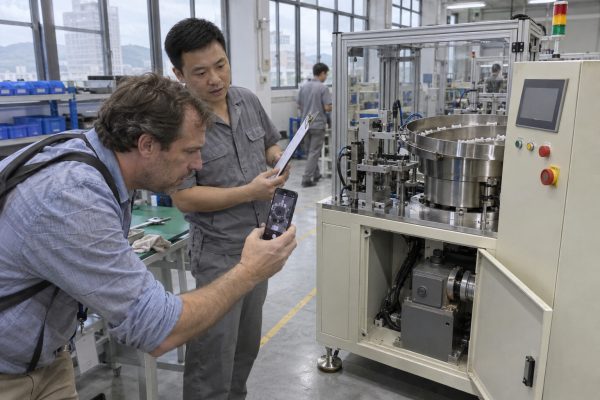
An automatic assembly machine that doesn’t match contract specs can stall a whole line. I’ve watched buyers panic. In our Wenzhou workshop, we handle it with evidence, not arguments.
If an automatic assembly machine doesn’t match contract specs, stop and preserve evidence, do not sign acceptance, compare the machine against the written acceptance criteria, notify the supplier in writing, request a root-cause remediation plan, and retest before releasing payment or claiming repair, replacement, or refund.
That sounds simple. In practice, buyers skip steps, sign the wrong paper, or argue about feelings instead of numbers. Below I walk through what to check, what you can claim, how to prove it, and how to prevent it next time.
A few years back, one of our cable lug assembly machines passed Factory Acceptance Testing 1, then jammed on site. The cause was the buyer's terminal strip, not our tooling.
First, check the contractual baseline: the technical specifications document, approved drawings, FAT and SAT protocols, and any signed change orders. Then confirm whether the mismatch concerns cycle time, yield, safety, or documentation, and verify that parts, utilities, and operators met the contract before blaming the machine.

A spec mismatch is two problems at once. It is a technical problem. It is also a potential breach of contract. You cannot fix either one until you know exactly what was promised. So I always tell buyers to start with paper, not with the machine.
Pull the signed contract and every technical schedule. Look for the quotation, the statement of work, the approved drawings, the FAT/SAT protocol, and any later change order. Then ask one hard question. Is this requirement a mandatory pass/fail criterion 2, or was it only a design target? Words like "high speed" or "capable of production" are not criteria. A written figure like 30 good parts per minute at 98% yield is a criterion. If the contract never defined the number, you have a weaker claim and a harder conversation.
Not every gap deserves the same response. We use three levels, and we tie each level to business impact rather than to cosmetics.
| Severity | Typical example | Usable? | Usual first remedy |
|---|---|---|---|
| Minor | Missing labels, incomplete manuals, documentation errors | Yes | Correction by deadline, small payment holdback |
| Major | Excess scrap, throughput below cycle time requirements, slow changeover, recurring stops | Partly | Corrective-action plan, retest, price adjustment, extended warranty |
| Critical | Cannot perform core function, safety risk, regulatory failure | No | Suspend acceptance, reject, replace, terminate for cause |
A small dimensional deviation can be critical if it makes the assembled product useless. A missing cosmetic cover can be minor. Judge by the effect on your line.
Factory Acceptance Testing happens at the supplier's plant before shipment. Site Acceptance Testing happens after equipment commissioning at your site. The difference matters. Ask:
In the terminal strip case I mentioned, the buyer's parts were outside the agreed tolerance band. The machine was conforming. The feed stock was not. That is why I check inputs before I check outputs. Causation decides who pays, and a joint fault analysis is far cheaper than a lawsuit.
Replacement versus repair is a trade-off we weigh with every claim. A rebuilt tooling plate ships in weeks. A full replacement machine can mean months of lost production.
Yes, but the remedy depends on the contract, governing law, defect severity, and whether acceptance occurred. Most agreements require a cure period and retest first. Replacement, rejection, or refund usually applies only to critical nonconformities, while major issues often resolve through repair, price reduction, or extended warranty.

The personal rule I share with every buyer sourcing from China is this. A claim succeeds when you can prove the gap between the delivered state and the contract, build a complete evidence chain, and then state clearly which responsibility the supplier must carry: rework, compensation, or refund. Everything else is negotiation. So before you demand money back, read the contract again, this time for the remedy clauses.
Many buyers assume every loss is recoverable. It usually is not. Look for these items:
| Clause | Why it matters |
|---|---|
| Deemed acceptance | Silence after an inspection window may count as acceptance and end your right to reject |
| Notice deadlines and cure periods | Late notice can weaken a claim; the supplier usually gets a chance to fix first |
| Consequential-damage exclusions and liability caps | Lost profit and machine downtime costs are often excluded or capped |
| Liquidated damages clause | Only valid if drafted properly; it fixes delay compensation in advance |
| Exclusive-remedy clause | Repair or replace may be the only remedy you have |
| Warranty start date | A 12-month warranty that starts at shipment can expire before you finish commissioning |
That last line deserves a pause. A 12-month term is the common reference point in automated-equipment deals. But the start date matters more than the length. I advise buyers to insist that warranty begins at successful Site Acceptance Testing, and that it covers parts, labor, travel, freight, programming, and recommissioning.
Withhold only what the contract allows. An improper payment freeze creates your own breach of contract. Better options include retaining the final-acceptance milestone 3, escrowing the disputed sum, or paying undisputed amounts while reserving rights. Conditional acceptance with a detailed punch list, cure deadline, and retest protocol also works well.
When the technical disagreement is deep, a tiered dispute resolution process 4 beats immediate litigation. Mediation first. Then expert determination by an independent automation engineer. Court or arbitration last. One creative settlement I have seen proposed is a performance-based payment conversion, where the final price adjusts to the OEE the machine actually achieves. It keeps the line running while both sides stay honest.
A procurement manager in the United States once sent us a WhatsApp video as proof of a jam. Twenty seconds long. No part lot, no air pressure, no settings.
Run a controlled, witnessed test using the contractual acceptance method, actual production parts, and calibrated instruments. Record lot numbers, settings, software versions, utilities, and operators. Count good parts, rejects, jams, and stops over a sustained run. Then issue a Non-Conformance Report with videos, logs, samples, and a signed test record.

That video proved nothing to our engineers. It could have been a bent feeder track. It could have been low air pressure. We asked for a proper test. Once the buyer ran one, the fault was obvious and we fixed it in days. Evidence speeds up remediation. Anecdotes slow it down.
Your file should hold the contract and technical annexes, purchase orders, emails, meeting minutes, approved deviations, FAT and SAT reports, HMI alarms, PLC logs, cycle counters, downtime records, retained samples, independent measurements, and a dated chronology of delivery, installation, and every supplier contact. Add the material batch numbers, component tolerances, operator names, and environmental conditions. The file must show not only that the machine failed, but the exact conditions under which it failed.
Say the contract promises 30 parts per minute at 98% good yield. A short demo hits 30. A sustained run looks different:
| Item | Contract requirement | Observed over 2-hour witnessed run |
|---|---|---|
| Gross cycle rate | 30 ppm | 30 ppm during run time |
| Jams and resets | Recovery within protocol limits | 14 jams, 11 manual resets |
| Reject rate | ≤2% | 5.6% |
| Good parts per minute | ≥29.4 | 24 |
| Input parts | Within drawing tolerance | Verified, lot numbers logged |
| Air supply | Per contract | Verified at specified pressure |
Now the buyer has a defensible NCR. The notice to the supplier should state the clause, the requirement, the result, the method, the date, the attached evidence, the schedule impact, the requested actions, a deadline, and a reservation of rights. A practical request asks for acknowledgement within two business days, immediate remote diagnosis, and a written corrective-action plan shortly after. Ask for an 8D report, not just a repair. A machine that merely runs after an adjustment has not been cured until it passes the original test again. For stubborn cases, a kinematic simulation or digital twin review can show whether the shortfall is a design flaw or a PLC tuning issue, which settles liability fast.
The hardest lesson from years of building non-standard equipment in Wenzhou: vague words like high speed cause more disputes than any mechanical failure. Numbers protect both sides.
Write a detailed User Requirement Specification with numeric pass/fail criteria for good-part throughput, yield, uptime, and changeover. Attach a FAT/SAT matrix, tie milestone payments to test completion, start the warranty at final acceptance, control changes with signed engineering change orders, and require software backups or source code escrow.

When we take on OEM or ODM projects for buyers in Germany, Japan, or the United States, the smoothest ones share one trait. The buyer sent a clear technical specifications document 5 before asking for a quote. The messy ones started with a drawing and a sentence. Prevention costs a few days of writing. A dispute costs months.
| Weak wording | Strong wording |
|---|---|
| High-speed assembly | 30 good parts per minute sustained over 4 hours, including jams and rejects |
| Reliable operation | Uptime ≥95% during SAT, recovery from jam within 60 seconds |
| Good quality | Reject rate ≤2% measured with calibrated gauges on buyer-supplied parts |
| Quick changeover | Changeover between product A and B within 15 minutes by one trained operator |
| Full documentation | Manuals, electrical drawings, PLC backups, spare-parts list delivered before final payment |
The figures above are examples. Yours will differ. The point is that every line becomes testable.
State who provides sample parts, utilities, operators, gauges, and test fixtures. State the tolerance band of the parts the machine must handle. Many disputes trace back to a buyer who supplied parts outside the agreed range or delayed samples. A clear allocation protects you as much as the supplier.
No verbal tweaks. Every deviation goes through a signed engineering change order that updates the acceptance criteria. If a change order is rejected, record that too.
Finally, qualify suppliers on more than price. Look at quality assurance standards, FAT/SAT deliverables, lifecycle support, lead time, and warranty terms. A supplier with a small team, like ours, can still deliver well. What matters is whether they will put numbers on paper and test against them with you watching.
A spec mismatch burns cash daily. Guesswork makes it worse. Prove the gap against signed criteria, keep your rights, and the remediation plan follows. Questions? Email [email protected].
1. Acceptance testing verifies that a system meets required specifications before final handover. ↩︎
2. ISO provides international standards for quality management and manufacturing consistency. ↩︎
3. UNCITRAL governs international commercial transactions and legal remedies for non-conforming goods. ↩︎
4. The ICC provides frameworks for international commercial dispute resolution and arbitration. ↩︎
5. NIST provides technical standards and guidance for manufacturing technology and performance metrics. ↩︎
