

Delay risks when shipping chamfering machines by sea from China to Europe worry every buyer we serve ISPM 15 wood packaging 1. A late machine stalls your line. Our Wenzhou export team plans for that.
Handle delay risks when shipping chamfering machines by sea from China to Europe by managing four stages: book early with confirmed space, track milestones in transit, pre-clear customs and CE documents before arrival, and fix contract responsibility for storage, demurrage, and contingency plans.
I will walk through each of those four stages in order HS code 2. First, I will show you where delays actually come from. Then I will cover [forwarder](https://yqunique.com/how-choose-reliable-freight-forwarder-shipping-pipe-cutting-machines/) selection, customs paperwork, and how to protect your production schedule when something still goes wrong.
Last typhoon season, one of our crated chamfering machines waited a week at the factory because Ningbo terminals closed Red Sea rerouting 3. The vessel sailed without it. That showed us where delays start.
The most common delays when shipping chamfering machines from China to Europe come from vessel rollovers and blank sailings, port congestion at Chinese and European terminals, typhoon closures, Red Sea rerouting around the Cape of Good Hope, missed transshipment connections, and customs documentation errors at destination.

A booked sailing date is not a delivery date. I tell every new buyer this on the first call. The carrier's published transit time is only one clock inside a longer chain. When we ship an automatic chamfering machine to Germany or Italy, I count at least eight separate clocks, and each one can slip on its own.
The published transit time usually covers only clocks four and five. It excludes trucking delays, cut-off uncertainty, rollover, transshipment waiting, customs inspection, port congestion 4, and final-mile scheduling. So I treat the carrier's number as the central estimate, then add separate buffers for origin handling, destination clearance, and inland delivery.
| Delay cause | What happens in practice | What we do about it |
|---|---|---|
| Vessel rollover or blank sailing | Cargo moves to a later vessel; out-of-gauge or flat-rack bookings are hit first | Book several weeks before cut-off; get written acceptance of weight, dimensions, and loading method |
| Port congestion in China | Truck queues, vessel bunching, terminal appointment shortages at Shanghai, Ningbo, Shenzhen, Yantian, Qingdao | Compare two origin ports; hold the machine at the factory until the booking is confirmed |
| Typhoon and weather | Trucking stops, terminals close, vessels omit calls; one reported event affected about 1.1 million TEU around Ningbo and Shanghai | Move production and paperwork forward before the typhoon window; set a weather-triggered escalation rule |
| Red Sea and Suez disruption | Cape of Good Hope diversion adds days or weeks, consumes capacity, and crowds transshipment hubs | Obtain both a Suez-route and a Cape-route ETA; never promise installation on the Suez number alone |
| Transshipment risk | Missed connections at Singapore, Port Klang, or Colombo; more handoffs, more damage exposure | Weigh direct service against cheaper transshipment service based on total reliability |
| European port congestion | Discharge, chassis, rail slot, and trucking shortages; storage charges accrue while paperwork is fixed | Pre-clear customs; reserve inland transport early for heavy cargo |
| Documentation errors | Mismatched model number, weight, value, or consignee triggers questions or inspection | Cross-check invoice, packing list, and Bill of Lading 5 before departure |
Industry reporting from specific disrupted months showed Far East–Europe schedule reliability as low as 6%, with average delays of 8.2 days, and in a later month 4% reliability with average delays of 9.9 days. I quote those figures as examples from particular reporting periods, not as permanent averages. Before every booking, I still ask our forwarder for the current schedule and port advisories.
Buyers often tell me they will simply add a big buffer and stop worrying. I understand the appeal. But a large buffer ties up cash, adds storage cost, and still fails when the route changes abruptly at sea. A moderate buffer plus milestone monitoring plus pre-agreed alternatives works better. Likewise, the fastest advertised route is not always the safest. Reliability and variance matter more than the shortest nominal transit time, especially when the fast option depends on a transshipment hub that is already congested.
A procurement manager in Germany once asked me why our quoted forwarder cost more than his spot-rate offer. I explained the difference was confirmed space, not price.
Choose a freight forwarder with priority space contracts on Far East–Europe lanes, proven out-of-gauge and flat-rack handling, a local trucking network at Ningbo or Shanghai, milestone-based tracking, a European customs broker partner, and written rollover and rerouting procedures rather than the lowest spot rate.

Freight forwarding services look similar on paper. The real difference shows up when a vessel is rolled or a typhoon closes the port. At that moment, a forwarder with a priority boarding contract gets our chamfering machine onto the next sailing. A forwarder working only on spot rates waits in the queue with everyone else. That is why I rank forwarders on how they behave during supply chain disruptions, not on their quiet-week price.
I keep a short list of questions, and I want written answers to each one.
| Criterion | Why it matters for a chamfering machine | Weak answer | Strong answer |
|---|---|---|---|
| Space commitment | Heavy cabinet machines on flat-rack or open-top get rolled first | "We will try to book it" | Named carrier contract, written confirmation |
| Heavy cargo experience | Our machines ship with a separate vibratory bowl feeder and stand; lifting points matter | No OOG reference jobs | Rigging plans, lashing surveys, past machinery shipments |
| Origin flexibility | Port congestion at one gateway should not stop the shipment | Single port, single trucker | Two origin ports, own trucking partners |
| Visibility | Milestone control beats a vessel-tracking link | Tracking link only | Shared milestone log with ETA history |
| Destination network | Clearance and last mile are where European delays hide | "Consignee handles that" | In-house or partner customs broker, pre-booked low-loader |
| Communication | Decisions need same-day information | Weekly email | WhatsApp or phone escalation within hours |
I do not tell buyers that direct sailing is always best. A direct service has fewer handoffs and lower operational complexity. A transshipment service may cost less or offer more departures, but every extra hub adds connection risk and handling exposure. The right answer depends on your final destination. A machine bound for Milan might do better through a Mediterranean port and road delivery than through a congested northern hub. A machine for Stuttgart may favor Hamburg or Rotterdam. I ask the forwarder to price both and show total door-to-door transit time, not just port-to-port.
The lowest freight quote often becomes the most expensive shipment. One rollover can trigger demurrage and detention charges, idle installation crews, and emergency air freight for parts. I calculate total landed cost including delay exposure, and I show the buyer both numbers side by side before we decide.
We learned a hard lesson in Italy when a packing list showed a different gross weight than the invoice. Customs held the machine for questions. Now we cross-check every line.
Prepare a consistent commercial invoice, packing list, and Bill of Lading, verify the HS code and customs valuation, confirm ISPM 15 wood packaging, and assemble the CE Declaration of Conformity, technical file, and user manual before shipment, then pre-lodge the import declaration with a machinery-experienced customs broker.

Documentation mistakes are the most preventable delay in the whole chain. The vessel can arrive on time and the machine can still sit at the terminal while someone corrects a model number. Customs clearance in Europe runs on consistency. If the invoice, packing list, and Bill of Lading describe the chamfering machine differently, the system flags it and a person has to look.
| Document | What we check before release |
|---|---|
| Commercial invoice | Model number, serial number, quantity, value, currency, consignee details |
| Packing list | Gross weight, net weight, dimensions, crate count; must match the invoice exactly |
| Bill of Lading or sea waybill | Shipper, consignee, notify party, cargo description matching the invoice |
| HS classification | Agreed with the European broker in advance; drives import duties and any permit check |
| Country-of-origin statement | Included on the invoice and supporting documents |
| Customs valuation | Consistent with the contract and Incoterms 2020 6 term used |
| Marine cargo insurance certificate | Where the term requires the seller to insure |
| Technical specifications | Power, voltage, dimensions, lifting equipment required |
| CE Declaration of Conformity | Signed, referencing the correct directives or regulation |
| User manual and safety instructions | In a language the importer and operators can use |
| ISPM 15 wood-packaging marking | Stamped on every crate and pallet |
| Import permits or licenses | Only if the destination country requires them for the machine type |
Buyers sometimes treat "clearance" as a single event. It is three separate gates.
A machine can pass the first gate and fail the second. That is why we prepare the technical file and declaration before the crate leaves Wenzhou, not after arrival. We also confirm who acts as the EU economic operator. For machinery, an EU-established importer, authorized representative, or qualifying fulfillment provider may carry compliance obligations, and that needs to be settled in writing.
Regulation (EU) 2023/1230 7 is scheduled to apply from 20 January 2027. I treat this as a planning issue on every quote. The question is not when the machine was built. The question is when it is first placed on the EU market and which transitional provisions apply. Some guidance indicates that used machinery first imported into the EU on or after that date may be treated as placed on the market for the first time. I raise this with buyers so they can obtain specialist regulatory advice early. I do not offer that advice myself; I flag the date and the risk.
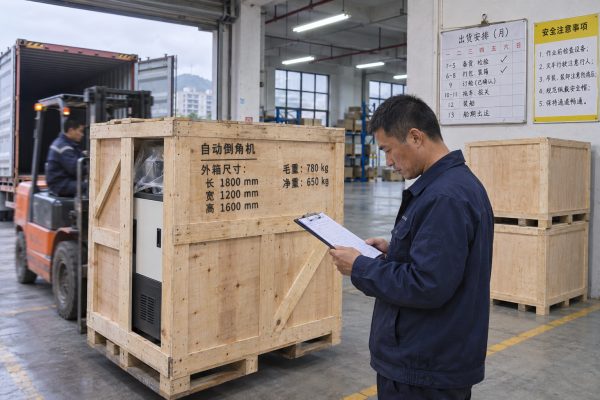
Our chamfering machines ship in wooden crates with the vibratory bowl feeder and stand packed as separate modules. Every piece of wood carries the ISPM 15 mark. A missing stamp can send a crate to fumigation or back to origin. Inside, we lock moving axes, protect the HMI touchscreen and electrical cabinet against condensation with desiccant and humidity indicators, apply corrosion inhibitors rated for marine transport, and mark the center of gravity and lifting points. We photograph everything before the lid goes on. Those photos become evidence if a claim arises later.
Every quote forces a choice between extra buffer stock and tied-up cash. Our engineers in Wenzhou prefer a smaller buffer backed by pre-identified spares and a signed contingency plan.
Protect your production schedule by fixing delay responsibility under Incoterms 2020 with a precise named place, setting ETA escalation triggers, holding critical spares such as controllers and cutting heads in Europe, pre-planning rail or alternative-port options, and keeping installation crews flexible instead of idle.

Delay disputes rarely start with the delay itself. They start because two parties agreed on a commercial term and nothing else. I have seen a DAP contract where nobody had decided who paid storage when a customs inspection ran long. So I split this stage into four parts: contract responsibility, visibility, contingency cargo, and insurance.
| Incoterms 2020 term | Seller does | Buyer does | Delay-cost gap to close in the contract |
|---|---|---|---|
| EXW | Makes machine available at our Wenzhou factory | Everything from export packing onward | Buyer owns origin delays; needs own China forwarder |
| FOB | Delivers on board at the named Chinese port | Main carriage, insurance, import, inland | Who pays if the vessel is rolled after gate-in |
| CIF | Arranges freight and insurance to the named European port | Import clearance, duties, inland delivery | Demurrage and storage after discharge |
| DAP | Delivers to the named place, unloading not included | Import clearance and import duties | Customs inspection time and who arranges unloading |
| DDP | Delivers cleared, duties paid, to the named place | Receives the machine | Tax registration and compliance complications for the seller |
"DAP Europe" is not a term. "DAP buyer's factory, Milan, Italy" is. The contract should also state who monitors the shipment, who handles customs inspections, who arranges the crane or forklift on site, who bears risk during inland delivery, and what happens if the machine misses an installation appointment.
We run one shared ETA and issue log with the buyer, forwarder, customs broker, and installer. The milestones are simple: machine ready, inspection done, export documents approved, truck collected, gate-in, booking confirmed, loaded, departed, transshipped, discharged, declaration accepted, released, collected inland, delivered, installed. Each milestone has an escalation trigger. If the booking is not confirmed within an agreed number of business days, if cargo misses cut-off, if the vessel is rolled, if the ETA moves by more than 48 to 72 hours, if the route changes from Suez to Cape, or if the machine sits past free time, someone picks up the phone the same day.
| Option | Best use | Limitation |
|---|---|---|
| Air freight for parts | Control boards, sensors, HMI units, tooling, documents | Usually unsuitable for the full cabinet due to size, weight, and cost |
| China–Europe rail | Urgent high-value cargo; reporting has described roughly two weeks by rail versus about a month by sea | Border, capacity, and geopolitical risk; handling limits for heavy cargo |
| Split shipment | Heavy base by sea, precision spindles and controllers by air | Requires modular design and reassembly skill on site |
| European spares stock | Replacement cutting head, motor, drive, or control board held near the buyer | Inventory cost; only works if identified before shipping |
| Alternative European gateway | Piraeus, Trieste, Gdańsk, or Mediterranean ports when northern hubs jam | Longer road leg; needs a pre-booked low-loader |
| Reschedule installation resources | Release crews and cranes instead of paying idle time | Needs early warning from the milestone log |
| Temporary production workaround | Outsource chamfering or run manual processing briefly | Quality and cost compromise |
Contingency cargo works only when it is identified before departure. We ask the buyer which single component would stop their line, and we plan that component separately.
Marine cargo insurance covers physical loss or damage, general average, water ingress, theft, and handling damage, subject to war and political-risk exclusions. Most policies exclude pure delay. They will not pay for lost production or a missed customer deadline. I say this plainly because buyers assume otherwise. For high-value equipment we add shock and tilt indicators to the crate and document condition at origin, transshipment, port arrival, and delivery. Good packaging also prevents a second kind of delay: a machine that arrives on time but needs replacement electrical parts or recalibration still misses the installation date.
A late chamfering machine idles your line and burns cash. Design the shipment before it reaches port, and delay becomes a managed variable, not a surprise.
1. International standard for phytosanitary measures regarding wood packaging material in trade. ↩︎
2. World Customs Organization’s official explanation of the Harmonized System for cargo classification. ↩︎
3. Official UNCTAD report analyzing the impact of Red Sea shipping disruptions and rerouting on global trade. ↩︎
4. The World Bank’s CPPI is the authoritative global benchmark for measuring port efficiency and congestion. ↩︎
5. Comprehensive overview of the legal functions and types of a Bill of Lading. ↩︎
6. Official source for international commercial terms defining buyer and seller responsibilities. ↩︎
7. Official EU legal text for the new Machinery Regulation replacing the old directive. ↩︎
