

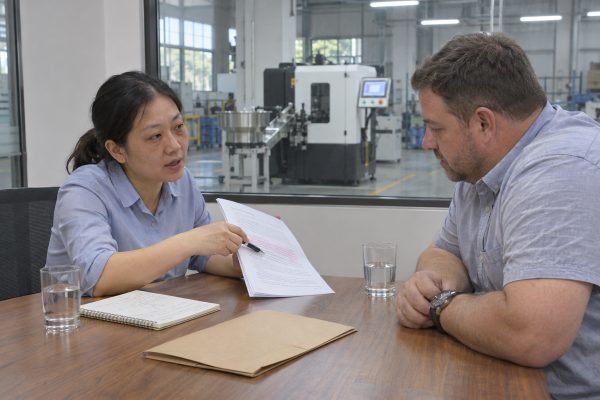
A force majeure clause can quietly wreck your chamfering machine delivery date. I have watched buyers sign supplier templates unread, then lose months. Our Wenzhou team drafts them differently.
Handle force majeure clauses when purchasing a chamfering machine by defining covered events narrowly, excluding ordinary delays and price increases, requiring prompt evidence-based notice, suspending payment for undelivered milestones, demanding mitigation, and setting a long-stop termination date with full deposit refund.
That is the short version. The rest of this article walks through what to write, how to react when a notice lands, which legal traps hide in cross-border deals, and how to tell a real claim from an excuse.
When we quote an automatic chamfering machine 1 to a US distributor, the contract draft usually arrives with a two-line force majeure paragraph. That brevity is the first warning sign.
A force majeure clause for a chamfering machine should include an enumerated event list, clear exclusions for ordinary delays and cost increases, causation and foreseeability tests, notice deadlines, mitigation duties, payment suspension rules, partial delivery terms, liquidated damages treatment, and termination rights.

The purpose of this clause is simple. It handles events that neither party could foresee, avoid, or overcome. It then says what happens to delivery, payment, transport, installation, and breach liability when such an event hits. In my experience, the clause fails when it stops at the first half and never answers the second.
One more point before the details. In common law jurisdictions, nobody implies this protection into an industrial equipment sale. If the equipment procurement agreement 2 does not say it, it does not exist. Courts also read vague catch-all phrases strictly against the party trying to delay delivery. So specificity helps both sides.
Our machines ship to the United States, Germany, Japan, Mexico, and India. Each route carries different exposures. The list below reflects what I think belongs on each side of the line.
| Qualifies if proven | Does not qualify |
|---|---|
| Fire, flood, earthquake, or typhoon at the supplier's plant | Ordinary lead time delays from a crowded production queue |
| War, terrorism, civil unrest, port closures, carrier cancellations | Steel, carbide, or electronics price increases |
| Sudden changes in export controls, sanctions, or dual-use technology regulations | Currency fluctuation or financing difficulty |
| Government-mandated shutdowns, quarantines, public-health restrictions | Failure to order long-lead components early |
| Total grid failure | Regional energy rationing the supplier could plan around with backup power |
| Ransomware where industry-standard cybersecurity was maintained | Cyber incidents caused by neglected security on CNC or order systems |
| Insolvency of a sole-source proprietary component vendor | Sub-supplier failure for standard motors or hydraulic pumps available on the open market |
The right-hand column matters more than the left. A supplier should never be able to relabel supply chain mismanagement, raw material cost increases, or a normal backlog as unforeseeable circumstances. I say this knowing our own team is the supplier in these deals. A clear exclusion list protects our reputation too, because it keeps honest delays separate from excuses.
Tie each event to specific contractual obligations. At minimum, address manufacturing completion, factory acceptance testing, shipment, export documentation, installation, commissioning, operator training, warranty response times, spare-parts supply, payment milestones, liquidated damages, and acceptance deadlines.
Payment deserves its own sentence. State that a milestone payment pauses when the corresponding delivery milestone is suspended. State that deposits are refundable if termination follows. Do not leave a buyer paying for a machine that is legally excused from arriving.
In our export work, a delay notice forces a trade-off between patience and protection. Waiting strands a production line. Terminating early can forfeit a nearly finished machine.
Protect your delivery timeline by requiring notice within a fixed window, demanding a revised schedule with evidence, enforcing mitigation such as alternate components or air freight, allowing partial shipment, limiting extensions to the proven impact period, and reserving substitute-sourcing rights.

A force majeure event does not cancel the contract. It pauses specific obligations for a specific period. Your job is to keep that pause short, documented, and narrow. Here is the sequence I recommend to buyers, and the sequence we follow ourselves when something goes wrong on our side.
Mitigation of loss is not a vague duty. For a chamfering machine, it translates into concrete actions. The table below shows what we can realistically do in our workshop and what a buyer is entitled to ask for.
| Disruption | Reasonable mitigation | Buyer safeguard |
|---|---|---|
| Standard motor or drive shortage | Source an equivalent from another approved brand | Buyer approves any substitution in writing |
| Port congestion or carrier cancellation | Reroute, rebook, or air-freight critical modules | Supplier bears or shares documented expedited freight |
| Installer cannot travel | Remote commissioning plus a qualified local integrator | No deemed acceptance until commissioning succeeds |
| Partial production stop | Ship finished modules separately | Separate milestone dates for shipment and installation |
| Prolonged plant closure | Offer a technically equivalent model or demonstrator unit | Original specifications on accuracy, chamfer range, and tooling remain binding |
Sellers want delay damages 3 waived for the entire excused period. Buyers should accept that only where notice was timely and mitigation was real. The waiver should cover the excused days and nothing more. If the supplier sat on the problem for two weeks before telling you, those two weeks are not excused.
Some sellers will push for open-ended time extensions and renegotiation instead of termination. I understand that instinct. A half-built machine represents real cost. But a buyer with a production schedule cannot absorb indefinite uncertainty. The fair middle ground is tiered: automatic extension for the proven impact, buyer-approved substitution next, then termination with deposit refund once the long-stop period passes. A standard machine with a six-week promise may justify 60 days. A customized line with a long manufacturing cycle may justify 90 or 120 days.
A German integrator once asked me which law governed our agreement. I had to check. That moment taught our team to settle governing law before touching the force majeure wording.
Key legal risks include unclear governing law, narrow or broad interpretation by courts, conflicts between your purchase order and supplier standard terms, Incoterms that leave gaps, export-control changes, payment obligations that survive suspension, hardship claims disguised as force majeure, and weak dispute forums.

A chamfering machine may be built in China, sold through a trading entity, shipped through a transit port 4, and installed in Texas. Each link adds a legal question. The force majeure clause cannot answer those questions on its own. It depends on everything around it.
Before negotiating events and remedies, confirm these items in writing:
Incoterms deserve a specific warning. They allocate transport costs 5 and transit risk. They say nothing about manufacturing delays, factory testing, installation, or termination. A buyer who assumes FOB or DAP terms cover force majeure has a gap in the contract.
This is the trap I see most often in the raw material cost debate. Steel, carbide, electronics, energy, and freight costs all move. A sharp rise makes performance less attractive. It does not make performance impossible. That is hardship, not force majeure.
| Feature | Force majeure | Hardship |
|---|---|---|
| Core question | Can the supplier perform at all? | Has performance become excessively burdensome? |
| Typical trigger | Export ban, plant destroyed, port closed | Material or energy price spike |
| Typical remedy | Suspension, extension, termination | Renegotiation or price adjustment, with limits |
| Buyer risk | Indefinite delay | Price creep after signing |
If you are willing to discuss price adjustment at all, put it in a separate hardship or change-in-law mechanism. Give it evidence requirements, caps, and its own termination rights. Never let it ride inside the force majeure clause.
"We cannot control ports, governments, or subcontractors, so we need broad protection." Partly fair. Governments and ports are genuinely outside anyone's control, and the clause should list them. Subcontractors are different. A professional manufacturer chooses and manages its vendors. A subcontractor delay should count only if the underlying cause independently qualifies and the supplier could not reasonably avoid the effect.
"Payment can always be transferred, so payment obligations should continue." Technically true, commercially unfair. Money for an undelivered milestone should pause with the milestone. The compromise we accept is simple: payments tied to completed and verified work continue; payments tied to suspended work pause; deposits are refundable on termination.
Finally, remember that interpretation varies by legal system. Some courts read these clauses narrowly. A sentence that says only "events beyond the seller's control" leaves causation, notice requirements, mitigation, and remedies to a judge or arbitrator you have never met. Write the answers yourself.
During a typhoon season in Wenzhou, our workshop lost power for two days. We photographed the outage, logged the hours, and sent customers the records unprompted. Real claims look like that.
Verify a force majeure claim by demanding third-party evidence such as government decrees or port notices, tracing causation to a specific component or shipment, checking whether the event was foreseeable at signing, reviewing mitigation attempts, and comparing the supplier's timeline against your own milestone records.

A conclusory letter saying "global logistics remain difficult" is not evidence. It is a request for free time. The burden sits on the supplier to show the event, the impact, and the link between them. Your side of the job is to keep your own records clean so the comparison is fair.
| Claimed event | Acceptable evidence |
|---|---|
| Export control or sanctions change | Published government decree, customs notice, or licensing refusal |
| Port closure or shipping disruption | Port authority report, carrier notice, booking cancellation |
| Plant shutdown or quarantine | Official closure order, local authority notice |
| Component shortage | Vendor correspondence, purchase order dates, alternative-sourcing checks |
| Cyberattack | Incident summary where legally permissible, plus proof of prior security practices |
| Energy outage | Utility notice distinguishing grid failure from scheduled rationing |
| Natural disaster | Weather service bulletin, insurance or incident report, dated photographs |
Keep the signed agreement, approved drawings, the promised delivery date, every milestone payment receipt, and all correspondence. Add quotes for replacement equipment if you start looking. A documented timeline is the single most useful tool when a supplier's story and your calendar disagree.
One objection comes up here. Suppliers sometimes resist disclosing sensitive vendor information. That concern is legitimate, and we feel it too. The answer is not to skip evidence. The answer is redaction or a confidentiality undertaking covering the disclosure. A supplier who refuses both is telling you something.
A vague force majeure clause turns every supply chain hiccup into your problem. Define events, demand evidence, suspend payment, and set a long-stop date. Then your machine arrives on your terms.
1. ISO standards ensure the quality and safety of industrial machinery like chamfering machines. ↩︎
2. The ICC provides standardized frameworks for international equipment procurement and commercial contracts. ↩︎
3. Explains the legal mechanism for pre-determined compensation in the event of contract delays. ↩︎
4. The WCO sets international standards for customs procedures and transit port operations. ↩︎
5. Incoterms rules by the ICC define the allocation of transport costs in international trade. ↩︎
6. Provides technical context for CNC systems used in modern automated manufacturing equipment. ↩︎
