

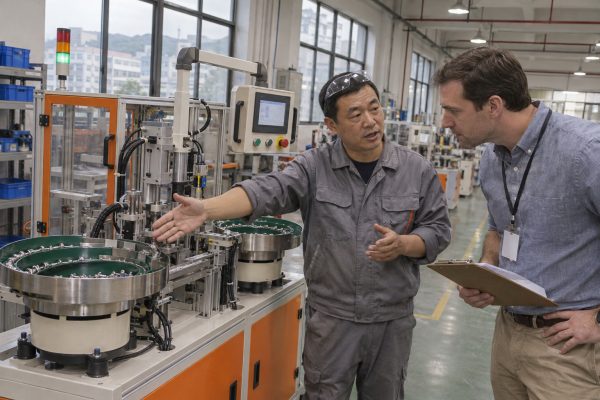
Choosing an automatic assembly machine supplier feels easy until the machine ships IATF 16949 1. On our Wenzhou production line, I have watched buyers regret cheap, on-time deliveries that nobody could support.
An automatic assembly machine supplier is worth a long-term partnership when it proves process capability on your actual parts, quantifies performance in a Factory Acceptance Test, delivers open documentation and source code, guarantees after-sales response times, manages spare-parts obsolescence, and shares risk after installation rather than disappearing after payment.
That answer is short. The proof behind it is not. An assembly system can stay in service for 10 to 20 years. Your products, volumes, software and regulations will change long before that. So the real question is not whether the supplier can build one machine. It is whether the supplier can stand behind that machine for its whole life. Below, I break the decision into four practical questions you can ask before you sign anything.
Last year a terminal crimping line left our shop only after a third run of inspection. The first two passed cycle time. They failed on jam frequency.
Expect a reliable supplier to operate a documented quality management system such as ISO 9001, run Factory Acceptance Testing with your production parts, measure OEE, first-pass yield, MTBF and changeover time, log every deviation, and keep traceable change-control records for mechanical, electrical and software revisions.

That story taught me something simple. A machine can hit its nominal speed and still be a bad investment. Quality control for automation equipment is not one inspection at the end. It is a chain of evidence that starts with requirements and ends with a signed acceptance report.
Buyers often ask about ISO 9001 2 and IATF 16949 first. These certifications matter. They show the supplier has standardized processes and a habit of continuous improvement. But a certificate on the wall does not tell you how the supplier behaves when a test fails. I treat certifications as a minimum filter. Then I look at the actual test records.
A proposal will usually show nominal cycle time. That number often excludes feeder jams, manual resets, rejected parts and material replenishment. The useful number is demonstrated output over an extended run with normal part variation. The table below lists what I ask a supplier to measure and how each metric can be gamed if it is not defined.
| Metric | What it tells you | How it gets hidden in a demo |
|---|---|---|
| Demonstrated cycle time | Real throughput, not catalog speed | Short runs with hand-picked parts |
| Overall equipment effectiveness | Availability × performance × quality | Planned stops excluded from the clock |
| First-pass yield | Parts correct without rework | Rejects quietly removed before counting |
| Mean time between failures | Reliability of feeding and tooling | Run stopped before the first jam |
| Mean time to repair | How fast an operator recovers | Supplier engineer fixes faults, not your operator |
| Changeover duration | Fitness for high-mix production | Only one variant ever tested |
| Vision detection accuracy | False accepts and false rejects | Lighting tuned for the demo room only |
I recommend asking for a redacted FAT package from a comparable past project. It should contain user requirements traced to design features and to test cases, a risk assessment 3 covering misfeeds, wrong orientation, sensor failure, tool wear and loss of air pressure, a deviation log, corrective actions, and a punch-list closure record. For medical, pharmaceutical, aerospace or automotive safety parts, the package may also include IQ, OQ and PQ qualification and process capability studies. A supplier who hands this over without hesitation is showing you how it handles bad news. That matters more than any sales presentation.
Every OEM request forces a trade-off I weigh carefully: how much of the design is proven, and how much is new development work with real schedule risk.
Verify OEM/ODM capability by sending real components for a feasibility study, requesting comparable project references with uptime data, reviewing in-house mechanical, PLC and vision engineering resources, asking the supplier to label each element as standard, customized or experimental, and pricing three future change scenarios before signing.

Custom machine builders love to say yes. The good ones also say "not yet proven." When a buyer sends us cable lugs or terminals with a new geometry, our first step is not a quotation. It is a set of questions about tolerances, material finish, assembly sequence, annual volume and the variants planned for the next three years. If a supplier presents a standard machine before asking those questions, that is a warning sign.
The fastest way to learn whether a system is designed for expansion or merely optimized for today is to ask the supplier to price and explain three futures.
| Scenario | What to ask | What the answer reveals |
|---|---|---|
| Modest product change | New terminal length, same family | Is tooling modular and quick to swap? |
| Substantial redesign | New material, new assembly step | Are feeders, stations and controls reconfigurable? |
| 25–50% capacity increase | Same product, higher volume | Can stations be duplicated or a second line be cloned? |
Some buyers push back here. They argue that a single-source proprietary system gives tighter integration and clearer accountability. That is partly true. One supplier for feeders, controls and inspection does reduce compatibility headaches. My answer is that the issue is not whether every component is open. It is whether you know exactly which parts create dependence and whether the contract protects you with source code, passwords, licenses and backups.
A second objection is that flexible, scalable manufacturing systems cost more and may run slower than a dedicated machine. Also fair. For a stable high-volume product with a long market life, a dedicated machine is often the right call. For an uncertain product mix, modular stations and flexible feeding earn their premium. A supplier who explains this trade-off honestly, rather than selling flexibility to everyone, is showing real OEM/ODM maturity. The same scrutiny applies to "AI-enabled" or digital-twin claims. Ask for the specific use case, baseline performance, false-positive rates and ongoing support. A buzzword is not a business case.
A procurement manager in the US once asked me on WhatsApp why a competitor's quote was so much lower. I asked him to request the exclusions list.
Red flags include guaranteed performance without test evidence, vague scope with heavy exclusions, unusually low pricing, black-box software, one salesperson answering every technical question, refusal of factory visits, shifting design assumptions, documentation promised for later, and no named contact for after-sales technical support.

His competitor's quote excluded feeders, vision, installation, training and the spare-parts kit. Once normalized, the gap nearly disappeared. The lesson generalizes. A low bid often converts into change orders, and change orders convert into longer equipment lead times. The way an automatic assembly machine supplier behaves before the order is the best predictor of how it behaves after.
| Warning sign | Likely consequence | What to do instead |
|---|---|---|
| Performance guaranteed with no test data | Failed site acceptance, disputes over who pays | Require FAT results on your parts in the contract |
| Vague scope, long exclusions list | Change orders, delivery slip | Compare quotes on a normalized scope sheet |
| Unusually low price | Corners cut on controls, safety or documentation | Ask how the supplier covers service and warranty |
| Black-box software, no source code | Dependence for every small edit | Write program ownership and backups into the contract |
| One salesperson answers everything | Thin engineering bench, slow problem solving | Insist on meeting controls and service engineers |
| Avoids factory visits or video audits | Subcontracted build, weak process control | Visit, or send a third-party inspector |
| Technical assumptions keep shifting | Design not frozen, rework during build | Require a decision log and change-control process |
| "Documentation will follow later" | Manuals, drawings and backups never arrive | Make documentation a payment milestone |
| Maintenance questions dismissed | Poor access, high downtime later | Ask for a preventive-maintenance schedule before signing |
I tell buyers to build one scope sheet and force every bidder onto it. Include tooling, fixtures, part feeders, vision systems, safety systems, controls hardware and software, factory system integration, installation and commissioning, training, documentation, spare-parts kits, travel, shipping, software licenses, warranty start date and performance guarantees. Only then does the price column mean anything.
Buyers sometimes ask whether a team of ten in Wenzhou is too small to be a long-term partner. It is a fair objection. Small specialists carry real risks if a founder retires or a key engineer leaves. Large suppliers carry different risks: slower response, more bureaucracy and less appetite for non-standard work. Neither size is automatically safer. What protects you is the same in both cases: complete documentation, delivered source code, a named support structure, and a contract that does not depend on one person's memory. Judge the controls and commitments, not the headcount.
The hardest lesson from eight export markets: installation day is when the relationship starts. Support quality, not delivery speed, decides if a line pays back.
Evaluate long-term service by checking guaranteed response times for critical failures, remote diagnostic access, a named support structure, spare-parts stocking and obsolescence monitoring, preventive maintenance programs, operator and technician training, full electrical and software documentation, and a lifecycle agreement that weights Total Cost of Ownership over purchase price.

When we ship a machine to Germany, Japan or Mexico, the customer is not buying a cabinet full of feeders and a PLC. They are buying our willingness to answer the phone in year six. That is why I judge a first cooperation on more than on-time delivery and price. I ask whether the supplier can keep supplying parts, technical support and after-sales service for the whole life of the system. This is the core of my view on supplier selection.
One question exposes more than any brochure: what happens when a critical drive, controller or sensor is discontinued? A strong automatic assembly machine supplier should explain how it monitors obsolescence, whether it proposes retrofit paths, and whether it keeps legacy expertise on staff. A low initial price becomes very expensive if the system depends on custom boards or proprietary controllers that nobody can replace in year eight.
Connected equipment can cut downtime through remote diagnostics and predictive maintenance 5. It also widens the attack surface. Ask how remote access is approved, authenticated, logged and disabled. Ask whether operational technology is separated from the enterprise network, who owns production data, what is sent to any cloud platform, and whether the machine keeps running if connectivity drops. Smaller suppliers may lack a formal cybersecurity program. Judge the actual controls and the contractual commitments, not the company size.
Purchase price is one line. The full picture includes engineering modifications, unplanned downtime, spare parts, software licenses, service contracts, training, energy, consumables and eventual modernization. Market research describes assembly automation 6 as a growing sector, with one forecast moving from about USD 38.01 billion in 2026 to USD 66.91 billion by 2034 at a 7.3% compound rate, and another estimating USD 31.62 billion in 2025 rising to USD 70.45 billion by 2034 at 9.31%. The spread between these numbers shows that definitions differ, so treat them as directional. The direction itself is clear: more connected, more modular machines, and therefore more long-term dependence on the supplier behind them. Vision and inspection is projected to grow faster than some other segments, around 8.1%, which supports asking whether the machine records process evidence, not only whether it assembles parts.
I encourage buyers to score suppliers before the final meeting, not after. Here is a starting weighting. Adjust it to your application: a regulated medical line should raise validation weight, a high-volume automotive line should raise uptime and spare-parts weight, and a startup with many variants should raise flexibility.
| Dimension | Suggested weight | Key evidence |
|---|---|---|
| Process expertise and demonstrated results | 20% | Tests on your parts, comparable references |
| Reliability and measurable performance | 20% | FAT data for OEE, FPY, MTBF, changeover |
| Service and lifecycle support | 15% | Response times, spare parts, training, obsolescence plan |
| Flexibility and scalability | 15% | Three-scenario pricing, modular stations |
| Safety, compliance and cybersecurity | 10% | Risk assessment, safety-rated controls, remote access policy |
| Openness and integration capability | 10% | Source code ownership, OPC UA, MES connectivity |
| Financial stability and organizational fit | 5% | Installed base, repeat customers, clear communication |
| Commercial transparency | 5% | Normalized scope, measurable acceptance criteria |
Turnkey automation projects succeed when the supplier treats this scorecard as the contract's backbone, not as a sales exercise. Industrial automation solutions that score well here tend to stay in service longer and cost less to own.
Cheap and on time is not enough. Demand proof on your parts, measurable acceptance, open documentation and a named lifecycle commitment. That is how a supplier earns twenty years of trust.
1. Global quality standard for the automotive industry, critical for evaluating assembly machine suppliers. ↩︎
2. Official international standard for quality management systems used to evaluate supplier process reliability. ↩︎
3. International standard providing guidelines on managing risks faced by organizations and industrial projects. ↩︎
4. The interoperability standard for secure and reliable data exchange in industrial automation. ↩︎
5. Techniques designed to help determine the condition of in-service equipment in order to estimate when maintenance should be performed. ↩︎
6. Market data and trends for the global industrial automation sector, including assembly systems. ↩︎
