

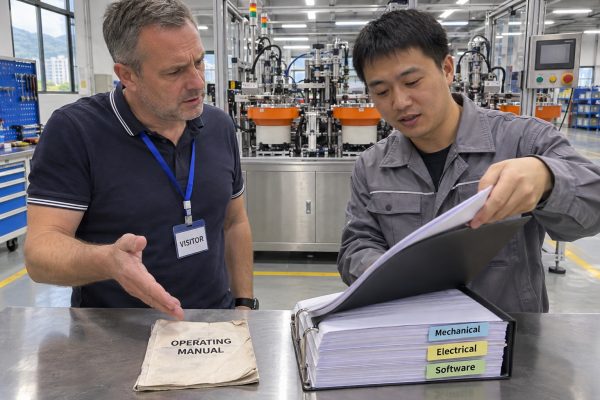
A German buyer visiting our Wenzhou workshop showed me the thin manual his previous automatic assembly machine supplier 1 called complete technical documentation. Nobody on his line could trace faults.
To require complete technical documentation from an automatic assembly machine supplier, write a Technical Documentation Package into the purchase contract before design starts. Define each document, format, deadline, and approval gate, verify files at Factory and Site Acceptance Tests, and withhold final payment until the as-built package is approved.
That is the short version. The rest of this article explains what belongs in the package, how to check it, what to do when a supplier pushes back, and how to turn the files into a daily working tool.
When we quote a custom terminal assembly line, I weigh one trade-off early: how much documentation to promise versus how much engineering time it costs. We now list it all.
Request a complete Technical Documentation Package, not just an operating manual. It should cover machine operation, electrical control, mechanical structure, pneumatic system, troubleshooting, maintenance, and spare parts replacement, plus Bill of Materials, PLC Programming Documentation, software backups, Risk Assessment Report, and acceptance test protocols, all with defined formats and deadlines.

The biggest mistake I see is a buyer who writes "supplier shall provide documentation" in the purchase order and nothing more. That sentence is not a requirement. It is an invitation for the supplier to send its standard booklet. Complete technical documentation from an automatic assembly machine supplier only arrives when the buyer defines it first.
Send a documentation matrix with your request for quotation. Each line should name the document, the owner, the required format, the submission deadline, and the acceptance criterion. It should also say which project gate the document belongs to. In our own projects, we split the matrix into five gates: design approval, Factory Acceptance Test, shipment, Site Acceptance Test, and final payment.
| Category | Typical documents | Required format | Gate |
|---|---|---|---|
| Mechanical | General arrangement, station assembly drawings, exploded views, tooling and fixture drawings, torque values, lifting points | Native CAD plus PDF | Design approval, as-built at SAT |
| Electrical and pneumatic | Electrical Schematics, panel layout, terminal schedules, I/O list, valve-manifold layout, pressure settings | Native CAD plus PDF | Pre-FAT, as-built at SAT |
| Controls and software | PLC Programming Documentation, HMI project, robot and vision programs, drive parameters, alarm list, version log, restore procedure | Native project files, backup media | FAT, re-verified at SAT |
| Safety | Risk Assessment Report, safety-function description, performance level calculations, validation records, Declaration of Conformity | PDF, signed | Design approval, final at FAT |
| Parts and service | Bill of Materials with manufacturer part numbers, Spare Parts List, Preventive Maintenance Schedule, Operation and Maintenance Manual | Spreadsheet plus PDF | Shipment, final at SAT |
| Records | FAT and SAT protocols, calibration certificates, test results, training records, master document index | PDF, signed | Final payment |
A Bill of Materials with only the supplier's internal codes 2 is almost useless to your maintenance team. Insist on original manufacturer part numbers for every commercial component. On our bowl-feeder assembly machines, that means the sensors, pneumatic valves, servo drives, and bearings all carry the maker's reference. Your purchasing team can then source standard parts directly and keep the supplier for custom tooling only.
The User Requirement Specification sets the baseline for everything else. If it is not signed by both sides, later disputes about cycle time, yield, or interface signals have no anchor. We ask every buyer to approve the URS before we release mechanical design. It slows the first two weeks and saves months later.
Two newer items are worth adding if your plant is moving toward Industry 4.0. A Software Bill of Materials tracks third-party libraries and firmware versions so you can manage cybersecurity vulnerabilities. A kinematic 3D model or basic digital twin lets your engineers test new product variants offline. Neither is standard yet, so price them separately in the quotation.
During a pre-shipment check on one of our bowl-feeder assembly machines, our electrician found a relay wired differently from the drawing. We fixed the drawing before the FAT.
Verify documentation by testing it against the physical machine at the Factory Acceptance Test and again at the Site Acceptance Test. Compare serial numbers, software versions, I/O lists, wire numbers, and Bill of Materials with the installed hardware, then restore PLC and HMI backups to prove the files actually work.

Documents are only accurate on the day they are printed. Every engineering change after that creates a gap between the file and the steel. The only cure is to treat verification as a test, with pass and fail criteria, not as a reading exercise.
| What to verify | How to verify it | Pass criterion |
|---|---|---|
| Machine configuration | Compare BOM, serial numbers, and nameplates with installed hardware | No undocumented component |
| Electrical Schematics | Trace sample wire numbers and terminals in the panel | Sample matches drawings fully |
| PLC and HMI software | Restore from delivered backup onto hardware | Machine runs in auto mode from backup |
| Safety functions | Trigger each emergency stop, interlock, and guard switch | Behavior matches Risk Assessment Report |
| Alarm and fault codes | Create faults deliberately; compare messages with alarm list | Every alarm appears in the documented list |
| Interfaces | Simulate upstream and downstream handshake signals | Signals match the interface specification |
Every file should carry a document number, revision, issue date, machine serial number, applicable software version, author, and approver. Without these fields, you cannot know whether the drawing on the floor is the latest one. We add a change description to each revision so the buyer's engineer can see exactly what moved between the FAT version and the as-built version.
Also ask for a master document index in a searchable electronic folder with consistent file names. Paper manuals are fine for operators, but the index is the controlled record.
A procurement manager from the US once asked me directly over WhatsApp why another vendor refused to hand over PLC source code. I gave him the honest answer.
If a supplier refuses complete technical files, first separate real intellectual-property concerns from simple convenience. Negotiate source-code escrow, buyer-use licenses, or release conditions, make documentation a priced contract deliverable with cure periods and payment retention, and walk away if the supplier will not support safe, independent maintenance.

Refusals usually come in four familiar forms. Each one has a piece of truth inside it, and each one has a workable answer. The table below is how I frame it when a buyer raises these objections against us, or against another vendor.
| Supplier objection | What is fair about it | How to resolve it |
|---|---|---|
| "Our standard manual is sufficient." | A standard manual does cover basic operation. | It does not cover machine-specific wiring, software versions, modifications, or interfaces. Require the matrix items as supplementary to the manual, never replaced by it. |
| "Source code is proprietary." | Custom function blocks may represent years of work. | Offer escrow, release on insolvency or failure to support, a buyer-use license without resale rights, or disclosure of interfaces and parameters 3 while libraries stay closed. Price full transfer separately if needed. |
| "Documentation will be finalized after commissioning." | Some as-built updates genuinely happen last. | Preliminary drawings, safety files, and software backups are needed for FAT and safe operation. Only the as-built revision may follow commissioning, with a fixed deadline. |
| "CE certification proves compliance." | The Declaration of Conformity is a real legal obligation. | Machinery Directive Compliance 4 addresses the manufacturer's conformity duty. It does not replace maintenance drawings, software recovery files 5, or production-validation records. Request the Technical File elements that support operation and audit. |
I will also push back on the opposite extreme. A buyer who insists on every native design file, including proprietary cam calculations and vision algorithms, raises the price and burdens the supplier for little gain. The better approach is risk-based. Require detailed, editable information for safety-critical, production-critical, and maintenance-critical systems. Accept controlled PDFs or interface specifications for less critical proprietary modules. For our terminal assembly machines, we release full PLC programs and schematics but keep certain feeder tooling geometry in PDF only, and we say so in the quotation.
Contract language resolves most refusals before they start. The clauses I recommend include:
Legal enforceability varies by country, so have the clauses reviewed locally. But if a supplier will not accept any version of these terms, that is a business-continuity signal. If they disappear, your line stops.
The lesson that changed our after-sales work: a technician in Mexico solved a feeder jam in minutes because our troubleshooting tree pointed straight to the sensor.
Use the documentation as a working tool. Installation drawings with foundation, utility, and interface details shorten commissioning; the Operation and Maintenance Manual, troubleshooting trees, and Preventive Maintenance Schedule become training material; and the Spare Parts List, software backups, and fault-code tables let technicians fix issues without waiting for the supplier.

A good package pays for itself three times: once at installation, once during training, and every week after that in after-sales support. Here is how each phase draws on specific files.
| Phase | Documents that do the work | What it saves |
|---|---|---|
| Installation | Machine layout with access clearances, foundation and anchoring drawings, utility connection points, lifting weights, interface dimensions, handshake signal list | Site preparation finished before the crate arrives; no surprises on air, power, or conveyor height |
| Training | Operation and Maintenance Manual, sequence descriptions, operating modes, recipe structure, user-access levels, alarm list, training records | Operators learn the real machine, not a generic one; training completion is documented for SAT |
| After-sales | Troubleshooting trees, fault-code table, Spare Parts List, Preventive Maintenance Schedule, backup and restore procedure, change log | Technicians diagnose most stops locally; spare orders are correct the first time; software recovery takes hours, not weeks |
Automatic assembly machines rarely stand alone. Ours connect to feeders, conveyors, presses, and test stations. The supplier cannot document equipment it does not own, but it must document every interface under its responsibility: mechanical transfer conditions, I/O ownership, safety-zone boundaries 6, emergency-stop relationships, and fault-recovery behavior. It must also state its assumptions and exclusions. A one-page interface summary avoids a week of finger-pointing between vendors.
The most useful training material is already in the package. Walk operators through the state transitions and the alarm list. Walk technicians through the I/O list with device locations. Have them perform a backup and restore under supervision. Then record who was trained and on which software version. We treat training completion as an SAT line item, so it cannot be skipped.
Calendar-based maintenance ignores how hard the machine actually runs. Ask for a Preventive Maintenance Schedule based on cycle counts, with wear-part identification, inspection intervals, lubrication points, and torque values. Pair it with a Spare Parts List that distinguishes consumables from long-lead custom tooling. If your plant tracks OEE, request a data map and API notes so the machine's cycle, downtime, and reject counters feed your system directly.
Remote diagnosis is genuinely useful, and we offer it. But access should be off by default and switched on by written authorization with logging and a time limit. Your cybersecurity team will thank you, and the change log will show exactly what the supplier touched.
Some buyers are now asking for AR-compatible maintenance guides or 3D exploded-view animations for complex stations. These are helpful for mechanisms with many small parts, such as pick-and-place heads above a bowl feeder. Treat them as an optional extra and price them clearly.
Thin manuals cause long stoppages and supplier dependence. Specify the full package before quotation, verify it at FAT and SAT, and withhold final acceptance until it matches the machine.
1. ISO provides the international standards for technical documentation and quality management in manufacturing. ↩︎
2. Wikipedia provides a comprehensive overview of Bill of Materials structures and component identification in industry. ↩︎
3. Wikipedia explains the role of interfaces and programming parameters in programmable logic controllers. ↩︎
4. Clarifies the EU legal basis for Declaration of Conformity obligations referenced in supplier compliance discussion. ↩︎
5. Official EU portal for the Machinery Directive, which governs technical file requirements for industrial equipment. ↩︎
6. IEEE is a leading authority for engineering standards, including safety and interface documentation for automated systems. ↩︎
